Thursday, 26 May 2022

My apiary

Hello and welcome to my page about my apiary. This page is mostly here so I can point people at it. The sort of people who might be interested are those who buy my honey. Although you might wish to take "Bismark's" advice. This page is pointed at by tinyurl.com/wmc-bees.

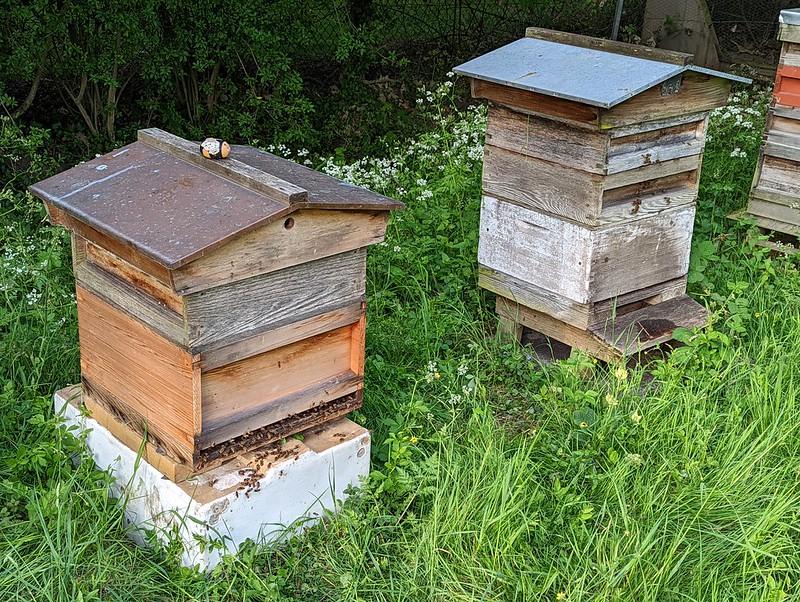
Let's start with a link to my most recent honey-extraction: Bad beekeeping: spring recolte 2022 (2023). And now, a picture of my two (2023: one) hives.

PXL_20220521_180736870

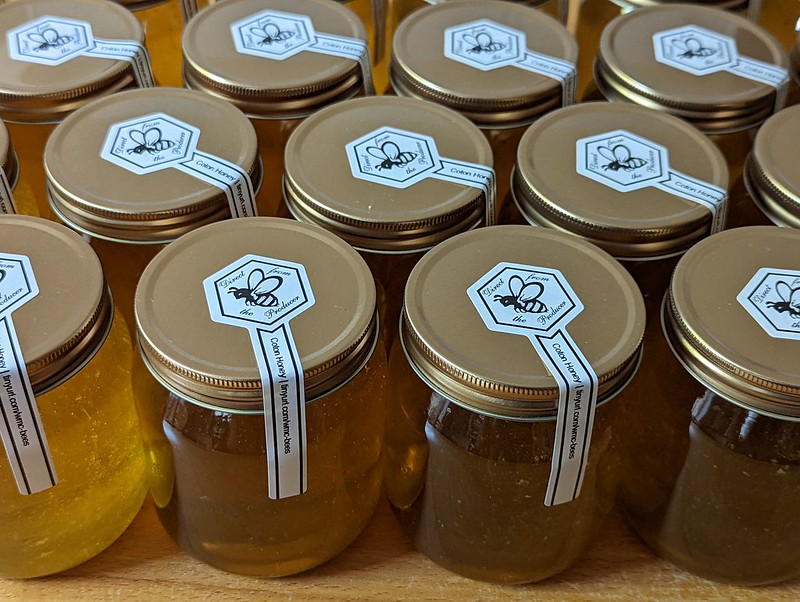
Yes, only two: I am an artisanal beekeeper. Over the years, the number of hives I've had has varied from zero (sadly) to four. Four was a lot to keep going. Two is a good number, I've been on that for a while. Here's some honey:

PXL_20220603_153240528

Recently - spring 2022 - I moved house from leafy Coton into Cambridge where I felt my bees might be less welcome, and so have moved them into the long garden of a friend who also keeps bees. This picture shows the fuller setup: mine are the two central; the far right is theirs; the far left is a spare, currently empty.

Extracting honey

After the frames are removed from the hive and de-capped (the bees will seal the cells with a little wax cap when they think they're ready; to spin out the honey this cap needs removing; I do this with a kitchen bread knife; see this picture) they are then put in the extractor and spun. I have a 1/3 share in a stainless steel "tangential" extractor (which means the frames are placed tangential to the circumference, which means they need to be spun gently, rotated, spun again, rotated, and spun again; which is why the pros prefer radial extractors. Pic showing the inside). Spun off honey then collects in the base of the extractor and can then be tapped off, filtered (in this case via the conical stainless steel filter shown here) to remove bits of wax and undesireable bits of bees, and collected. It is then fit to be bottled.

PXL_20210609_145338900

The archives

There are lots of old blog posts over the years; let's list some:

* Beekeeping, 2021 (an index page which I failed to find, hence created this one)
Bad beekeeping chez M+S (swarm collection)

Tuesday, 24 May 2022

Scifi and Fantasy reviews

281839557_568185454666409_5760724985706195430_n Inspired by John Aspden and now by RP (too), here are my sci-fi and fantasy reviews, arranged in order of favouritism (for other reviews, see here). I achieved this order by starting at the most recent and going backwards, inserting into wherever they fit. Books of course cannot be linearly ranked in this fashion; in particular literary quality and fun ideas are hard to inter-rank. As I add more you should take the ordering ever less seriously, the discrepancies grow larger. Books get points for: quality and fun of reading; novelty; interest of the ideas; worldbuilding; being a classic; "must include something by this author"; and more. Note that points-for-ideas does not imply that I agree with them, merely that there are some; you get more points if I agree, of course. But sadly most SciFi authors tend to pick up crap philosophy (hello Plato, I'm looking at you).

This list only includes stuff I've actually written reviews for, which is most of the recent stuff but very sporadic earlier. Stuff I would add: The Deep; more Banks; Blish; more LeGuin; Wolfe; Benford; The Forever War;  etc.

Sometimes I read and review Other Stuff.

I find that I'm quite reluctant to award high marks to anything recent. Either writing is getting worse, or I'm getting stricter in my old age. Nothing in my "top" list is from my past 10 years; my highest-recent is Ann Leckie's the Raven Tower from 2019... oh but there's Ancillary Justice.

The top, but unrankable: The HobbitLord of the Rings, The Deep.

Beasts and Engine Summer, John Crowley
* Foundation, Isaac Asimov
* Icehenge, Kim Stanley Robinson
* The Anome / The Brave Free Men / The Asutra, Jack Vance
* White Queen, Gwyneth Jones
Neuromancer, William Gibson
Anathem, Neal Stephenson
The Iron Dream, Norman Spinrad
Across Realtime, Vernor Vinge
Starship Troopers, Robert Heinlein
* Divine Endurance, Gwyneth Jones
* Dune and Children of Dune, Frank Herbert
* City of the Chasch / Servants of the Wankh / Dirdir / Pnume, Jack Vance
* Ancillary Justice, Ann Leckie
* Stations of the Tide / Vacuum Flowers, Michael Swanwick
* Consider Phlebas, Iain M Banks
* The Left Hand of Darkness, Ursula LeGuin
* Rendezvous with Rama, Arthur C Clarke
* Northern Lights, Philip Pullman
* The Mote in God's Eye, Larry Niven and Jerry Pournelle
* Helliconia Winter, Brian Aldiss

(those above this marker are "you should read")

* Emphyrio, Jack Vance
* The Raven Tower, Ann Leckie
* The Dragon Masters, Jack Vance
* Ancillary Sword, Ann Leckie
* Grass, Sherri S Tepper
* Uprooted, Naomi Novik
* City of Illusions, Ursula LeGuin
* The Forever War, Joe Haldeman
* The Moon is a Harsh Mistress, Robert Heinlein
* Look to Windward, Iain M Banks

* Matter, Iain M Banks

Pavane, Keith Roberts

* Inversions, Iain M. Banks

The Grain Kings, Keith Roberts 

* The Twilight of Briareus, Richard Cowper

* The Enemy Stars, Poul Anderson
* The Caves of Steel and The Naked Sun and The Robots of Dawn, Isaac Asimov
* Out of the Silent Planet / Perelandra / That Hideous Strength, C S Lewis (note Till We Have Faces is "other")
* Heroes and Best Served Cold, Joe Abercrombie

* Alchemised by SenLinYu
* Big Planet, Jack Vance
* Atlas Shrugged, Ayn Rand
* The Diamond Age, Neal Stephenson
* The Martian, Andy Weir
* The White Mountains, John Christopher
* The Cadwal Trilogy: Araminta station; Ecce and Old Earth; Throy, Jack Vance
* The Languages of Pao, Jack Vance
* Narnia: the Lion, the Witch, and the WardrobeThe Silver ChairThe Voyage of the Dawn Treader, and The Magician's Nephew, C S Lewis
* Spinning Silver, Naomi Novik

* The Witch Roads, Kate Elliot

Nettle and Bone, T. Kingfisher

* Travel Light, Naomi Mitchison

Around the World in Eighty Days, Jules Verne
* The Crucible of Time, John Brunner
* The War against the Rull, A E van Vogt

* Broken Angels, Richard Morgan

* Maker of Universes, Philip Jose Farmer

The Secret Commonwealth, Philip Pullman

(those above this marker are "worth reading")

* Mickey 7, Edward Ashton
* The Long Tomorrow, Leigh Brackett
* Red Sister, Mark Lawrence          
* Blindsight, Peter Watts
* Wyrms, Orson Scott Card
* Ender's game, Orson Scott Card
* Confluence: Child of the River / Ancients of Days / Shrine of Stars, Paul McAuley

* Eon, Greg Bear          
* Blood Music, Greg Bear
* Space, Time and Nathaniel and The Canopy of Time, Brian Aldiss
* The Undercover Aliens, A E Van Vogt
* A World Out Of Time, Larry Niven
* Eversion, Alistair Reynolds
* The Memory of Earth, Orson Scott Card
* Neptune's Brood, Charles Stross

Children of Earth and Sky, Guy Gavriel Kay
* The Lions of Al-Rassan, Guy Gavriel Kay
* Rosewater, Tade Thompson
* Star King, Jack Vance

* Marune: Alastor 993, Jack Vance          
* Involution Ocean, Bruce Sterling
* Project Hail Mary, Andy Weir
* Fifth Planet, Fred and Geoffrey Hoyle

* The Inferno, Fred and Geoffrey Hoyle

* October the First Is Too Late, Fred Hoyle          

* Dark Light, Ken McLeod
* Tenth Planet, Edmund Cooper
* Sabriel / Lirael / Abhorsen, Garth Nix
* Shikasta, Doris Lessing
* H G Wells anthologyThe War of the Worlds
* The Book That Wouldn’t Burn, Mark Lawrence

* The Storm Lord, Tanith Lee  

* Redshirts, John Scalzi
* Sundiver, David Brin
* Blue Remembered Earth, Alastair Reynolds
* Rotherweird and Wyntertide Andrew Caldecott
* The Ten Thousand Doors of January Alix E. Harrow
* The Owl Service, Alan Garner
* Utopia, Thomas More
* Glory Road, Robert Heinlein
* Revolt in 2100, Robert Heinlein
* The Witches of Karres, James Schmitz

* The World in Winter, John Christopher
* The Bloody Sun, Marion Zimmer Bradley          
* All the Colors of Darkness, Lloyd Biggle
* Empire of the Atom, A E van Vogt

* Navola, Paolo Bacigalupi

* Final Days, Gary Gibson

(those below this marker are "meh")

* Anthem, Ayn Rand
* The Lion of Comarre and Against the Fall of Night, and Earthlight, Arthur C. Clarke
* Feersum Endjinn, Iain M Banks
* The Gift / The Riddle, Alison Croggon
* Daughter of smoke and bone, Laini Taylor
* Toyman, E C Tubb

Derai, by E.C. Tubb   

Tales of Pirx the Pilot, StanisÅ‚aw Lem       
* The Green Odyssey, P J Farmer
* The Alchemaster's Apprentice, Walter "Captain Bluebear" Moers
* The Left Hand of God Paul Hoffman

* The Devils, Joe Abercrombie
* Fourth Consort, Edward Ashton

* A Trace of Memory, Keith Laumer

Seed of Stars, Morgan and Kippax

* Ice and Iron, Wilson Tucker

* Time and Stars, Poul Anderson

Macroscope, Piers Anthony

* The Unforsaken Hiero, Sterling E. Lanier

* Transition, Iain Banks
* The Brightness Reef trilogy, David Brin
* Artemis, Andy Weir
* Nemesis, Isaac Asimov
* The Narrow Land, Jack Vance
* The Forge of God, Greg Bear

* The Thousand Emperors, Gary Gibson
* Something Coming Through, Paul McAuley
* The Moat Around Murcheson's Eye, Larry Niven and Jerry Pournelle

* The Gardens of Delight, Ian Watson

* A Wrinkle in Time, Madeleine L'Engle

* Ringworld, Larry Niven
* The Eye of the World, Robert Jordan
* I, Robot
* With a Strange Device, Eric Frank Russell

The Neutral Stars, Morgan and Kippax
* The Centauri Device M. John Harrison
Quest for the Future, A E van Vogt

As On a Darkling Plain, Ben Bova

* Journey to the Center, Brian Stableford

* Against Gravity, Gary Gibson

* Gridlinked, Neal Asher

Hull Zero Three, Greg Bear

(those below this marker are "you should not read")

* The Grace of Kings, Ken Liu

* The Dosadi Experiment, Frank Herbert

In Ascension, Martin MacInnes
* The Atlantic Abomination, John Brunner
The Million Year Hunt, Kenneth Bulmer
* The Martian Missile, David Grinnell

* Operation Chaos, Poul Anderson

Raising the Stones, Sherri S Tepper

* The Fresco, Sherri S. Tepper    
* Wherever Seeds May Fall, by Peter Cawdron
* Three Body Problem Cixin Liu
* Light, John Harrison
* Ancient Light, Mary Gentle

Cold Steel, Kate Eliott

* Hammerfall, C J Cherryh    
* Proxima, Stephen Baxter
* Bones of the Earth, Michael Swannick
* The Exiles Trilogy, Ben Bova
* Heart of the Comet, David Brin and Gregory Benford
* On the steel breeze, Poseidon's Wake, Alastair Reynolds
* Seveneves, Neal Stephenson
* Fractal Noise, Christopher Paolini

See also

Science Fiction: The 101 Best Novels 1985-2010

100 Must-Read Science Fiction Novels

Diary of an injury: my back #4

A post from 2016 refers. I don't think I did a post for #2 or #3, which were both on the erg. #2 about 6 months back, #3 about 2 months ago. #2 was me doing a 10k, and at the first stroke something felt wrong, or odd; but it is very hard to describe what. I stopped at... I forget. Perhaps after 7k. Having vainly dropped the split in order to complete. I should have stopped earlier. For #3, I did stop earlier, but not early enough; after 2k. #4 was just lifting that stupid heavy bulky black ceramic junk round the side into the bin.

Motto: be more careful.

On HeiaHeia: #4; #3; #2 (probably).


Saturday, 16 April 2022

Book review: Einstein

1650053946729-c3c0a19b-a10f-4c2c-9990-73444221f6b4 A book I've had around for ages, and may even have read before. It is quite decent. A reasonable intro to the life and work. Goodreads likes it. JB turns out to be a real physicist, which is always helpful when dealing with this kind of stuff. To quibble, some of his pre-modern-physics is wrong in minor ways (Copernicus's model was not "simpler" than the prior work, at least in terms of number of epicycles used) but if there are errors elsewhere, strangely enough I didn't spot them.

There are almost no equations in the book, so this is no place to learn the maths of relativity, and indeed it isn't a good place to learn the theory either, because that isn't the point. But it's good on Einstein's childhood and early intellectual development, which in some ways could be considered the most interesting bit, from the point of view perhaps of an aspiring physicist. Even in an earlier world where being stateless at age 16 wasn't too much of a problem, the casualness with which AE floated around surprises.

I think it is somewhat on the uncritical side. The refusal to accept QM is said, but not strongly explored. The end-of-life at Princeton is said, but the amount of space given to all those years is slight. Women are elided.

I preferred Subtile is the Laird, but that's harder work, if I recall correctly.


Friday, 15 April 2022

Book review: the Enemy Stars

1650053994179-1683b6eb-5cb9-4de0-bf5d-6d9df832c7f9 Poul Anderson. Not Tau Zero (which you should read, if you haven't yet), but perhaps somewhat similar. Except, darker. Perhaps too dark: it gets rather knotted up in people striving for exploration - the stars - even in the face of tragedy and death, as though that was controversial. People die on mountains all the time and people don't get so tied up about it.

The beginning is kinda nice, reminiscent of "the planters" of Engine Summer; but he fumbles it; instead of a vista of time, we're just swept forwards a bit to another sort of society with no particularly interesting properties. So his spaceships have (somehow) been accelerated to half light speed - this is neither plausible nor necessary - and are not permanently crewed, but instead there's a "mattercaster" which allows people to show up for one-month-long tours of duty. This is convenient for the story but doesn't make much sense; you'd leave them uncrewed for most of their time, no? And if you have a "mattercaster" why have fuel tanks? Why not cast the fuel? Nevermind; this is only pretending to be hard sci-fi.

Also somewhat implausible is the idea that this ship's voyage is so long; there are plenty of much closer stars. Or that they would even see the "dead star" much less want to or be able to divert to it. Again, never mind.

After that we're in "human" terrain which - to be 'onest wiv yer guv - isn't the strong point of sci-fi and not what I want to read it for, either. But the connection to Kipling is well done, and mostly rescues that bit.


Thursday, 14 April 2022

Back to the Old Place

Yesterday I took Miranda back to Magdalen, via Mother, slightly complicated by me testing positive for Covid. But we sat at the far end of her dining table and left the garden door open.

Magdalen featured a water meadow - the one by Addison's Walk - full of fritillaries, which must have been there in my time, but I never looked. The virtues of Instagram, which is where I found out about it.

PXL_20220413_144241627

After that, I decided to tootle back via Berkhamstead. And to get to Berkhamstead I went the cycle route I used to use, via Headington, the A-road, Tetsworth to the W edge of the Chilterns, up via Chinnor... I now see this is the Lower Icknield Way. Then through Wendover, with a little trouble finding the right way, and down Stablebridge Road to the hump-backed bridge I've driven over so often but never stopped to see before. But there's a little parking area, and path down, and it turns out to be the Wendover Arm of teh Grand Union Canal - and, should I ever go that was again by bike, it looks to be much better to cycle along the canal than heave up over the hill. See GPS trace, with pix.

Thence to Berkhamstead, which remains much as on my last visit; I parked past Dean Incent's and had a coffee - Nero, but it was 6 and the locals had shut - on the far side of the cross roads, watching life go by. Berko isn't prepossessing from that viewpoint; but it remains a nice place.

After, up onto the common, before going down to Great Gaddesden for the graves. And remarking, again, how lovely the countryside is. I shall record some names, so they may be found: Diana Vignoles Nash nee Proctor; Wilfred Henry Nash. And so, home.

See also

A piece of Olde Englande

Tuesday, 12 April 2022

Book review: Around the World in Eighty Days

1649796254165-b8a198f1-755c-42c4-9633-4cb01c782ab5_ Wiki has an appropriate article; or you can try Goodreads. I dug this out because of our housemove, and partly motivated by having watched the BBC's eight-part adaption with M, which takes great liberties with the story (though it does copy some bits: the train-and-rickety bridge is in, though it is in the States, not Italy, for example; the burning-the-wood-bits-when-the-coal-runs-out, too). Unlike the Beeb's highly sexed-up storyline, in Verne very little happens for most of the book: Our Hero Really does just make most of his train and boat connections, with the excitement being supplied by Fogg remaining calm and unmoved by the tension. At some point this becomes too much even for Verne so he throws in Fix-the-detective to act as an "enemy".

However, the book is problematic, largely because it is flat; dull. And this is largely due to the central character of Fogg being dull. He begins as a totally opaque "high quality" "typical" Englishman and doesn't change much during the book. But Verne's prose is to blame too.

I presume part of the charm of the book of the time was as a travel book; nowadays, of course, all this is known. But the "travel guide" aspect is quite thin too, in part because Fogg himself is so uninterested in everywhere he goes. In other places the flatness of Verne shows through: for example, of a piece of railway line in the States we are told "There were few or no bridges or tunnels on the route". That's the sort of thing you might write of a typical piece of railway, but in this case, we're talking about a specific not a generic piece of railway, and it either has bridges or tunnels, or it hasn't. So Verne is being slack.

Since I'm here, I could make some brief notes about the Beeb version, starring Dr Who. This injects some pizazz into Verne, some of which is welcome: Fogg himself is no longer a blank slate. Some is too anachronistic and woke for my tastes: Passpartout becomes black, and there is a woman along. But worse (a-la Dr Who) is the tedious amounts of emotionalising, and the long-drawn out shots of Our Here's face as some new-but-dull emotion strikes home.