Sunday, 3 August 2014

The Peloponnese: Wednesday

Don't get up for a run: my excuse is my ankle, which felt a bit iffy, and also I was clearly tired yesterday afternoon; perhaps I'd have had the will to visit the Acrocorinth but for that. M does get up early - around six, because she isn't feeling sleepy, and goes out for a walk on the front. I get up at 7:30 and do the other thing I've wanted to, which is to go for a swim in the Gulf of Patras. Not that I get very far from shore. It shelves quickly; dive down to the bottom and retrieve two pebbles to take home. The wind has moderated somewhat, but the waves get bigger than my head not very far out. B'fast at 8, about as yesterday and good. Miranda goes for one last swim, and then its pack-n-off. First stop is the Corinth canal - the deep cut bridge - to show the children who are I think moderately impressed even if they don't say so. Then, slightly on a whim and because we pass by it, stop at Ancient Corinth. Ever so slightly embarrassingly I'm now struggling to remember anything about it. Not a number one site, indeed. The temple of Apollo is the most obvious, and quite impressive. The Roman fountain / bath, which I think they should have filled with water. Perhaps my pix will jog my memory when I come to fill this out.

And then onto the road, via a confusion of directions, towards Patras. Not quite the motorway we'd hoped, because its constantly interrupted by roadworks as they expand the width. Also the Greek way of using the road is entertaining: you're expected to drive in, or move over onto, the thing that in England would be the hard shoulder, if its necessary for people to overtake you, or people on the other side. So all in all it takes about 1.5 hours to get to Rio, just before Patras, where we stop for a cafe and gaze at the bridge across the gulf, which is really very big but somehow not terribly impressive from where we are. And anyway, we're busy playing cards.

After more exciting adventures in which-way-to-join-the-motorway, caused in part by the remodelling, we zoom along towards Pyrgos and then to Olympia our destination. The countryside around that stretch of road is, I would say, flatter and less interesting. As we come towards Olympia the hills begin again; ours is the Europa hotel, picked by M as a Best Western. Its above the modern town, and all very nice in a suitable-for-American-tourists kind of way, ie characterless. But we're only here for one night and it has a decent pool.

...whatever...

M and I visit Ancient Olympia from 6 to nearly-8. There's not all that much there of the gasp-in-awe variety; a temple of Apollo (another one!) and some mighty columns from the temple of Zeus; and the running track for the history of it.

...stuff...

Meal in the evening in the "garden" (as the rooftop resto turns out to be closed): salmon au limon for D, which he pronounces excellent; Greek salad for me (I haven't had one this holiday, only bits of other peoples); Mozzie salad for E; and risotto for M. And more cards of course: what I have come to call the Peloponnesian war.

The Peloponnese: Tuesday

Alarm 6:30 an run another 10 k: along the front, to the tiny "port" (1 k) then up the long slope at the end, past the old gents on the exercise machines, and out of town. The wind is against me (row brothers row) and so is the hill (but god is for us, oh yeah) but the views are good and for the moment I don't care about being fast, I care about nursing my left ankle and doing some distance. At 3 k I pass the sign to Poseidion resort 1 k, and it is, and 1 k further I turn. I start to get sun as I come back into town, and so back.

B'fast at 8 in the room over the front of the hotel: fresh orange juice, coffee, range of bread and pastries, honey, very Greek olives that E won't eat (*not* like olives du marche; and I'm not sure if that's a brand or a type).

Head out just past 9 for the north side of the bay to Perachora, a site M has found for us. Its a small but idyllic site, with the remains of a temple and cisterns and stuff; there's not a lot to see, no standing columns just bases; but you can see the outlines of foundations and the situation is charming (LINK WIKI). Unfortunately the children don't take to it at all; although the cove is small, sheltered and lovely neither of them will swim, but I do, and its delightful. Sit with wet trunks on the old stone seating of the old temple, guest house, or whatever, and realise for perhaps the first time that the people who made this were building forever. That is, I think, they had a different concept of time and no concept of progress. They didn't expect their stuff to be superseded and ripped down in 50 or 100 years; they expected that if they built well, it would be there forever. And, perhaps, they were right. There's a tiny little chapel I visist on the way out; a painting of Christ (I thin) seated on a lion holding a lamb. And a collect-'em-all row of icons at the back.

Then back a few km to a lake (now connected to the sea by a small channel) called Vouliagmenis about 2 k long; we're not sure where is the "correct" place to stop, but pick by chance a good place called, according to google maps, Ypanema. And there is a cafe or two, and a little jetty where you can queue up to take the sausage boat. So we sit in the shade and have our rounds of whist and - innovation - cucumber. One time I'm out I swim - again, no-one else does - and another I go round counter-clockwise to the tiny sweet church - not open, nice simple glass - and then to the channel to the sea, guarded by Greek flags.

On the way back to Loutrakis I collect roadside shrines; though the best examples I've seen are some I didn't bother with, because I assumed they were common, near Dimitsana. Oddity: behind one, which had inside it a bottle of lamp oil for the faithful, was a little careful rubbish heap of old bottles. Its as though the faith is still there, but its a faith that doesn't care for the earth at all (Later - on the coast road to Pyrgos - I realise that many of them - perhaps this is an innovation - are in commemoration of a specific death; which makes collecting them seem a little ghoulish).

Lunch in the hotel - pizza, other unexciting stuff, but M had digestive troubles overnight shall we say and wanted something safe and simple. Then an hour's siesta, followed by the Game of Risk. Which we played on the "red and black sofas", as Mission, and used the cards to determine the starting positions. I was a bit sleepy and not really thinking, and got eliminated early on, so slept feeling too hot. After that really sleep in the room, till past 7.

Decide a swim would wake me up, so invite E in, and we have a lovely talk together as we swim. she declares this her favourite (small) pool ever, mostly because its 3 m deep. By this time - about 8 - the pool is in shadow but the water still warm, and its very pleasant. To my surprise she is about as fast as me at front crawl. But I'm still better under water. And we talk about holidays, and the problems of finding something we all want to do. Game: throwing stones (though I'm slightly eliding two pool sessions together here, never mind, no-one cares about the precise details) and trying to find them underwater. I have an advantage that I can see, with my glasses on, whereas she swims without and can't.

Meal: walk along the front, the sun has set but there is a lovely orange glow and a fingernail moon, about 10 mins along to "Nikos": aubergine for me, Greek salad for M, spaghetti for E and fried shrimps for D. And a slightly rough half bottle of Macedonian rose.

The Peloponnese: Monday

My alarm goes at 6, but a quick squint indicates the sky is still dark, or at least I believe that, so I reset the alarm for 7 and fall asleep. At 7 I do get up, put on the running kit I left out last night, and head out: about time to do 10 k. I run back through the village and along the road south; its level enough, though noticably not level, and after a while I get into it, though I'm slow. Its cool at this time, and quiet: only 10 cars pass me the whole way out and back. Views over the peaceful hills, and a cloudsea in a distant valley, and the plumes from the two power stations climbing up into the blue sky.

Back, shower, in time to join the others who were at breakfast a few minutes earlier. The same as yesterday, except that D and E finish all the cheese and ham toasties, and I have one too.

I do a final wander through the village and photograph: its picturesque, and the back alleys are convoluted: the new road is now the main artery, but in there are lots of hard-to-piece-together lanes that were presumably once important. Finding the church(es) is quite hard; and I do what M and I managed yesterday, which is to spend 10 mins getting to the church, only to disover a back stair leading down directly to the hotel. I'm still not sure how that works.

We manage to leave by just-past-nine which is quite good going for us, and head North. More mountain roads which I enjoy driving on at ~40 km/h, for perhaps half an hour before we come over the far side onto bigger roads. Some gorgeous stretches of roadside flowers: hollyhocks, those curious yellow spiky things; blues. Then onto the motorway: brutal but efficient; small tolls. After a while it seems to me that we really ought to rearrange our plans: we're going to get to Mycenae at about 11, and climbing up to the citadel in the heat of the middle of the day just doesn't make sense (since we're on schedule I really should have thought of this yesterday: had I done so, we could have stopped for coffee and cards in Dimitsana or one the way in the interior). So, change plans, and decide to drive straight to our new hotel in Loutrakis, which we've almost booked, just a few k north of Corinth.

We go through the outskirts of Corinth, which is something of a dump, then see the Sea! Stop at the mouth of the Corinth canal, to look at the traces of the tow-road which existed since antiquity. There's not much left - maybe 20 m of old stone with grooves scored into it - and looking now its hard to imagine the effort of dragging a ship over, on rollers or trolleys or whatever. D and E not much interested. There's a new bridge - probably a swing-bridge - over the canal, and up in the distance, where the banks grow much higher, an arced bridge. I want to go and gaze at the deep cut at some point.
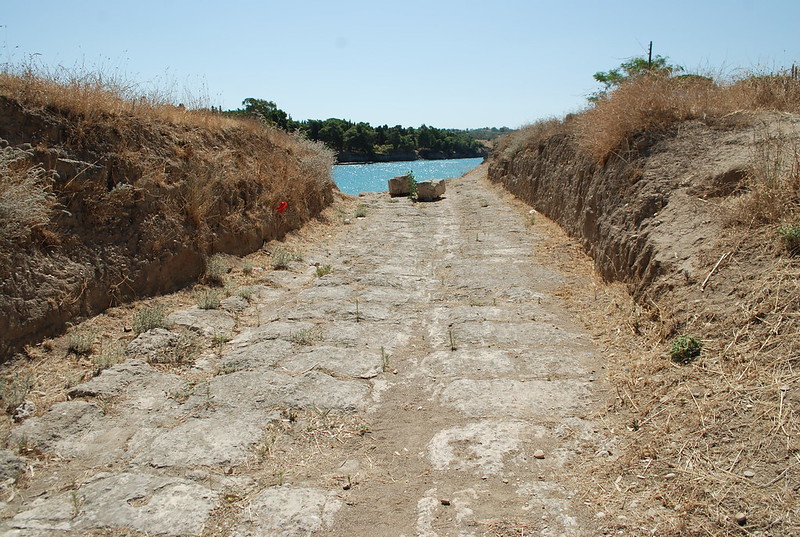
DSC_3734

And so, up the strip, to our hotel. Its a bit mixed, but our hotel looks nice - quite narrow, but goes back a long way in a sequence of courtyards with a pool at the back. Its windy by the sea - I keep forgetting that - blowing onto the shore. The children collapse in their room, and M and I come out to the first courtyard where we can see the sea and its whitecaps, and I write this, after first getting through the overthrow of the four hundreed and the Athenian loss of Euboea and the near collapse of their empire; and once again the importance of enterprise in war. And then the machinations with the Persians, which T only realised was important in book VIII, and then suddenly the book is over, the Athenians spared final defeat by T's death.

Lunch: to the taverna next door, which is quite basic, run by locals, and serves us decent food. E goes for simple sphagetti, I for aubergine salad and dolmades (the latter somewhat disappointing; wet rather than oily), whereas D and M go look at the guys icebox, where he shows them the fish available. D chooses a "dorada" perhaps a snapper, and M grilled sardines. And I have Mythos Greek bier. And it goes well. We're about the only customers though; in fact the front is pretty quiet around lunchtime. Its quite windy - not sure if this is the daily sea breeze or if its an atypical blow.

After: siesta, and some time by the pool: E swims, with M, then M out and I am inveigled in, and enjoy self with E.

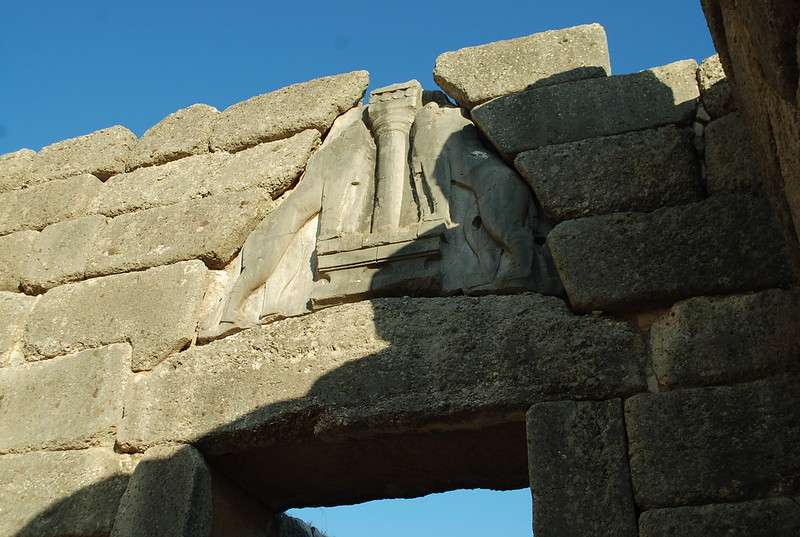
Now its roundabout 5, and M and I start thinking about heading off to Mycenae, having allowed the children to convince us they really don't want to go to see a pile of old stones. That's a bit sad; I'd like to think they would like to see and experience this stuff; but they lack context. So we go alone, together. Getting back through Korinthos is a bit hit-n-miss (oh yes, and at some point we cross over the canal at what looks like its deepest point, so we stop and marvel, briefly; definitely something to show the children) but we hit the motorway and then it works, until we turn off, signed, and follow roads and hope, and it turns out to work. There's a little town nearby, souvenirs and hotels and stuff, but we don't stop. Pass the "tomb of Atreus" and 500 m on we're at the end. Just a little walk past the gate (8 euro each for adults) and a gentle slope up to the citadel. Its hot, though. The path leads straight to the Lion Gate as the first thing you see, and its as impressive in reality as I could have hoped for from the pictures: massive, solid, present, ancient. What more can I say? Look at the pictures; imagine it for yourself. The walls it is embedded in are indeed "Cyclopean" - composed of huge blocks. No-one builds that way since or now, probably because it just doesn't make much sense.
DSC_3786

After that most of the rest of the citadel is less exciting, unless you're an archeologue: the usual kind of here's-the-foundations-of-some-thing-that-we-guess-is-a-palace and so on. "Grave Circle A" is better, because more complete and with more structure. The "back gate", the not-Lion gate, is fairly massive though smaller. We notice there that the lintel block has been carefully cut to allow a recess for the door, which looks like a lot of work. The guide notes that the over-lintel block isn't a load-shedding triangle, but it is two stones blocks arranged, again, to shed the load off the lintel.
From the top of the citadel - and indeed, from the road here, enough that we got slightly confused about which was which - you can see the hill of the citadel of Argos in the distance, rising above its plain. It looks so old in the haze of distance and slanting light of evening, yet is young compared to Mycenae.

M goes to the museum, whilst I spend another 10-15 minutes looking at and photographing the gate. Its more than three thousand years old. I can't possibly imagine what the people who built it thought.

The museum is quite decent, says M, and while we're here we'll just nip down to the "tomb of Atreus" or whatever they call this. Cunningly, this is arranged so you walk towards it then turn a right angle so you see it properly, and then wow! Its enormous, the entranceway and the door. Inside is another wow, because the space is much bigger and higher than you expect, stone "beehive" construction (see, they still hadn't invented the arch). Above the door lintel is yet another way of shedding the load, in that there's a triangular gap in the stonework.

And so back to the hotel, where D needs to be woken to go out for a meal at the same taverna.

The Peloponnese: Sunday

All of Sunday's photos.

We slept long and well. I woke, dozed, woke and so on; eventually up at 9:15 and we all went down to breakfast. Served in the entrance hall; plenty of other folk about, possibly there for the rally. Breakfast was: sweetish bread, a variety of homemade jams, a gingerbread biscuit cake and a slice of homemade chocolate cake; later what appeared to be toast but was actuallly a cheese and ham toastie; D and E got through theirs but we didn't. Orange juice, water and coffee. We finished up after eating outside to play some whist.

Behind our table was a repro of a picture: idealised peasants gathered round a wall on which they trace the inscription "et in arcadia ego". Which I know from Brideshead revisited, describing the first sweeping up of the main character into the new world. However, M looked it up and apparently its from a painting by Poussin, and the wall is a tomb (this isn't obvious in the picture, it is folded into the background) and so the text becomes "even in Arcadia there is death".
Being in Arcadia is a strange thing; of course, it is not the mythical land of peaceful meadows that the West made it. Its a mountainous, rural hinterland quite akin to central Corsica, or the French alps, or somesuch: quiet, backward. And hot, in summer.

And so, really later than we should have been, to visit the monastries and the gorge. *Now* I have the geography fairly well in my mind; before, I didn't, and without it things are very confusing. Dimitsana is high above the East side of the gorge of the Lousios; the gorge itself is limestone and the river very deeply cut into it, so you can't see it except from close to. Any of the roads heading down into the gorge are slow and switchbacky, no matter what the map may show. For bonus points, many of them are pot holed in places, and in others gently slipping away.

First to Moni Emialon, which is sort-of a bit beyond the water-power museum, and a small cute church. Anyway, its the easiest to get to, and very quiet. It claims that you ought to be properly dressed (no shorts, etc) and to be shut from 1 to 5; but I'm not at all sure either were enforced. Since we weren't properly dressed we crept in quietly and sat in the courtyard; we didn't try to go into any of the buildings. It was lovely and shaded. Being Sunday morning, we could guess that any monks were likely at their prayers. There was a large central ?walnut? tree, its trunk painted white as all courtyard trees here are, and in lieue of a church tower it was hung with bells. So we sat in the cool shade appreciating it and the stillness, craning our necks up to the limestone cliff that overhangs the place. And stroked the local cat.

Then, back along the road to the water power museum, which we visisted because it was there, and because D and E like water wheels. Its actually quite good: the style there (because there is a lot of vertical fall) is different from the English. There was a fulling tank (a large conical pit into which a jet is directed to swirl stuff around) a nice pic of an old shepherd in full garb (I have a copy); a video on tanning and some skins and stuff; a gunpowder mill (this area was a centre during the War of Independence).

Just before we got back in the car I remembered the cute-old-little-church and went for a look; its stuffed full of icons and religious pix and, oddly, double headed eagles. Which I thought was Austro-Hungarian. Lovely and cool inside. Some greeks with kids came in, talked noisily and without a trace of reverence, and then just at the end the 6-7 years olds spontaneously kissed the pic of Jesus before leaving.

And so on - its now, well, middle of the day and hot out, though cool in the car with the AC on. We now have a choice and end up going to Moni Philosophu, which involves winding all the way into the gorge and up some of the far side. There is a "new" bit - 1691 - and the very old but now abandonded bit, from 900's. Arriving, there is a courtyard with more very welcome shade, then a proper-looking monk (cassock, beard) welcomed us with water (very welcome) and a sweet, gave a very brief description in English and a rather longer one in Greek, and then we looked around. The "new" church is small, indeed tiny by the standards of say English parish churches, but painted inside and filled nearly with a vast chandalier far too big for it, and delightfully cool.

After that, to the "old" bit which is signposted as 800 m away, the guidebok says 400 but don't believe that. In the noonday heat its a hot walk and D in particular got a bit grumpy. So that when we got there, it was a bit disappointing: its in ruins, and what you see are the old walls under the overhanging limestone cliffs, all much deeper into the gorge than at Emialon. And you can climb up inside to the church right at the end. In the right frame of mind, in quiet, you could sit still and try to think about how it might have felt to live here as a monk; but in the noonday heat with two somewhat grumpy kids, it was more like a pile of stones. And so back.

Thence, back to Dimitsana via the northern route, arriving about 3:30 I think, as the rally was finishing. To a cafe - the one opposite the old one where all the old blokes sit at their individual tables watching the world go by - since we're all hungry and thirsty; I have two cokes. Giant beans, sausage, greek salad, tzatziki. And some more whist.

M and I would both like to see Ancient Gortys, but D and E would rather, errm, not; so in a fit of compromise we agree that in the evening we'll go down and look and they won't. In the end we leave a bit earlier, at 5:30, and happily the roads - once off the main road, and past the potholed section near the top - aren't too bad, so it takes about half an hour. We only find the "asklepeion" which is of mysterious purpose; and a bit next to it with massive thick walls, or foundations, but the plan of which they outline is hard to interpret; perhaps it was for a row of colonades. There's a road/track leading to the acropolis, but also a path up by the river (oh, and also a teensy chapel) and so we follow that path, which wends up the west side of the gorge until crossing on a new bridge (apparently there are ruins of the old one, but we couldn't see it; also nearby the remains of the Moni fulling mill, not exciting) and then upwards and we end up at the Moni Prodromou (aka Moni John the Baptist) which was the one that the lady of the hotel had shown us pix of and recommended. It is probably the most impressive of the three, since the buildings are stuffed under the overhang with balconies leaning out in what looks a most precarious manner. Rumour has it that you can rent rooms there. We didn't go in; it was 7:30 and again there were "please dress properly" signs; though there were also a row of robes hanging up that maybe you were allowed to borrow.

The views as you come *up* the gorge are far more spectaculr than those looking down; so were I to recommend anyone visting this area it would be to get up early, park at Gortys, have a quick look at the site then, and walk up to Prodromou while its still fairly cool. If you had anyone prepared to go back and drive the car round, you could then walk on to Philosophu I think.
Back down takes half an hour, then I wade out into the river but don't swim - it really is quite cold. And so home, stopping to admire the sunset over the Arcadian hills. Indeed we got to see it several times: in the valley, the sun was behind the hills; as we climbed out it rose.

And back to the same taverna in Dimistana for dinner: stuffed tomatoes (which was actually a stuffed tom, and a pepper, and an aubergine); tzatziki; spinach pie (spinakopeta?); "salt pork and eggs" (pork omlette) and green beans. I'm currently winning the whist competition. The sky is pure deep blue when we start and black when we finish.


The Peloponnese: Saturday

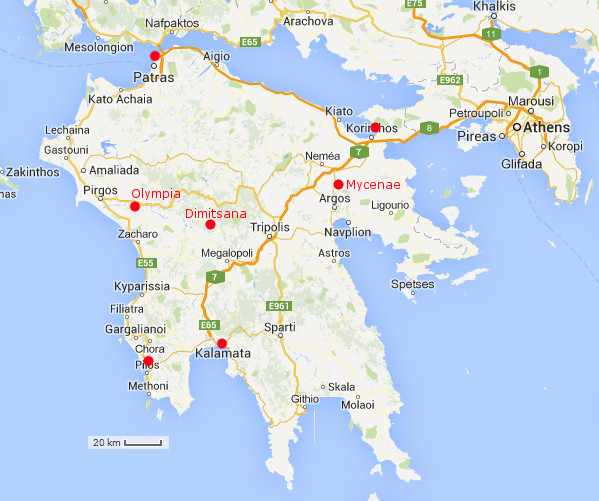
greece-map Our family holiday this year, inspired to some extent by me reading "A History of the Peloponnesian war" by Thucydides. And by us not having any better ideas. The Peloponnese is not the islands and its not Athens, its a somewhat unfashionable backwater containing delights like Mycenae. M booked us flights into Kalamata airport, a car, the first two nights stay in Dimitsana - which I and you had never heard of - and we took it from there.
Here's your handy helpful orientation map, and guide to the days:

  • Saturday: fly in to Kalamata, drive to Dimitsana
  • Sunday: the Lousios gorge and monasteries
  • Monday: drive to Loutrakis (coastal strip just N of Corinth); evening trip to Mycenae
  • Tuesday: Petachora
  • Wednesday: drive to Olympia via Patras and the bridge
  • Thursday: Olympia, and drive to Gialova / Pylos / Sphacteria
  • Friday: in place
  • Saturday: drive to Kalamata and fly out.
Far far more pictures than you could possibly want to see are on flickr.
Leave at 2:15, Gatwick parking and bus in no hassle, fail to get a coffee in the airport as the queue was too long and by the time we'd got it, there was no time to drink it; on the flight to pre-booked seats all fine (don't waste your money on speedy boarding), flight fine, I snooze all the way - I haven't been to bed, this being the last night of the bumps.

Flight say 3 hours, 8:40, and they are 2 hours ahead, so 11:40; and we're out of the airport of Kalamata at 12. There's a lady with a sign with our name which I wasn't expecting (and didn't see, but M did) for our Europcar hire, and we pick that up, and off we go. Into the interior.
Stop at Megalopolis for a cafe in the town square, and also buy somewhat randomly chickpeas, cheese and a nectarine to be going on with lunch; the cheese shop in particular being genuinely rural with not-for-show wooden tubs of feta. Roads initially good, becoming rural and mountainous later as we head up into the interior; we're in Arcadia which is perhaps not what you'd expect from the std classical allusions. Just outside Megalopolis is some architectural remains, which we decide to pass by.

Just before the village, at about 1, we're stopped by the police: there's a rally going on, and we'll have to wait (for either 15 or 50 mins, its not clear, but it turns out to be 15). It turns out to be the practice round for tomorrow: a variety of semi-homespun cars zoom round the corner, up to the start-line tent, wait (guy with starter flag, another guy with a wooden chock on a pole so they don't have to brake), then Go! And after 15 mins, so do we, into the village, narrow street, and find our hotel, park with some difficulty - we haven't yet got used to Greek-style "anywhere you like" parking.

Settle into the hotel, which is cool and has a shaded interior courtyard cool even in the heat of the day. I forget the rest of the afternoon and evening: we ended up eating without Daniel who was dead to the world; on a terrace (formally the town square, but invaded by the two tavernas nearby) overlooking the hills.

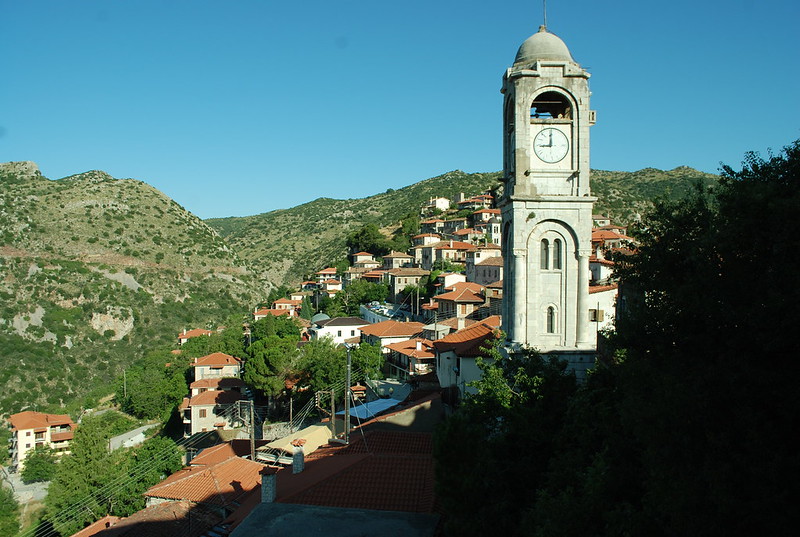
Here's a pic (actually taken on day of departure, but it didn't change much) looking northish. The main road is hard to see; look for the telegraph poles.
DSC_3733


Saturday, 21 June 2014

Book review: Hallowe'en Party

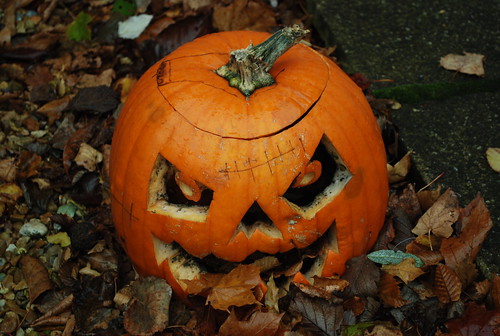
DSC_5824-d-pumpkin-faded Hallowe'en Party is a crime story by Agatha Cristie featuring "Hercule Poirot, the renowned Belgian detective". I picked it up because a friend of my daughter was reading it, and finished it that day.

Pros: well, there's a mystery to solve. And there's some (rather heavy handed) social commentary. And there's a wonderful girl called Miranda in it, just as there is in reality.

Cons: its all rather formulaic. Though to be fair, calling an Agatha Christie formulaic is like calling peas green.

I won't describe the story; wiki has done that. Its a variant on the mansion-house-murder theme, where there are a carefully limited supply of suspects. There is one nice twist (see footnote 1) but otherwise the identity of the murderer (see footnote 2) isn't too hard to see.

Things that are objectionable:

1. Superintendent Spence, a retired police officer, just happens to have settled nearby. Blimey, that's a bit of a co-incidence, no? And an essential one: not only does he short-circuit the evidence gathering, he also provides an entree for Poirot to people who would otherwise not have talked to him.

2. Although the investigating detective is nominally Poirot, nothing in the book depends on this, or reflects on it in any way. In particular, the thoughts and reactions of the detective to the social situations he comes upon are completely un-Belgian; they are in fact the thoughts of a well-brought-up-Englishwoman, viz Agatha Christie. Or, put another way, the book would have been better as a Miss Marple story. This includes the way he looks at houses, gardens, interiors, people. I object to this because its part of the "formulaic"ness of the book; its really a storyline / plot, with generic characters inserted to fill it out. The detective might just as well have been called X and the characters A, B, C and so on (indeed the children sort-of are; there was an Ann, a Beatrice, and I forget the others but I think a C too).

3. There's some social commentary; after all a child has been murdered, and although she is careful to point out that no sexual assault took place, the crime places that and similar ideas in our minds. Many of the characters rabbit on, in a not entirely convincing way, about how the world has been getting worse recently. And there's stuff about how nutters who should have been locked up are at large; possibly this was a political issue in 1969 when the book was written. And then, it turns out that two slightly dodgy teenage boys are the saviours of Miranda, even though they wear red velvet jackets. Or something; I forget the details. Anyway, my point is that's all a bit heavy handed.

So, there you have it. Perhaps I ought to try reading an early Poirot, and see if its any better. By contrast, I recall reading a Maigret ("Maigret au Picratt's", and yes I was pleased with myself for reading it in the original French) which was full of character.

Footnotes

1. The one nice twist is that Joyce really is a liar. We're all set up to believe that this one time she actually told the truth - about witnessing the murder - but it turns out she was lying about that too.

2. Murderers, of course, but I didn't want to say that in the main text.

Friday, 20 June 2014

Book review: Daughter of smoke and bone

Yet another of the books I've read on Saturday mornings in Waterstones. And for that purpose, its fine: undemanding, fun. Read all about it: Daughter of smoke and bone.

But - and its the usual but - it is ultimately forgettable, derivative, formulaic. Perhaps its the book someone who would have liked to be a 17 year old art student in Prague would have written. The initial ideas and environment sits well, the odd situation is nicely set up, but as so often it falls down in trying to make sense of the initial setup (if three's a war over there, and one side has doors into here, then why mess around with teeth? Buy guns! And so on).

And yet, if part two appears and is any good, I'll likely read that too.