Tuesday, 24 November 2026

Two concerts

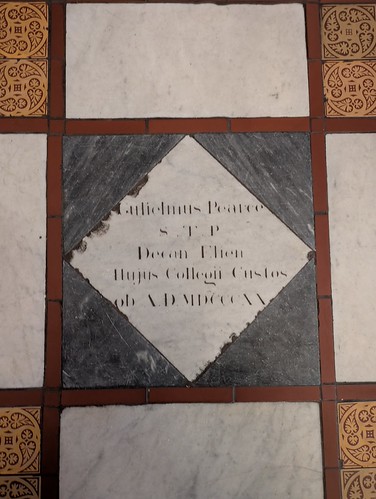
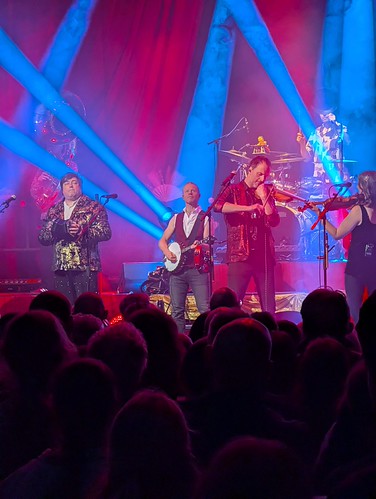
We went to two concerts: Bellowhead's 20th anniversary tour at the Corn Exchange, and Marc-Andre Hamelin in Trinity College chapel as part of the Cambridge Music Festival. I'll let you guess which pic is from which event.

PXL_20261119_203539075 PXL_20261120_212035146

M got us standing tickets at the Corn Exchange because she wanted to dance, and indeed did so; I didn't want to and contented myself with leaning against the wall. We got a valuable wall place because we turned up on time at 7:30 instead of at 8:30 like any sensible person would. We got to hear the support act, which was Senegalese and meh. Bellowhead remain good; the old classics are still classics; M thought she could detect some falling off of Jon Boden's voice.

That was Thursday; Friday brought us through the cold night air to Trinity and its glorious sparse chapel with the famously hard seats, where Francis Bacone sleeps in the antechamber watched over by Newton. M greatly enjoyed Hamelin, but I am no fan of modern classical, and found Weinberg and Enescu trying. Debussy is fine, as M plays that and I am habituated and anyway it is pleasant. Chopin I forget, and Earl Wild meh. I should not have outsourced my "do I want to hear this?" choice I fear.

Monday, 23 November 2026

Book review: A Room with a View

PXL_20261123_171922948 By E. M. Forster. Unlike Where Angels Fear to Tread, where the English abroad meet Italians, here the English meet the lower classes, with Italy but a backdrop. But the theme, as ever, is aspects of the changing nature of Englishness.

Our heroine, Lucy, daughter of a respectable but not important family, meets in her pension in Florence a variety of folk, including the lower class Emerson pere et fil, to whom they - she is travelling with her elderly cousin - become unwillingly indebted after an incautiously expressed wish because the E's insist on switching rooms, so that Lucy might have A Room with a View. Here I need to confess that this book languished over the summer, and so my memory of the exact events is sketchy. But a small indescretion - a kiss - by Emerson fil occurs amongst a field of violets. Naturally, L's chaperone insists that they immeadiately leave for Rome.

Back home, in the rural Weald - where is the Weald? GMaps suggests it is on the way to Hastings, that sounds about right - E becomes engaged to Cecil, a higher-status chap she had met in Rome, who does not get a sympathetic book. And out of some mischief, he arranges that the E's should rent a local cottage / villa; our protagonists meet again.

Eventually, L throws off her stultifying engagement to C, and after the wise words of pere, and with the endorsement of Mr Beebe the local clergy, ends up married to fils. The book ends with the realisation that her frosty elderly cousin had, in the end, deliberately not intervened at the vital moment, thereby allowing the course of love to run to completion.

So much for the storyline. What that doesn't show is how civilised the whole book is; how delicately written. Forster has a lovely way of dropping into his characters thoughts: at one point for example we learn that Mr Beebe can bear being silent, but not silence, and so is obliged to speak. The E's - well, especially the elder - are types of advanced peasant; that is, they are still poor but no longer think like yokels; perhaps this is William Morris-y type stuff breaking through. Although he is perhaps functionally only the Wise Old Man. Though I'm really not sure we should be taking his see-clearly-via-passion stuff seriously.

Thursday, 19 November 2026

Book review: There Is No Antimemetics Division

PXL_20261119_141949660There Is No Antimemetics Division by "qntm" aka Sam Hughes. Meh. Recommended by E, who was apparently greatly enjoying it. I read about half way, around page 100 - one good thing, it is not a doorstep - but stopped. It had run out of appeal, and likely of ideas.

The idea is that a class of "anti-memetics" exist; devices or entities that, unlike memes which spread themselves, instead cloak themselves. People forget they have seen the things, computer records degrade, paper records decay, and so on. The immeadiate problem is that while it is possible to imagine such a mechanism in human storage memory, which is mediated by consciousness and still rather mysterious, it is rather hard to see anything similar operating on computers, and impossible on paper, without a rather large suspension of disbelief.

The next problem is that's kinda the only idea the author has, and seeing the same idea played out across three-I-think-it-was stories I was getting rather bored.

Goodreads has those who love it and those less enamoured; of the latter variety all agree that the second half is worse so I feel justified in giving up.

The Painted Church

Aka All Saints' Cambridge. Just opposite Jesus. Has a pottery exhibition until December the 6th.

PXL_20261119_142044278

We visited on a gray day and the interior was gloomy; it might well look better on a sunnier day. The interior is painted, likely from stencils; there are William Morris-ish associations. I wasn't keen on most of the stained glass which seems a little muddy to me. The "diagonal words" window was better. The exterior seems unremarkable to me.

PXL_20261119_141710289

Wednesday, 18 November 2026

New fleece

PXL_20261118_113430756 My old, somewhat-beloved but certainly well used fleece, was a Berghaus one... and I can look it up; bought 2019, it was a Berghaus Men's Activity Polartec Thermal Pro Interactive Fleece Jacket, size M. Currently unavailable. The new one is a MOUNTAIN EQUIPMENT Highpile Mens Jacket, size L. £100 from Cotswolds.

The new one has slightly shallower pockets, which is mildly annoying; but my phone still fits in the breast pocket. The rather thick fleecy collar is a bit obtrusive at the moment. Despite being L instead of M it feels less roomy


Tuesday, 17 November 2026

Book review: Ice!

ICE!_1978_by_Arnold_Federbush_Art_by_Lou_Feck By Arnold Federbush. Goodreads. Not a great book; of interest to me because of the ice-age stuff. I read it online or rather skimmed the first 100 pages. That was enough to tell me it was the expected rag-bag of confusion.

It has the usual ideas: that stuff-we're-doing causes warming, which somehow causes cooling. It has the 10 kyr period, which is supposed to be the length of interglacials but which it garbles into the time between ice ages. It has animals moving south, even during the warming phase, which makes no sense at all. All of this is sufficient that I suspect that someone who actually cared could tell which specific sources he was using.

Refer to Was an imminent Ice Age predicted in the '70's? No for the usual actual scientific content.

Monday, 16 November 2026

Book review: The Murder of Roger Ackroyd

PXL_20261112_144706682 But alas not really a review, because I'm writing this months in arrears, merely to remind myself that I have read it. Here's wiki on it, and that will mostly do you.

From what I recall: I think the Dictaphone rather gimicky, and for the accolades it gets that would have to be missing. The narrated-by-the-killer bit is lovely.

Apart from that, though, I would say that it is a std.christie, rather than anything outstanding.

Saturday, 14 November 2026

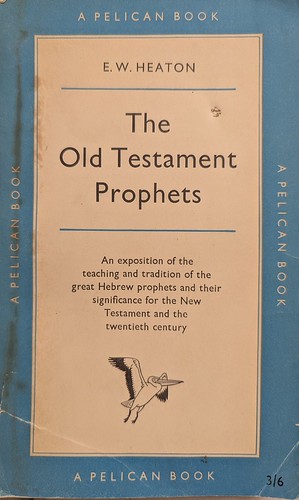
Book review: The Old Testament Prophets

PXL_20261114_203305025 We have owned The Old Testament Prophets by E.W. Heaton for time out of mind; it has M's name on the flyleaf, but Mfd's earlier, from '68. Eventually, as part of my read-the-bible jag, I decided to read it for background and context.

But I did that a couple of months back; and even at the time I felt that little was sticking; so even less has stuck now. So this is less of a review than a record of having read.

The main thing that I blurrily recall is the idea of the "Jewish nation" whatever that means was coming into being, and moving into Canaan. I think the book is old enough not to know that the Egyptian Captivity is made-up, so some of what it assumes as background is also likely fake. But nonetheless, there's a conflict as the Jewish religion is being shaped. And the prophets are... people, perhaps outsiders, who show up and complain at the people and the kings that they are a bunch of idolators, that God is preparing a reckoning for them if they don't repent, but that nonetheless The People are specially beloved of God. And there is a need for them to distinguish themselves from the Canaanites.

And somehow this is mixed up with the religion of the Canaanites; I think maybe not said explicitly but implicitly it is separating the Jews, making distance from The Others.

Well, not much of a review, sorry. I think the book - and this is from my poor memory - is a little too religious (Heaton is after all a priest) and assumes that in-universe, and so not too inclined to synthesise as I've attempted to; so I don't especially recommend it.

Friday, 13 November 2026

Jesus

Possibly the start of a series on Cambridge colleges. But more likely a one-off. At the pre-Raphaelites at the Fitz we discovered that Jesus chapel had a lot of their stained glass, so went for a look. It is good; you should go. Full set of pix. First the ceiling. I don't think this is anything to do with the p-Rs; they only did the stained glass.

PXL_20261112_142626307

Looking out of the chapel into the... ante-room? With M.

PXL_20261112_144433817

Some of the glass. I rather like the central image, bracuse if you look quickly, it looks like Jesus is holding up one of the faithful's heads.

PXL_20261112_144117588 PXL_20261112_144103500 PXL_20261112_144212119

And a token bit more glass (full window):

PXL_20261112_143131833

Those are the orders of angels, and Man, to round out the ten frames. We start with Seraphim, Cherubim, then Idrom, whatever they might be. Following the order, they are thrones... so, sigh, the leading "i" is really a "t", the "d" is an "h", and the "m" is "n i" so that one is "throni".

And the tower ceiling.

PXL_20261112_144850542

After that, to their rather nice cafe. They even have papers.

Thursday, 12 November 2026

Book review: Archangel

PXL_20261112_113836483 Having read and enjoyed Fatherland, I foud Archangel second hand so gave it a go. I think that as a thriller it is superior: the ending in particular is great, from that perspective. As a book overall I prefer Fatherland; Archangel seems just a little parochial by comparison. But Archangel suffers a little by being read immediately after Fatherland, since the over all plots - evil empire, long-lost dox exposing terrible secret - are rather similar.

We're in Russia, during Yeltsin's premiership - I think this is not explicitly said, but there is a scene where a character on the phone to him hears the clink of ice cubes in a glass and thinks oh no, not this early in the morning - when all is chaotic; there is liberalisation, vast fortunes swirling around, but also longing for ye olde dayes amongst those losing out.

Our Hero, a scruffy feisty historian who has offended too many others, is at a conference in Moscow organised by the archives. And is approached by an old scarred man, ex Beria's service, who knows where Stalin's fabled notebook is buried. And then the chase is on.

Sadly - in my view; but then it would perhaps have been just too similar to Fatherland - the notebook turns out to be not Stalin's, but a young woman on whom he fathered a child, who turns out to be still alive, in the forests not too far from Archangel. And the plot turns into chasing him down. That makes a fine thriller but somehow, to me at least, rather small scale.

I think I thought to myself that Our Hero meeting the Old Guy was rather coincidental; happily this is fixed up at the end: it was all arranged (and that makes everything better: because as the Evil Villain says, only by having Our Hero release the info would it get global attention and be believed; and it allows lots of background stuff - like digging up the box - to be more believable). I think Our Hero should have guessed this, or at the very least considered it. I'm also rather dubious about the Son living off in the woods for so long, especially as town is only an hour or so away by boat. Oh, and a flaw: as Beria is dying, he shouts "Archangel", which means nothing to most Western readers, but really everyone who heard it would know is a city in Russia.

The book does a good job of showing you how badly the Soviet Union broke so many people's lives and what a terrible regime it was.

If you like forests-in-snow, then I think Billion Dollar Brain does it better.

Meta


I find myself asking Gemini questions now, so here is its answer to "is Archangel or Fatherland a better book?". FWIW, Goodreads gives F 4.03, and A 3.83.
Fatherland is widely considered the better and more iconic book by Robert Harris compared to Archangel, though both are gripping thrillers.

Fatherland (1992)

• Premise: An alternative history noir set in 1964 where Nazi Germany won World War II, and a Berlin detective named Xavier March uncovers a massive state secret while investigating a murder.
• Why readers love it: It is often praised as Harris's breakout masterpiece and a true classic of the alternative history genre. Readers highlight its chilling, richly imagined atmosphere of a victorious Nazi superstate and a tense geopolitical standoff with the United States.
• Consensus: Most fans and reviewers rank it higher in Harris's bibliography, citing a stronger and more iconic concept than his later thrillers.

Archangel (1998)

• Premise: A post-Soviet political thriller set in modern Russia, following a historian (Fluke Kelso) who tracks down a secret notebook belonging to Joseph Stalin.
• Why readers love it: It is a fast-paced, entertaining read with a satisfying ending and fascinating snippets of Soviet-era history.
• Consensus: While some individual readers prefer its pacing or setting, it is generally viewed as a more conventional thriller that lacks the cultural impact and atmospheric dread of Fatherland.

I find "more iconic" grates, here and whenever I see it elsewhere. Something either is, or isn't, iconic; I don't think it can be used in degree. 
Monday, 9 November 2026

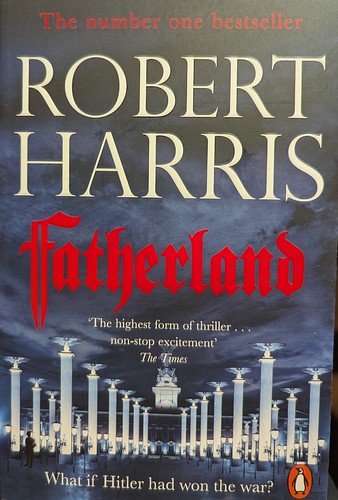
Book review: Fatherland

PXL_20261109_143639714Fatherland is a 1992 alternative history detective novel by English writer and journalist Robert Harris. Set in a world where the Axis won World War II, the German Reich spans from the Rhine to the Ural Mountains and so on. Unlike SS-GB, which is set in 1941, this is set well after the war, 1964. I read it perhaps 15 years ago, I think from Mfd's copy - which in retrospect is strange - but recalled little of it, other than the dream-like Autobahns heading east over the ridges, to keep the winter snow off the roads. So I was a little disappointed on the re-read to find that is only a sentence, towards the end.

The plot is that the Krauts, having "won", and having implemented the Final Solution, and then covered it up, are finally killing off the last officials who know. Our Hero is a KriPo (Criminal Police) officer who starts with a body found in a lake; evenutally he assists in smuggling out documents; and ends up hunted off towards the barely visible ruins of a razed concentration camp.

So there's lots of nice investigation, and slow discovery of historical facts, and uncovering what was going on, and indeed a primer on the Holocaust for those who had forgotten. We get digs at Speer's tasteless gigantic Berlin - I recall reading his book years back, and being amazed at how unimaginative and derivative it all was: "we'll have an arch, and it will be much bigger than the Arc de Triomphe", and very dull. Like Trump. And so on.

The grey pall that SS-GB portrays extends to the book's present: while the Krauts have "won", a rump Russian govt behind the Urals propped up by the US fights on bleeding greater Germany; resettlement to the East is not nice; the Gestapo are still active and feared and poison the land, and so on. In a way I would have liked a more optimistic book, where the world was flourishing, and perhaps Our Hero has to wonder whether revealing long-forgotten reality is really worth upsetting prosperity.

I feel that the book's central premise isn't reasonable: that 11 million Jews could not actually go missing and have no-one know. Indeed the books characters admit this to themselves towards the end, but say that without evidence... waves hands. "The East" seems to be a land of mystery, as though behind an Iron Curtain, which doesn't seem right. But with all that, it is a fun read.

Friday, 6 November 2026

The holocaust of the laptops

PXL_20261105_165329121 Alas poor laptops, I knew them well. The EGU stickers on this one make it a BAS laptop, and I left there in 2007. That one, a P3110CT, is so old it had an actual hard drive. And the lower sticker is a PalmPilot alphabet code. There were Qualcomm stickers on some others, though I think those were Q stickers I gave to E for hers.

But they had been gathering dust and taking up space in the living room for ages, so eventually had to go. The power supplies have long vanished, so to wipe them I chiselled open the backs, ripped out the SSDs and broke them. Arguably overkill; they likely have no secrets and were likely unbootable without an unreasonable level of effort, but it was sorta fun.

So now they are all at Milton Tip for disposal. Sic transit gloria mundi. You'll be pleased to know that I've used the space released to tidy up my diaries, which I'll never read again.

Refs