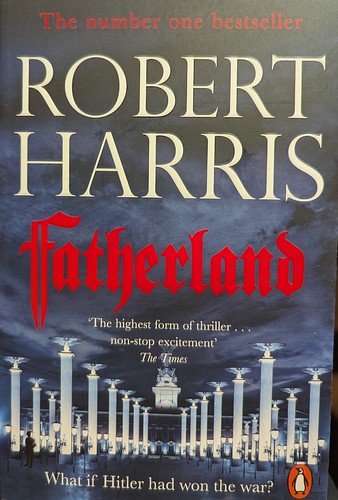
 Fatherland is a 1992 alternative history detective novel by English writer and journalist Robert Harris. Set in a world where the Axis won World War II, the German Reich spans from the Rhine to the Ural Mountains and so on. Unlike SS-GB, which is set in 1941, this is set well after the war, 1964. I read it perhaps 15 years ago, I think from Mfd's copy - which in retrospect is strange - but recalled little of it, other than the dream-like Autobahns heading east over the ridges, to keep the winter snow off the roads. So I was a little disappointed on the re-read to find that is only a sentence, towards the end.
The plot is that the Krauts, having "won", and having implemented the Final Solution, and then covered it up, are finally killing off the last officials who know. Our Hero is a KriPo (Criminal Police) officer who starts with a body found in a lake; evenutally he assists in smuggling out documents; and ends up hunted off towards the barely visible ruins of a razed concentration camp.
So there's lots of nice investigation, and slow discovery of historical facts, and uncovering what was going on, and indeed a primer on the Holocaust for those who had forgotten. We get digs at Speer's tasteless gigantic Berlin - I recall reading his book years back, and being amazed at how unimaginative and derivative it all was: "we'll have an arch, and it will be much bigger than the Arc de Triomphe", and very dull. Like Trump. And so on.
The grey pall that SS-GB portrays extends to the book's present: while the Krauts have "won", a rump Russian govt behind the Urals propped up by the US fights on bleeding greater Germany; resettlement to the East is not nice; the Gestapo are still active and feared and poison the land, and so on. In a way I would have liked a more optimistic book, where the world was flourishing, and perhaps Our Hero has to wonder whether revealing long-forgotten reality is really worth upsetting prosperity.
I feel that the book's central premise isn't reasonable: that 11 million Jews could not actually go missing and have no-one know. Indeed the books characters admit this to themselves towards the end, but say that without evidence... waves hands. "The East" seems to be a land of mystery, as though behind an Iron Curtain, which doesn't seem right. But with all that, it is a fun read.

No comments:
Post a Comment