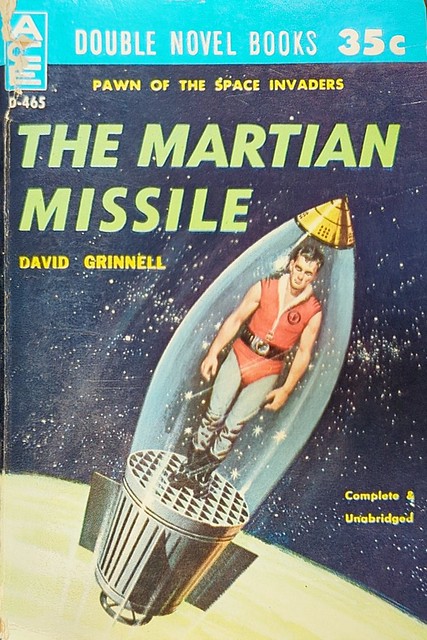
By David Grinnell. A book of about the quality you'd expect from the cover. The other half of The Atlantic Abomination. Characterisation and description are non-existent and writing quality is low, so we fall back on the plot, which drags.Tuesday, 31 January 2023
Book review: the Martian Missile
By David Grinnell. A book of about the quality you'd expect from the cover. The other half of The Atlantic Abomination. Characterisation and description are non-existent and writing quality is low, so we fall back on the plot, which drags.Sunday, 29 January 2023
Book review: the Atlantic Abomination
John Brunner. Very much not one of his finest. An "Ace" double-paperback with the equally cruddy "The Martian Missile". The intrinsic idea - monster disturbed by deep-sea expedition with mental powers seeks to dominate humanity but is foiled - is so-so but hardly novel; shades of Cthullu or Godzilla or such; but the prose is dreadful as are the wooden characters.The initial catastrophe that overtakes the master race is somewhat sketchily described, but I blame them for failing to foresee it; and it seems implausible that they didn't. Or put another way, the very crude and very simple master-slave society sketched out isn't really plausible. Notice, by the way, that in the intro His Impreial Evilness speaks to his people to make them do stuff; by later in the book we have the rather less plausible scheme by which he causes pain which only stops when you do what he wants.
HIE's treatment of his slaves in our time doesn't seem very plausible either, as they are too likely to die, to his own inconvenience.
The most that can be said for this is that it passed a few hours in Blackwell's who have foolishly moved their scifi section to another building.
Thursday, 26 January 2023
Sunday, 22 January 2023
Book review: Blood Music
Blood Music by Greg Bear, author of the disappointing Eon. Years ago I read the back of BM, and decided not to read it. Recently, faced with someone else recommending it, and a lack of alternatives, I tried again. And the first half is fine if unexceptional, but then it goes downhill. So it goes, all too often.The problem is what you'd expect: GB is fine describing the science-biotech interface and related matters, and weaves an interesting story around it. But once he has to try to describe what it would be like if intelligent cells existed, he fails. I think he fails pretty badly, too.
This is because... what would life be like, if you only had streams of info, rather than extracting info from sight and sound and hearing? That's effectively what life is like for these cells: they have no senses other than picking-up-information1. We do have people a bit like this, those deaf and dumb and sightless, who can only read braille or equivalent. Would they, if miniaturised, somehow be good at reshaping the body they inhabit? Not obviously. Would their near-first-act be to fix something like eyesight, whose principles would be completely alien to them? Unlikely.
FWIW I think the idea of intelligent cells is doomed, from various kind of information-content type grounds, but we wave that away for the purposes of the story. Also, for some odd reason these cells are able to take skyscrapers to pieces; why exactly they are capable of chewing up steel and concrete is never mentioned or considered; it is almost as if GB, having thought of these vast sheets of goo, somehow can't imagine them not able to do it. I'm also unconvinced by their structure: life is adaptable, if vast sheets of goo was a good idea, biologically, we'd see it already.
In geopolitics, with the USofA gone, the naughty Russkies get up to some nuking of various bits. GB has forgotten the submarine deterrent, which would still be fully active and quite capable of striking back; this is careless of him.
Towards the end, there is some voodoo about what-observes-the-tree-in-the-quad; the idea being that the addition of so many trillions of observers in some way strains reality, leading to some poorly-described cataclysm or singularity (TBH I'd stopped reading carefully by this point and was just skipping along desperate to get to the end; and now I'm on this there's also some voodoo about how similar capability allowed the microbes to neutralise a nuclear strike, oh yeah, that's really believeable). This has no real realation to the rest of the story (other than being necessary to explain why only the USofA rather than the rest of the world is enfolded, which in turn is necessary for drawing out the story) other than to bring it to a convenient end.
Refs
Notes
1. From the far-future of 2026: this is actually the position that AI finds itself in...
Friday, 20 January 2023
Book review: Blindsight
TLDR: exciting but disappointing.Wiki provides a reasonable summary; and as usual Goodreads will provide opinions. Author: Peter Watts.
The basic setup is decent: something alien has undeniably scanned Earth; and we send a ship to find it. There's some oddities in there though: why the aliens would choose to scan us so blatantly, and yet hide; why they would cunningly redirect their transmissions through a hard-to-detect indirect link, and yet be detected. I think those needed to be more important for the plot, but they aren't, so they're just plot-candy. Unlesss they can be justified as camouflage, for the real plot? A sparer book would have made the real plot more obvious.
Another oddity: the aliens are hanging waay out, but our characters never show any interest in how long they've been there. Is "Big Ben" moving wrt to the Sun? This is never asked. Did the aliens hitch a lift on it, or did they just want the mass, and so choose to settle there and eat it? Possibly the latter, but the lack of discussion is strange. Are the aliens just one of a zillion ships that the alien species has sent out, or alone? Why, if the aliens can function happily out by Big Ben, do they care about the Earth at all? We never know.
The main cute idea is that the aliens are intelligent, but not conscious (whether this is even possible or not is of course not known, but that's OK: this is a story). I was disappointed by how quickly this becomes clear: it seems to be that the mystery could have been preserved longer; it feels impatient. This sort-of segues into / combines with various other issues of consciousness (the narrator, the vampires) in what feels a rather ill-disciplined way. Issues vaguely linked to consciousness (blindspots, saccades) are kinda linked into the story line but in a wallpapery way, that only disguises the fundamental lacks, without contributing anything to the ideas.
Although it sort-of purports to be a "discussion of consciousness" it isn't; it is just a humble sci-fi story. The "discussion" comes via the central character trying to make sense of things; but this is a combination of asserting implausibilities (consciousness is evolutionarily useless and costly; can you see the problem with that?) and lots of incomplete sentences and half-seen side glances.
I don't mind the vampires, though they do feel like an idea too many. But I'm sure I've read the "crucifix glitch" idea elsewhere, many years ago.
Saturday, 14 January 2023
The year 2022
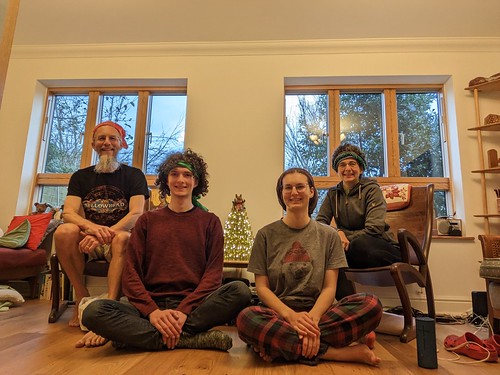
I don't keep a diary; I do have a series of unconnected social-media accounts which I hope one day AI will connect and trawl. For the present, let's try and remember what we did. My picture is from Christmas, in the new house.We actually moved into the new place on the last of March, prompted by our purchasers needing to move in by April First. But we'd bought the place a couple of months earlier. So we frittered those two months away getting the walls painted and the floors re-done, and then scheduled the moving company frantically at the last moment.
As if to prove to myself that I really am getting old, I have Diary of an injury: my back #4 in May.
July: town bumps.
August: family holiday in Saas Fee and Zermatt; and I walked from there to Chamonix, so to speak.
September: a trip to Pembroke. Climbing, woo! E has taken up indoor climbing too.
I end with Christmas 2022. We (DEI) spent Boxing Day climbing at Horseshoe Quarry, and promised each other to do more.
Book review: The Crucible of Time
By John Brunner. Wiki says "The novel deals with the efforts of an alien species to escape their homeworld, whose system is passing through a cloud of interstellar debris, resulting in a high rate of in-falling matter. The species' unique biology and their biological technology complicate matters" and that's about right. This review from Goodreads gets most of it: although the story is mostly interesting enough, it gets somewhat same-y after the first third. Perhaps because the first couple of chapters were published initially as short stories. And then the book becomes primitive-society-reaches-for-the-stars, and we kind of have to grind through their tech progress. Which he does his best to make interesting, since they are bio-focussed. But the recurring motif of society falling apart due to some natural catastrophe or another, and rebuilding slightly higher, gets a bit dull and towards the end just slows the book down.