Tuesday, 31 December 2013

The book of the old year: 2013

This is a sort-of chain letter for our family for the year 2013. But really its assembled from a sequence of blog posts I wrote, so its rather heavily biased towards me. Miriam writes lots of exciting diary, but no-one gets to read it except her.

General: Miriam and I continue and even flourish at CSR; work remains interesting and engrossing. Miranda left Coton primary - an emotional event - but is now enjoying her first year at the Perse with new friends, but still keeps up with the old. Daniel took his "early maths" GCSE and got the desired A*, and as the year ends is buried in revision for mock GCSEs and work experience forms.

February: Howard "flee you fools" Roscoe dragged me out winter climbing in Coire an t-Sneachda which was lovely. I'll hope, somewhat wistfully, to do more next year.

March: was an extended family stay at English Heritage properties inside Dover Castle. It was a particularly bleak time of year, weatherwise, but perhaps that allowed us to get into the spirit of how it must once have been.

April: I ran the Brighton marathon for the third time, and got my first quasi-respectable time: 3:46:34. Amsterdam in October was even better; overall, it was a good year for my running.
  8858966685_7c73ced942_o

May: more climbing, again featuring the Old Man of the Mountains, and all of us: Stanage, Youth. This year has been a year of Daniel taking up climbing; he is now technically slightly better than me, if you discount leading. Even better he is doing competitions with school, and going off bouldering with friends.

May also saw the welcome return of the bees: my old lot didn't survive the very long cold winter, poor things, but a new lot started sniffing around and to my delight moved in.

June saw some flowering in the sadly neglected garden. But peonies are reliable.

DSC_2113

July: as for the last few years, the focus of my life in early summer is rowing, and in particular the town bumps. This year I was effectively men's captain and through a mixture of luck, perseverance, enthusiasm, reliance on home-grown talent and skill we ended up with a good crew: up 3, and it could have been blades if only Nines 2 weren't so slow.

After bumps M+J were once again kind enough to look after the infants for a week and Miriam and I sneaked off to the Stubai to go mountaineering. Woo! It was great. Unseasonally snowy which gave us a hard time trekking between huts and meant I had to retreat off the Habicht, but wonderful anyway.

In August I took our club to Peterborough regatta and I finally got my point! After all these years. And we won it at IM3, too, against a pretty decent Twyk-men crew. If you don't row, it will mean nothing to you; if you're still Novice at 50 you'll know what I mean.

And of course we had a family summer holiday. Having made no plans at all we ended up with a "drive through France and do some climbing" sort of holiday, which worked very well, especially the three days in Fontainebleau.

September saw the end of the rowing season with the Boston rowing marathon in the VIII, and my personal view. You're safe now: there's no more rowing on this page.

October: Amsterdam marathon - even closer to a respectable time -3:43:06. One day I hope to get down to 3:30; I really can't decide if its likely I ever will: at some point my general-fade-off-due-to-old-age will start becoming more important than my improvements from fitness. Miranda came along for the trip, though she didn't run. We stayed with Si+B in their apartment, and Miranda went shopping with Becky.

December: Miranda gets her grade 4 piano with 80/100, which is a merit. We draw a discrete veil over an earlier episode. Grade 4 clarinet is next summer.

Christmas-to-New-Year is the familiar round of staying with my Mother - who will be 80 next year, and I'll be 50, the horror - and M+J. A quiet life, and a pleasant one.

Saturday, 28 December 2013

Uncle Tom's Top Hat

He was in the 2nd Border Regiment (or is that the second battalion of the Border Regiment? I'm not sure). I have his brass prismatic compass. The top hat case is a fixture of my mother's house, but it comes from my father's side, the Proctor side.
 

The baggage labels: the "Jamaica Direct Fruit Line Ltd.". Time frame: the 1920s.
 

The hat itself, in its glory. Still pristine after all these years, because unused.
 

And here he is. On the left. I'm the one in the middle. My father, Peter, is on the right. This is taken at Lyndhurst.
 

Me again, and my mother, and Great Aunt Jess. Who isn't actually my great aunt, but I can never remember the true relationship.
 

Wednesday, 18 December 2013

Book review: Ancient Light

http://xkcd.com/483/.

Alas, there really isn't much more to be said. I gave up about 2/3 of the way through. The book - and the predecessor, Golden Witchbreed - works only when the air of mystery and hints of ancient alien civilisation is played with a delicate touch. In GW she just about survived; but in AL that touch is lost, the mystery evaporates, and all that is left is silliness.

Wednesday, 11 December 2013

Book review: Ancillary Justice

This is very good. I've found various reviews that say much what I would, only with more gush, so I'll just annotate them.
 
Jaine Fenn has a review I like: as it says "SF but not quite Space Opera" which is what I was struggling to say: it has spaceships, it has travel between worlds (as that review says, "travel between worlds is too simple, treated rather like a short sea voyage" but that is fine; see comparison to Cecilia Holland), but these aren't handled the way you'd expect from yer typical male writer. For example, there are no loving descriptions of the hugeness of the ships or the power of their weapons; all that is left aside. It reminds me more of Floating Worlds by Cecilia Holland (which is brilliant; better than this; better than most things).
 
TOR has a review which I mostly like, and which pushes the pronouns issue, which I agree was well done (though in my recollection she gets it somewhat wrong: I think its just that Breq finds it really hard to tell gender, and usually doesn't care).
 
One of the nice things about the book is the way it surprised me. Example (somewhat spoiler-ish, so skip if you like): in one of the climatic scenes, JoT has just shot (one instance of) Anaander, and the other AM's have deployed the break-comms weapon, so everyone is on their own. The narrative voice (One Esk 19 I think) then heads off, and I thought "oh well, we're going to have a somewhat tedious fight scene". But no! There's no fight scene at all; One Esk just heads straight for the exit and leaves in an escape pod. Brilliant.
 
A criticism. The imagined empire doesn't really make a great deal of sense. The problem is that the "annexations" are brutal and violent, and remain that way even after the native population are subjugated. That's necessary for the flow of the book, but it doesn't actually make sense. That level of violence is known - now - to be counter productive and to Just Not Work. Its hard to imagine it being used as described.

Sunday, 24 November 2013

Film review: Catching Fire (Hunger Games book 2)

I read the Hunger Games (then, book 1 and only) several years ago when we bought it for Daniel in Spain in 2011. I enjoyed book 1 (as did D, and subsequently Miranda); and they've both read books 2 and 3, which I haven't (I briefly browsed the opening of book 2 and decided that I didn't like it).

The film is excellent, if you like an exciting action movie. The production quality is very high, it all looks excellent, and the pace is fast enough that the holes in the story / concept only jar briefly, and if you're watching for them. Some of the slightly subtle surrounding details of persons is good too: for example the metamorphosis of Effie from soulless PR-bot to someone still in that role - the change is not too jarring - but who cares about her team and their place.

The "hoverships" are lovely, they look like spaceships. Quite a few details of the districts are good too: the village-square bits, the thin snow cover, the housing, it all fits and looks and works well.


No more Mr Nice Guy

So, I genuinely think it was a well-done film: I enjoyed it, its pretty long, but it doesn't drag. Far from it; I was disappointed when it ended to realise it was over. However, I wouldn't be me if I didn't whinge a bit.

There are some trivial holes, which I'll mention as examples, but they also expose my contempt for the water-fat folk of Hollywood:

* when you see Katniss in the initial return-from-hunting scene, walking over rocks in the woods, its pretty clear that she's an actress walking in the woods; not someone used to it. Its in the way she moves, her awkwardness.
* In my experience, when there is snow lying on the ground and wind in the air its cold out, and you dress for it, hunkered down into warm clothes.
* Katniss has an infinite supply of arrows.

All trivia. Another one is the format of the Games themselves. We see them entirely from the viewpoint of the participants. But think of them from the viewpoint of the spectators - aren't they a bit boring? What you want to see is people stalking each other, cunning fighting, hardship, endurance. But death by poison gas is just a bit random. As is from waves of water.

The biggest hole, though, is the political structure of the world. The capitol is huge, as it has to be. New York, or London sized. Millions of people. All, apparently, living in luxury. District 12, by contrast, is small: the town-square meeting is of thousands, at most. There's no way these districts can possibly be meaningfully contributing to the economy of the capitol - the capitol is clearly not living off their backs. With that gone, the reason for oppressing them disappears too. I suppose you could wave this away - that the districts we see are only a sketch intended to represent a larger substance. It still seems hard to believe that, given their tech-level, the capitol would bother oppress these people.

Oh, yeah

I suppose the film could also be about making difficult choices: Katniss occasionally has to worry about the folks back home. And stuff. Balancing one good/bad against another. But a film is a bad place to explore such choices, and this one doesn't even try. Which is good; its there to be action, not thought.

Wednesday, 20 November 2013

Book review: Tinker, Tailor, Soldier, Spy

Its a classic, innit? Anyone will tell you that. I enjoyed it; indeed, it was quite a page-turner. But... well, I'm not quite satisfied.

Oh, yeah: its a spy whodunnit. I can't talk about it without spoiling the surprise. Don't read on if you care.


The flaws

The flaws, the flaws, Carruthers! I think they are threefold: firstly, that it seems a very small world. To some extent the book begins to address, or talk around, this point towards the end: "Gerald" goes on about how small a place England has become. But what I mean is that the Circus seems to spend its whole time chasing its arse. Perhaps you can argue that for dramatic effect all other operations are elided? Secondly, it seems less original than it must once have. Perhaps it was The Original of the "there's a mole in our spy network" type story; but its a commonplace now, and that's the view I'm reading it from. Third was a plausibility problem: how does a retired spy end up subverting the whole Circus? That would be terrible security, if possible. How can Guillam so trivially steal and photograph files he's not entitled to? Oh yeah, and fourthly, I don't think the central plot is entirely believeable either: the idea that everyone was so naive as to believe an unexplained sudden flood of intelligence as genuine seems far fetched. Its also necessary that, say, Jim be so emotionally wound up after Testify that he not go talk to Smiley, which is unexplained; as is Smiley being sent away by Control during the operation. As indeed is Jim's bizarre decision to go ahead even though he knew he was compromised.

The virtues

But, its quite a good book. Well written. Good storyline. Exciting. Once you know the answer the denouement isn't a surprise but even so I could see myself reading it again, because its complex enough that on the first reading you'll miss stuff.

Something worth calling out - though the text does point it out, several times, because it is the central cleverness and he doesn't want you to miss it - is the cuteness of the "knot": by allowing the idea that a genuine Russian source had to be fed "chickenfeed" in exchange for his high-quality stuff, it was necessary for there to be a fake-mole in the Circus, who should not be investigated; and therefore the true mole could hide behind the fake mole.

Sunday, 17 November 2013

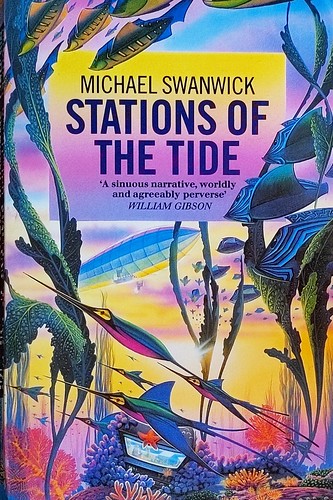
Book review: Stations of the Tide / Vacuum Flowers

PXL_20210213_085520169~2 By Michael Swanwick (who also wrote the promising but ultimately disappointing The Iron Dragon's Daughter, as well as the best forgotten Bones of the Earth).

As usual, there isn't much to be said without revealing the plot, so the key take-home messages are:

* both are excellent,
* I've read them before and I'll read them again,
* they've got new ideas and new thoughts in them.

They're both, rather vaguely, set in the same universe. But I can't really tell you more about that until I talk about the plot. So if you haven't already read them, I advise you to stop here and go read them.

The Plot


VF sets the scene for SOTT. But I read SOTT first. There's a scene - somewhat towards the end of SOTT, as the Bureaucrat starts to unravel the mystery - where he talks to Earth's Avatar in the Miranda system. Its a delight, and I found it powerful and memorable. But it won't make much sense unless you've read VF.

Umm, actually, I find that I don't really want to tell you the plot. What would be the point? If you've read it, you know it, and if you haven't, you don't, and a  potted summary really won't help you. Let talk, instead, about...

The Ideas


So, like I say, they're linked, but it only matters a bit. In the first book, Rebel Elizabeth Mudlark is questing the solar system trying to work out who she is, and ends up at Earth, talking to Earth aka the Comprise, which is now a hive mind (there's a slightly implausible explanation of why Earth is confined to the Earth, except for a few who those who live in space let out; given the tech Earth has, I think it would be trivial for it to sweep them away; but no matter, it suits the book. And there's a partial explanation of this anyway, which is that Earth needs Integrity).

So Earth has tech (transit rings, but not FTL), but the Dyson-tree folk of the Oort cloud have biotech, in particular mindtech, and Earth wants Integrity, which will allow it to glob off lumps of itself and send them starwards, and not have them fall apart into not-Earth2. And it turns out that a Wizard of the cloud has sent REM in, as a cross between a finger of herself and a sale item; and that although wetware reprogramming is commonplace, her personality is resilient, due to said Integrity.

In the end, a bargain is struck, and Earth gets Integrity in exchange for Tech; both sides get the stars, if I recall correctly. The armless child representing Earth is a nice touch; vulnerability.

1615457016143-abd6238e-d53b-4ead-8bb7-02c10b7ac023_

Cut, to


Back at Stations of the Tide, things move at a gentler pace. The first scene is set on an airship (how people love airships!) and the magician makes his mysterious appearance1 - and disappearance - and the theme of magic, or rather not really magic (I have to say that, rather than "of course", because this is scifi; but its scifi not fantasy: there is no "true magic") but the ability of people to convince others of magic. SOTT is a darker book than VF.

And here too the theme of integrity comes back, in the need to be grounded in reality, and the way people can be fooled into destroying themselves. How well would you survive under the onslaught of such magic? I'm not describing this well: really, read the book.

The ending is good - unlike so many other books, there really is an ending, with (many bonus points, since this is scifi) a gloriously humourous bit when then Bureaucrat finally tells his briefcase for the third time to construct some illegal tech.

And I haven't even told you about the trip to the edge to meet Earth. Its well done, and the bits that can be done are well sketched in without breaking the other bits. In this kind of stuff, that's a lot of the skill.

2021


I've re-read Vacuum Flowers and enjoyed it again. What jars a little perhaps - now the shock of the story has worn off - is the implausibility of the chain of events taking REM to Earth. And I notice the similarities in style to Neuromancer. But, still good. Still excellent? I'd certainly recommend it over an awful lot of other stuff.

And now SOTT. Again, good. But holes begin to open up: just why did Gregorian want to be chased? It isn't clear. There's a faint explanation at the end, but it was not terribly plausible and I instantly forgot it. There's also - I'm tempted to call it crude, but I've only just noticed it, so maybe it isn't - an unpleasant feature: the Bureaucrat is pushed around by all these worldly-wise magicians of the Tidewater, but has the last laugh: he not only has higher tech, he can actually do the things they merely pretend to. Isn't this a bit revenge-of-the-nerds type stuff? Trivia: the "tsunami" from melting ice caps would not of course be any such thing: it would be gradual. And I find the long-seasonal dimorphism implausible, just as it was in Helliconia: I doubt evolution can do that.

Notes


1. (Added 2021): in fact this isn't the magician. Also note that the magicians of SOTT are not the same sort of magicians as VF: they are manipulators of people's minds, somewhat in the manner of our stage magicians; not people skilled at manipulating actual reality.

2. Which when you think about it is very much the same "society shall not decay" that Plato wants and that Popper criticises him for.