Friday, 9 March 2018
Film review: Black Panther
In my defence, Miriam took us to it. As a film, it was fun. Read more about it at wiki. There's a kind of plot, there are action scenes, there are fight scenes, and there is some moralising. Though the moralisation is shallow: don't do bad things; and people with good lives should help people with bad lives if they can.

Wednesday, 7 March 2018
Fortune is bald behind
And so must be seized by the forelock. Which is to say... it is easy to see things in retrospect. A proverb I first met in the form in one of Patrick O'Brian's book; I think in the mouth of Captain Aubrey (no! It was the governor).
To my delight, I find it in Carmina Burana:
To my delight, I find it in Carmina Burana:
| Verum est, quod legitur, fronte capillata, sed plerumque sequitur Occasio calvata. |
It is written in truth, that she [Fortuna] has a fine head of hair, but, when it comes to seizing an opportunity she is bald. |
Sunday, 28 January 2018
Kingsfoil
I struggle to read books nowadays without finding things I want to look up online. Miram says that's a good thing. The latest is "Kingsfoil", which occurs at the start of A wizard of Earthsea:
I didn't notice it before. I don't find it noticed much on the web; there's a brief mention here for example.
She took him into her hut where she lived alone. She let no child enter there usually, and the children feared the place. It was low and dusky, windowless, fragrant with herbs that hung drying from the crosspole of the roof, mint and moly and thyme, yarrow and rushwash and paramal, kingsfoil, clovenfoot, tansy and bay. There his aunt sat crosslegged by the firepit, and looking sidelong at the boy through the tangles of her black hair she asked him what he had said to the goats, and if he knew what the rhyme was. When she found that he knew nothing, and yet had spellbound the goats to come to him and follow him, then she saw that he must have in him the makings of power.
I didn't notice it before. I don't find it noticed much on the web; there's a brief mention here for example.
On walking down New College lane
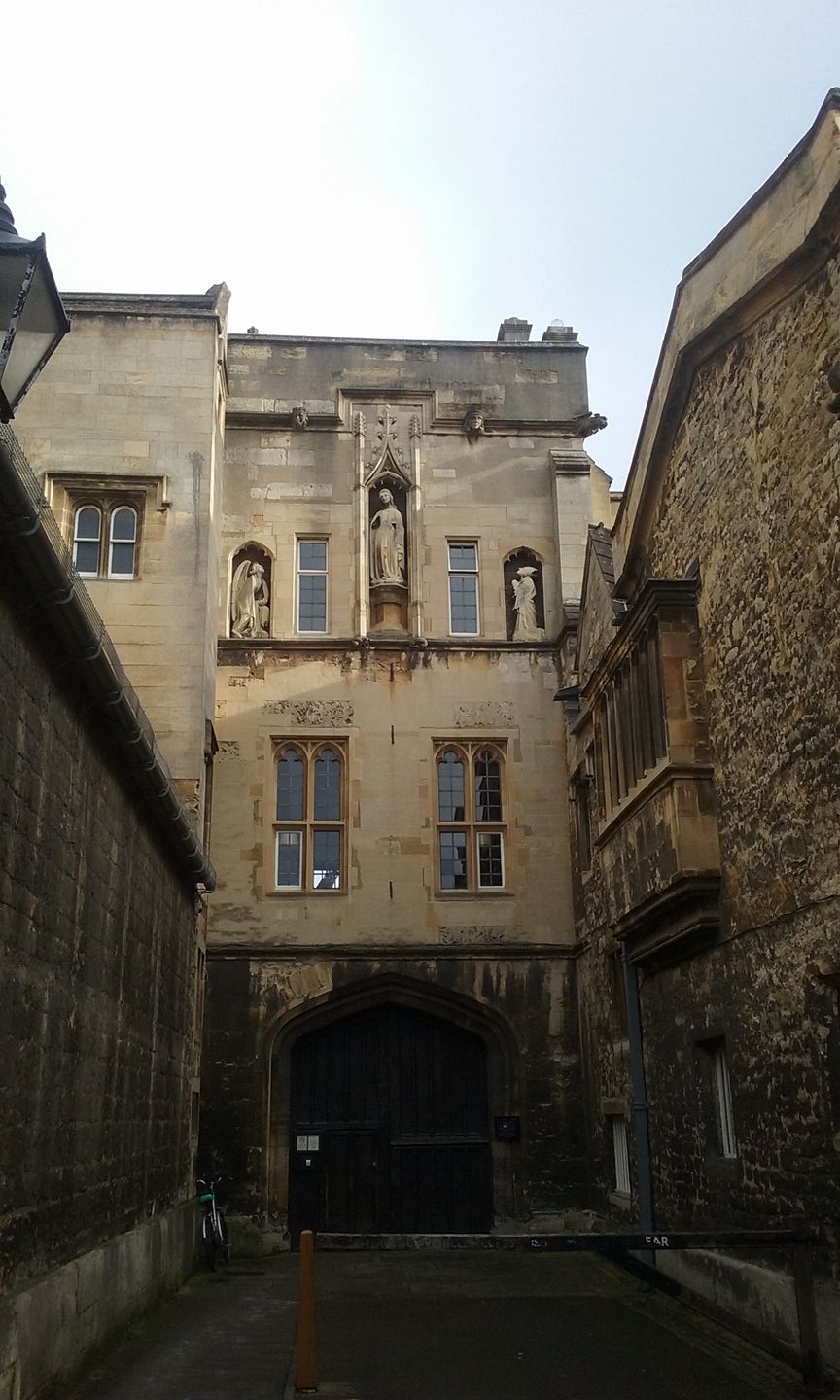 New College lane is about my favourite part of Oxford; the most Oxfordy bit of it. You can, if you squint, pretend that nothing has changed in hundreds of years - as long as you ignore the tarmac and the double yellow lines. But certainly little has changed in the thirty years since I left.
Today I was fortunate enough to have some warmth and some sunshine, and few people. The frontage here is just gorgeous. Astonishingly the wiki article doesn't even have a pic of it; barbarians. Take careful note of the priest praying on the right and the angel adoring on the left.
You might complain that this isn't the best of photos and you would be correct to note this but not to complain; this is the photo I took today and that is the important bit. What you can't see here is the light on the arches of the bridge just out of sight on the right, where the road turns. Every time I pass here I remember a May Day morning many years ago when I was stumbling along here and happened to pass as some bloke was playing a hand drum and perhaps singing - it is so long ago I cannot recall the details. For the moment and the place it was perfect.
We were in Oxford for the Bebras finals. Sadly E didn't win, but enjoyed it and got a creditable 155, we're not exactly sure out of how many. I bunked off most of the events, since I know what a cellular automaton is. So I spent much of the day sitting in Blackwells (reading Words of Radiance) with an afternoon walk around Christchurch meadow. But I did go to Hertford for lunch (nice Hall; E folded me a Dragon Curve) and the tour - nice college - and the prizegiving - nice chapel.
Friday, 12 January 2018
Book review: Artemis
By the author of The Martian but IMO inferior. Partly because it is so much of the same genre: engineering puzzles, but on a moon city. Yes, it has a spunky female heroine and so on, but that only gets you so far. See-also Goodreads.
So what's wrong, apart from the rather derivative must-write-a-second-book feel? The setup is rather more contrived. The entire politics and economics of the situation feel unnatural. There's a city on the moon, but it is the only one, and it is dying - effectively - because... the author can't be bothered to imagine why it might not be dying. People went to all the effort of building it and then... stopped. I think about half way through the book the author realises this, but can't work out how to escape. This is because engineering is his thing; the politics in the Martian didn't really work either, but were much smaller; here they can't help be a largeish part, and they don't work.
Also the setup. In the Martian, the central plot is natural; here it is forced. It all feels so trivial. The engineering behind the plot might work, but who cares?
Reverting to general patterns, another flaw is "why did this happen now?". What happens is that in the largely un-law-protected (but for mysterious reasons rather law-abiding) city of Artemis, gangsters start showing up and killing people and the authorities, such as they are, are powerless. There's a mega-rich guy at the start of the story, and weirdly he has but one - apparently unarmed - part-time bodyguard; he presumably relies on the safety of the city despite the total lack - as it emerges - of any mechanism for that protection. But if all of that were true, the gangsters would have shown up a year earlier. Or before then. And this then swings back to the-politics-is-not-well-thought-out. There are echoes of Heinlein's moon, but what could have been interesting in the hands of a "Plato" interested in constitution building just doesn't work here.
So what's wrong, apart from the rather derivative must-write-a-second-book feel? The setup is rather more contrived. The entire politics and economics of the situation feel unnatural. There's a city on the moon, but it is the only one, and it is dying - effectively - because... the author can't be bothered to imagine why it might not be dying. People went to all the effort of building it and then... stopped. I think about half way through the book the author realises this, but can't work out how to escape. This is because engineering is his thing; the politics in the Martian didn't really work either, but were much smaller; here they can't help be a largeish part, and they don't work.
Also the setup. In the Martian, the central plot is natural; here it is forced. It all feels so trivial. The engineering behind the plot might work, but who cares?
Reverting to general patterns, another flaw is "why did this happen now?". What happens is that in the largely un-law-protected (but for mysterious reasons rather law-abiding) city of Artemis, gangsters start showing up and killing people and the authorities, such as they are, are powerless. There's a mega-rich guy at the start of the story, and weirdly he has but one - apparently unarmed - part-time bodyguard; he presumably relies on the safety of the city despite the total lack - as it emerges - of any mechanism for that protection. But if all of that were true, the gangsters would have shown up a year earlier. Or before then. And this then swings back to the-politics-is-not-well-thought-out. There are echoes of Heinlein's moon, but what could have been interesting in the hands of a "Plato" interested in constitution building just doesn't work here.
Refs
Sunday, 31 December 2017
Theatre review: Warhorse
 Warhorse was a children's book but now it is a play. We went to see it as our first Christmas not-a-panto this year; and that made sense. TL;DR: good.
It is all rather well done. As everyone says, they horse puppets work well despite there being no attempt to hide the puppeteers; the bird puppets sort-of work too: well, the little flying-joyously ones do, and maybe the crows. I'm less sure about the comedy goose. Another bit that works well is the shooting, which is sudden and startling, rather than slow. The tank towards the end is odd; that didn't seem to make sense at the time. Looking now at the wiki page about the book, I think that's how Joey gets stuck on the wire, but that wasn't really clear in the play.
The only bit that sticks out as implausible - other than the inevitable co-incidences, which aren't too blatant - is Friedrich the German artillery officer practically doing a "lumberjack" and saying "I didn't want to be a soldier".
But what do we make of it on the moral or intellectual plane? It ticks all the obvious boxes: war is bad, hard work and perseverance is good, drunkenness is bad (errm, even if it has good consequences, never mind that), and so on. But we knew all that anyway, so that doesn't get you much. Does it provide any kind of insight? Does telling WWI from the viewpoint of a horse bring anything fresh and new? No.
Thursday, 12 October 2017
Book review: The Martian
The Martian (Goodreads) was recommended by D, and I enjoyed it. It is sci-fi but "hard"; the plot is closely based around near-term plans for how early exploration off Mars might happen. The genre is "engineering"; essentially the lone protagonist faces a series of challenges and overcomes them not by heroism or exceptional intelligence but by being resourceful, thinking things through and ingenuity.
[This review written in early 2018 after I'd read the inferior Artemis as well, but backdated to mid-October which is about when I read TM.]
Plot (but you can get this from the wiki page or elsewhere): a dust storm means the explorers need to leave early but by accident one bloke is left behind, presumed dead. Can a rescue rocket get to him in time, and will it come to him or will he need to trog across half of Mars to get to it?
Most of all of this is well done and convincing. Details are plausible, so I'll point up a few that aren't. The sudden-evacuation-in-storm isn't quite; I can't think they would be so poorly prepared. The politics back on Earth is naive. The not-tell-the-departed-crew bit isn't believeable. Turning over the rover towards the end felt a bit too much like let's-throw-another-obstacle-at-him. But that contrasts with the rest, where the obstacles arise naturally and do not feel contrived, and the story mostly flows well.
[This review written in early 2018 after I'd read the inferior Artemis as well, but backdated to mid-October which is about when I read TM.]
Plot (but you can get this from the wiki page or elsewhere): a dust storm means the explorers need to leave early but by accident one bloke is left behind, presumed dead. Can a rescue rocket get to him in time, and will it come to him or will he need to trog across half of Mars to get to it?
Most of all of this is well done and convincing. Details are plausible, so I'll point up a few that aren't. The sudden-evacuation-in-storm isn't quite; I can't think they would be so poorly prepared. The politics back on Earth is naive. The not-tell-the-departed-crew bit isn't believeable. Turning over the rover towards the end felt a bit too much like let's-throw-another-obstacle-at-him. But that contrasts with the rest, where the obstacles arise naturally and do not feel contrived, and the story mostly flows well.
Subscribe to:
Posts (Atom)