All Hell Let Loose is a history of WWII, by Max Hastings. One of the children had it; I read it; it wouldn't normally be my reading material. It is a thick book, with some illustrations. I thought it good.
Spoiler alert: the Germans lose.
The main advantage of the book is it's sweep: it covers the entire war, in very rough proportion to the amount of death and fighting, and so covers the Eastern Front far more than the traditional English schoolboy education, that I received, ever did. It also, somewhat refreshingly, largely covers the actual fighting, rather than politics, or causes, or economics. It doesn't entirely ignore economics, of course - pointing out, for example, that pure weight of US industrial capacity doomed Japan from the start (so why did they fight at all? Because they were stupid enough to deceive themselves: they thought they could expand, and then offer peace, which the US would accept though being soft and reluctant to accept casualties).
Other "nice" things it mentions - again, an example from Japan-US - is that some of the land campaigns were strategically pointless. Not all; some tiny rocks captured for airstrips were valuable. But once the US had wound itself up, its submarines and surface Navy had largely suppressed the Imperial Navy, and so large garrisons of Japanese troops on... the ?Philippines? - I recall the concept, of course, not the actual examples - were no harm to anyone. They could have been bypassed and dealt with after the war was finished. But all the obvious things - commanders who wanted to fight, an army that had been created and therefore had to be used, lack of will in the overall command - meant that a whole pile of mainly US troops would die pointlessly killing lots of Japanese troops.
Slightly to my disappointment he doesn't cover "what if"s much. The most obvious large-scale "what if" is perhaps what if the Germans had put up lesser, or even token resistance on the Western front and diverted resources to the Eastern (of which the "battle of the Bulge" would be only a part). Then the Western allies would have reached Berlin and parts East first, perhaps even in 1944, leading to much less misery for Germany but perhaps also a much altered post-war balance, since the Commies would have got to conquer much less of Eastern Europe. The answer to this is perhaps that Hitler was mad enough to think he was going to win - or felt obliged to claim this in public - and so couldn't adopt this as a policy; that would only have been possible if he'd been deposed by the generals, but in that case they'd probably just have surrendered, so we rapidly go off into "actually, it couldn't have been like that".
There are hints of other "what if"s: he suggests that the Africa campaigns were but a side-show and largely pointless; but also that better strategy from the Krauts might have cleared the British out of the Med entirely, in which case Egypt and so on might have gone rather differently.
Philip Hensher writes a review that promotes the "individual voices" in the book. And, true, Hastings does quote quite a few people, officers, men, and civilians. But I wouldn't count that as a major part of the book.
Another good bit of myth-busting (again, to this English ex-schoolboy) is how poorly our armies performed in the colonies in the Far East against Japan. There's a certain myth that though there were a fair number of blimps in charge the actual fighting men were good; but this doesn't really seem to have been true. Few of the British soldiers particularly believed in what they were doing, and so weren't good at it.
And, so it goes. Overall, he does a good jobs of grinding in the terrible destruction wreaked on hapless populations by the fighting going on over their heads, largely in the Eastern Front. And all so totally pointless.
Sunday, 15 January 2017

Saturday, 7 January 2017
Christmas 2016
A follow up to the immensely successful Christmas 2015. What changed?
Daniel didn't break up from school ages before Christmas, since he is now at university. Instead, he came down ages before Christmas. We didn't work Christmas Eve, instead travelling to Marcham for a meal out with Si+B on the 23rd, who were off to Hayling Island for Christmas. We stayed in Marcham that night, and to Milton-u-W on the 24th after brunch, in time for afternoon coffee and a read of the paper before carols around the village tree.
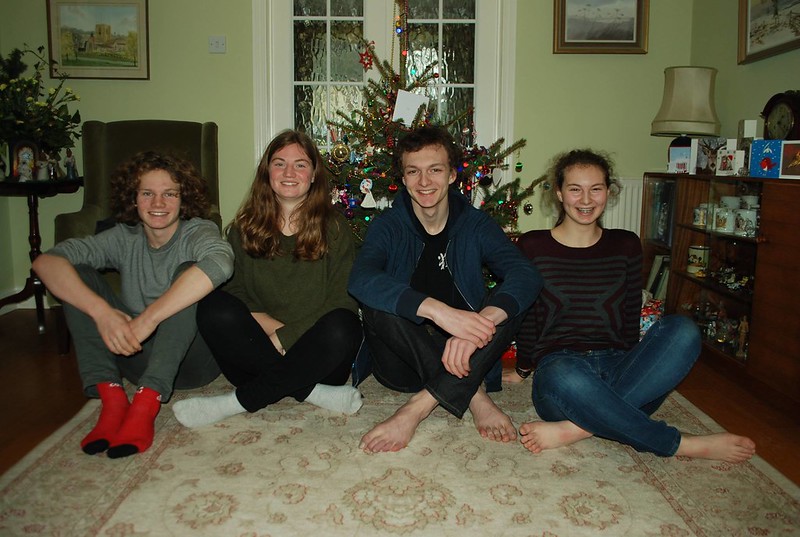
This year I managed a half marathon on Christmas morning, somewhat slow at 1:48. We didn't finish the washing up before the Queen's speech. Otherwise, reassuringly like last year. E now has braces; L too is at university, Leeds.
Which I see I didn't finish, another fine tradition. After boxing day comes the Trip To The Panto, this year Jack and the Beanstalk at Cheltenham, followed by Bella Italia (why C, not Oxford? I'm not sure; it used to be O, before 2015). We will probably think of something else, next year, the children are rather old for panto nowadays. BI is felt to be better than Jamie's Italian. The next day was a rest day and little was done - a lunchtime walk to the pub (the Lamb) for some.
Then the xfer to Marcham, which is rather less traditionally Christmassy, as is traditional. The meal at SoJo was on New Year's eve, after which E and I walked along the canal to Christ Church meadow and around. It was a grey day be we had a pleasant walk and chat, and (since she ponders the possibility of going to Oxford) she got to see some of it with new eyes. Then a sit in Blackwells cafe, and home.
When back home (having stayed an extra day, so that E could watch the Sherlock on New Year's Day) we were sad to find Little Cat not there; nor did she return next day. This, too, is in some danger of being traditional, as it happened once before. But a day or two later M was phoned up; P had been found, phew.
Daniel didn't break up from school ages before Christmas, since he is now at university. Instead, he came down ages before Christmas. We didn't work Christmas Eve, instead travelling to Marcham for a meal out with Si+B on the 23rd, who were off to Hayling Island for Christmas. We stayed in Marcham that night, and to Milton-u-W on the 24th after brunch, in time for afternoon coffee and a read of the paper before carols around the village tree.
This year I managed a half marathon on Christmas morning, somewhat slow at 1:48. We didn't finish the washing up before the Queen's speech. Otherwise, reassuringly like last year. E now has braces; L too is at university, Leeds.
Which I see I didn't finish, another fine tradition. After boxing day comes the Trip To The Panto, this year Jack and the Beanstalk at Cheltenham, followed by Bella Italia (why C, not Oxford? I'm not sure; it used to be O, before 2015). We will probably think of something else, next year, the children are rather old for panto nowadays. BI is felt to be better than Jamie's Italian. The next day was a rest day and little was done - a lunchtime walk to the pub (the Lamb) for some.
Then the xfer to Marcham, which is rather less traditionally Christmassy, as is traditional. The meal at SoJo was on New Year's eve, after which E and I walked along the canal to Christ Church meadow and around. It was a grey day be we had a pleasant walk and chat, and (since she ponders the possibility of going to Oxford) she got to see some of it with new eyes. Then a sit in Blackwells cafe, and home.
When back home (having stayed an extra day, so that E could watch the Sherlock on New Year's Day) we were sad to find Little Cat not there; nor did she return next day. This, too, is in some danger of being traditional, as it happened once before. But a day or two later M was phoned up; P had been found, phew.
Wednesday, 4 January 2017
When we were very young
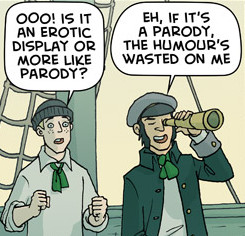 Looking for something else (I'll tell you later) I found GeoCities and diaries on the early web (James Baker, ‘GeoCities and diaries on the early web (preprint, 2016)’, in Batsheva Ben-Amos and Dan Ben-Amos (eds.) The Diary (Indiana: Indiana University Press, 2017)).
More that two years ago (my how time flies) I wrote The dim and distant history of climate blogging, but that was about blogging. Since it was irrelevant - and I thought probably lost - I ignored my even more pre history, which was a - gasp - Geocities website.
Aanyway, a wayback machine archive of that early site is here and to make assurance doubly sure there's an archive of that here (which will probably load faster). The photo (if you're wondering) is taken from a scan of my work pass. The picture of Miriam is on the other side of the Cherwell high footbridge in the University Parks.
The picture (don't click on it of you are of a delicate disposition) is re-used as traditional from the "dim and distant" post.
Sunday, 1 January 2017
Blood pressure, 2017
A follow-up to the exciting "blood pressure" of 2016, and precursor to 2018. Summary: generally just on the safe side of 120 / 80.
2017 / 01 / 01: just before...
* 125 / 85 (63)
* 109 / 74 (63)
* 114 / 72 (61)
...and just after a 10 k run. Readings taken about as fast as the machine would; perhaps at one minute intervals.
* 151 / 88 (101)
* 126 / 81 (98)
* 114 / 83 (94)
* 118 / 83 (88)
* 116 / 80 (87)
2017 / 10 / 29:
* 120 / 79
* 149 / 89; 105 (just after 12k)
* 110 / 75; 55
* 113 / 74; 66 (next morning)
2017 / 01 / 01: just before...
* 125 / 85 (63)
* 109 / 74 (63)
* 114 / 72 (61)
...and just after a 10 k run. Readings taken about as fast as the machine would; perhaps at one minute intervals.
* 151 / 88 (101)
* 126 / 81 (98)
* 114 / 83 (94)
* 118 / 83 (88)
* 116 / 80 (87)
2017 / 10 / 29:
* 120 / 79
* 149 / 89; 105 (just after 12k)
* 110 / 75; 55
* 113 / 74; 66 (next morning)
Friday, 23 December 2016
Book review: An Inspector Calls
Technically a play not a book, but I read Miranda's copy. We will be going to see the play, too, so you may get a "play review" next year.
An Inspector Calls by J. B. Priestley is, as wiki says, 'classic "drawing room" theatre'. It works very well; well written, neatly handled, and there is one (or perhaps two) clever and one not so clever twists at the end. However there are flaws: the final ending is not needed and is one twist too many, and probably blurs the message; the inspector's final speech reads like something out of Ayn Rand (though mercifully much shorter) and is far too unsubtle; and the whole thing is, in a way, too well turned.
Let me do that last criticism first. The play is very "neat": everything fits carefully together, all the threads fit, everyone reacts as they have to. This helps keep things moving along and helps keep you reading, but begins to feel by the end a little too pat, a little too careful (yes I know my criticism of the final twist somewhat vitiates this point, but never mind, I shall leave you with it anyway).
The inspector's final speech is a rousing cry to, well, whatever; I didn't actually read it; or if I did, I immeadiately forgot it. I've read such things before. For an actual real inspector, it would have been totally out of character, and I think you'd have expected Mr Birling to notice and complain of this. But more importantly, it is entirely unnecessary to anyone who has been paying any attention to the play. The play has carefully brought out the various aspects of the way in which the family's behaviour has lead to the death of the young woman - or, when you realise she may have been a composite, the various aspects in which they have degraded the lives of various women. That's a good way to do it, because in a sense the audience "discover" this for themselves, and will be inclined to accept the ideas. But when the inspector jumps up and tries to ram the same thoughts down your throat, you rebel. Or at least, I did.
The revelation that the young woman is - probably - a composite is clever, and well done. Probably the best bit of the play. Suddenly, a number of things we saw before - principally, the inspector only showing a photo to one person at a time - all make sense. Also, excellently, we see the way different people react to it: most obviously, the two children retain their - deserved, admitted - guilt; whilst the parents discard it, concerned only for outside appearances. And Gerald is perhaps ambiguously in between.
A tension that I think could have been explored, but wasn't: what will the two children do? The implication, by the end, is that disgusted by their parents they will leave home, and live on... what? How will they balance their conscience against comfort and financial security? Another unexplored aspect was the relation between Gerald and Sheila. The implication is that their nice, comfortable but rather shallow "love" has been disrupted by events, but perhaps they have come to see each other more deeply; Sheila's brief note that they'll need to start from the beginning again is quite touching. Perhaps that's all that is needed.
I expected more about knighthood. At the start the scene is carefully set: Arthur is prosperous but second-rank, and the marriage and knighthood would pull him up. As the play went on he should have become more and more desperate to avoid any of this becoming public (he is concerned to some extent, but not nearly as much as he should be). Perhaps that wasn't necessary; the play is about something a little deeper than social class.
Lastly, the final twist - that someone really has died - rather jars. It seems pointless and disruptive. "What does that mean?" we inevitably ask, and inevitably there is no answer. Does it mean that the carefully constructed twist about the composite Eva is wrong? That would be most unsatisfying. Does it mean that instead of having to consider their morality, we're back to a rather more straightforward tale of worrying about nasty details becoming public? That, too, would be unsatisfying. Again, it seems so unsubtle; as though some theatre manager, unsatisfied with the play's existing subtle and ambiguous ending, wanted some zing at the end. Before that last twist, the "inspector" has come to seem like something supernatural, a kind of angel, who has brought harsh truth into these people's lives, and given them the chance to react and show their characters. That was all that was needed.
An Inspector Calls by J. B. Priestley is, as wiki says, 'classic "drawing room" theatre'. It works very well; well written, neatly handled, and there is one (or perhaps two) clever and one not so clever twists at the end. However there are flaws: the final ending is not needed and is one twist too many, and probably blurs the message; the inspector's final speech reads like something out of Ayn Rand (though mercifully much shorter) and is far too unsubtle; and the whole thing is, in a way, too well turned.
Let me do that last criticism first. The play is very "neat": everything fits carefully together, all the threads fit, everyone reacts as they have to. This helps keep things moving along and helps keep you reading, but begins to feel by the end a little too pat, a little too careful (yes I know my criticism of the final twist somewhat vitiates this point, but never mind, I shall leave you with it anyway).
The inspector's final speech is a rousing cry to, well, whatever; I didn't actually read it; or if I did, I immeadiately forgot it. I've read such things before. For an actual real inspector, it would have been totally out of character, and I think you'd have expected Mr Birling to notice and complain of this. But more importantly, it is entirely unnecessary to anyone who has been paying any attention to the play. The play has carefully brought out the various aspects of the way in which the family's behaviour has lead to the death of the young woman - or, when you realise she may have been a composite, the various aspects in which they have degraded the lives of various women. That's a good way to do it, because in a sense the audience "discover" this for themselves, and will be inclined to accept the ideas. But when the inspector jumps up and tries to ram the same thoughts down your throat, you rebel. Or at least, I did.
The revelation that the young woman is - probably - a composite is clever, and well done. Probably the best bit of the play. Suddenly, a number of things we saw before - principally, the inspector only showing a photo to one person at a time - all make sense. Also, excellently, we see the way different people react to it: most obviously, the two children retain their - deserved, admitted - guilt; whilst the parents discard it, concerned only for outside appearances. And Gerald is perhaps ambiguously in between.
A tension that I think could have been explored, but wasn't: what will the two children do? The implication, by the end, is that disgusted by their parents they will leave home, and live on... what? How will they balance their conscience against comfort and financial security? Another unexplored aspect was the relation between Gerald and Sheila. The implication is that their nice, comfortable but rather shallow "love" has been disrupted by events, but perhaps they have come to see each other more deeply; Sheila's brief note that they'll need to start from the beginning again is quite touching. Perhaps that's all that is needed.
I expected more about knighthood. At the start the scene is carefully set: Arthur is prosperous but second-rank, and the marriage and knighthood would pull him up. As the play went on he should have become more and more desperate to avoid any of this becoming public (he is concerned to some extent, but not nearly as much as he should be). Perhaps that wasn't necessary; the play is about something a little deeper than social class.
Lastly, the final twist - that someone really has died - rather jars. It seems pointless and disruptive. "What does that mean?" we inevitably ask, and inevitably there is no answer. Does it mean that the carefully constructed twist about the composite Eva is wrong? That would be most unsatisfying. Does it mean that instead of having to consider their morality, we're back to a rather more straightforward tale of worrying about nasty details becoming public? That, too, would be unsatisfying. Again, it seems so unsubtle; as though some theatre manager, unsatisfied with the play's existing subtle and ambiguous ending, wanted some zing at the end. Before that last twist, the "inspector" has come to seem like something supernatural, a kind of angel, who has brought harsh truth into these people's lives, and given them the chance to react and show their characters. That was all that was needed.
Saturday, 26 November 2016
A visit to Micky
We went to visit Micky today, as we do rather less frequently than we probably ought. She had just come out of a spell in hospital with a chest infection, that should have been one week but turned into two due to complications of getting an extra NHS-type carer for her, to visit sometimes. Luckily for us M+J handle most of this stuff, and indeed they had been to visit yesterday.
We found her ostensibly fairly well, except for a rather nasty-sounding cough that was presumably a hangover of her chest infection. We had the usual format of visit: come in, talk for a bit; have lunch; play a round of scrabble until Micky grows tired and/or sleepy; and go.
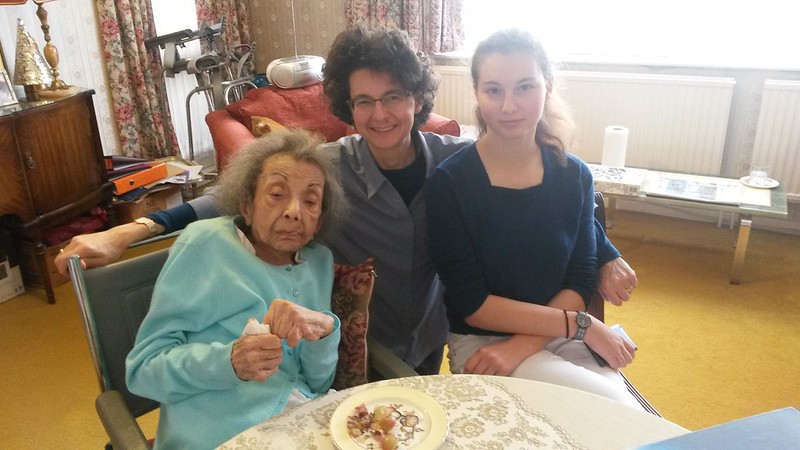
Here's a photo from just after lunch, with the afternoon light streaming in from the window. Later, Miranda and I sat looking out at the Jewish folk going about their Sabbath business, comparing hat types. I was amused to see that from above the shtreimel is hollow inside.
Alas, Micky was only superficially well. Her hearing appeared weaker, it was hard to hear what she said, and... Well: we tried a game of Scrabble but never really got started. Later, Miriam tried her on just the basics: recognising letters. Micky could do some, but not all. We tried a jigsaw - one made with Escher pieces, perhaps not the wisest of choicest no matter how interesting the shapes might be. But, she would pick up the pieces and not seem to distinguish front from back. In conversation, more than ever before, she would apparently lose the thread and start random new topics.
We found her ostensibly fairly well, except for a rather nasty-sounding cough that was presumably a hangover of her chest infection. We had the usual format of visit: come in, talk for a bit; have lunch; play a round of scrabble until Micky grows tired and/or sleepy; and go.
Here's a photo from just after lunch, with the afternoon light streaming in from the window. Later, Miranda and I sat looking out at the Jewish folk going about their Sabbath business, comparing hat types. I was amused to see that from above the shtreimel is hollow inside.
Alas, Micky was only superficially well. Her hearing appeared weaker, it was hard to hear what she said, and... Well: we tried a game of Scrabble but never really got started. Later, Miriam tried her on just the basics: recognising letters. Micky could do some, but not all. We tried a jigsaw - one made with Escher pieces, perhaps not the wisest of choicest no matter how interesting the shapes might be. But, she would pick up the pieces and not seem to distinguish front from back. In conversation, more than ever before, she would apparently lose the thread and start random new topics.
Disabling the stupid EU cookies notice
I discover that you can turn off that stupid irritating waste of everyone's time EU-inspired cookies notification in blogger. Instructions are here but were non-trivial for me to follow, and I'm supposed to know this kind of stuff. So to be more explicit...
Actually, just look at the picture. You need to add the line
<script>cookieChoices = {};</script>
About where I've shown it.

Actually, just look at the picture. You need to add the line
<script>cookieChoices = {};</script>
About where I've shown it.
Subscribe to:
Posts (Atom)