Monday, 1 September 2014

Stubai: Monday 1st September: Lauterer See and Bremer to Nurnberger

Yesterday: Habicht and Innsbrucker to Bremer
Tomorrow: rest day.

Overnight I'm in dorm #8 with some mixed US / UK types; its about a 5-person room. Sleep well. Awake about 7 to cries of "Its snowed!" Whilst I can admire their youthful enthusiasm I cannot share it; instead I quietly groan "Oh, great" to myself and sleep in for a bit. That, and the total cloud, precludes anything exciting for the day. I'd half-planned the xfer to the Nurnberger via the Aperer Feuerstein but I think that needs to be revised now (but see Saturday the 6th).

Last night I'd talked to some English-type folks who had done the "klettersteig" from the lake and they said it was easy. So I rather regretted not taking it, and wanted to go have a look so I'd know for the future; a perfect project for a cloudy morning. After a leisurely breakfast I toddled over; its 1 km and takes about half an hour or so each way. GPS track.

Here's a view from the lake back towards the hutte (notice how I'm inconsistent there? I use "hutte", but "lake" instead of "lac" or "see". Well, never mind):
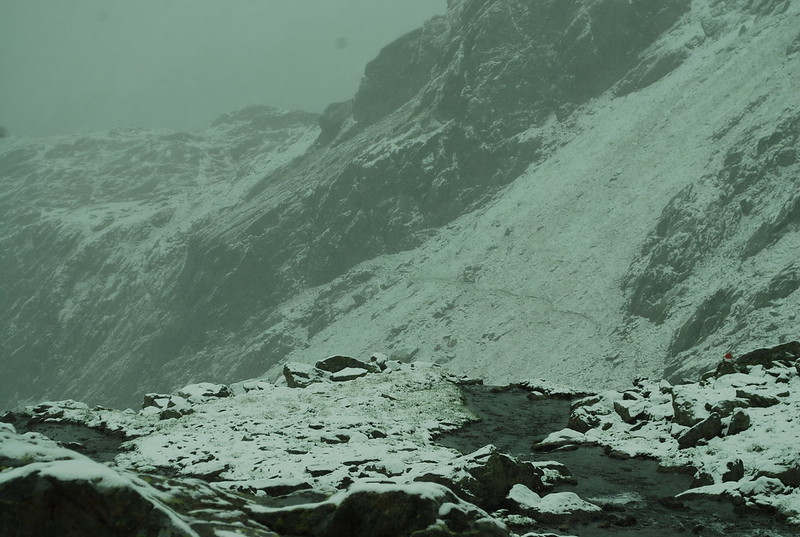
  DSC_4168

You see the path wending across the slope and heading towards what looks like a rather unpleasant rock band. But in fact its fine; that's where the "klettersteig" is, of course.

Also, since I'm being self-indulgent, here's towards the lake:
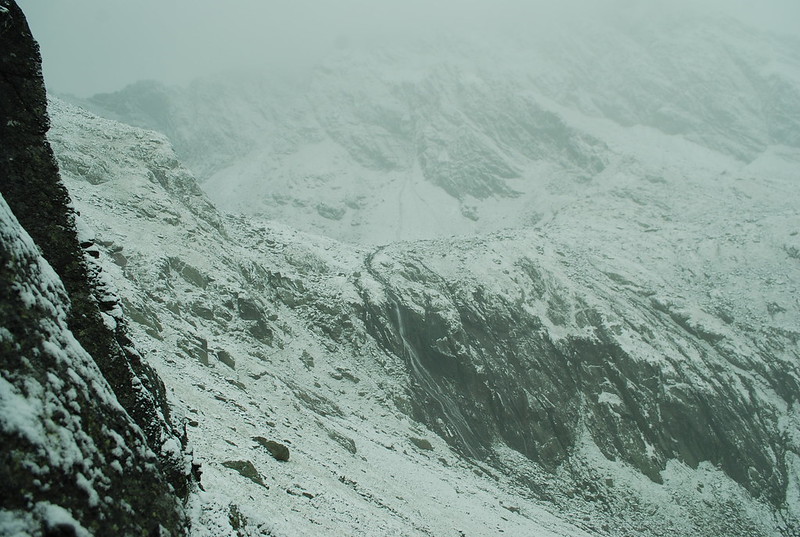
  DSC_4155

As I'm sure you've noticed it was a fairly grey day. Here's my best shot at making the "difficult chimney" look as exciting as possible:
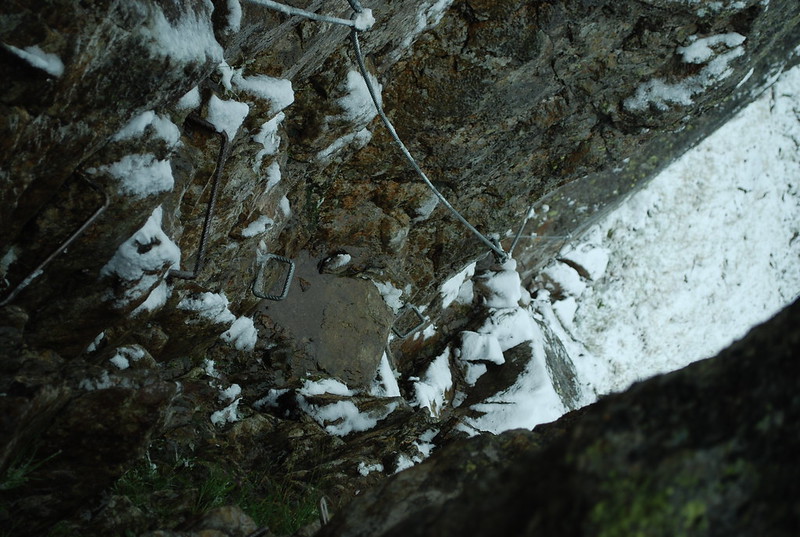
DSC_4175

Since it really was a fairly narrow chimney its quite hard to photograph; here is a view looking up, from the start. As you can see, there's piles of ironmongery and you can see that with even more snow, it might be hard to climb or descend.

In fact, that's not the only tricky bit, there's also the "difficult slab". As you see from the below, its not all that difficult, or rather it wouldn't be in good conditions. But in the wet its smooth and slippy, and with a bit more snow (and last year there was lots and lots more snow) you'd have trouble finding the cables. And about 5-10 m to the right is a sharp drop-off, as show in the very top pic.
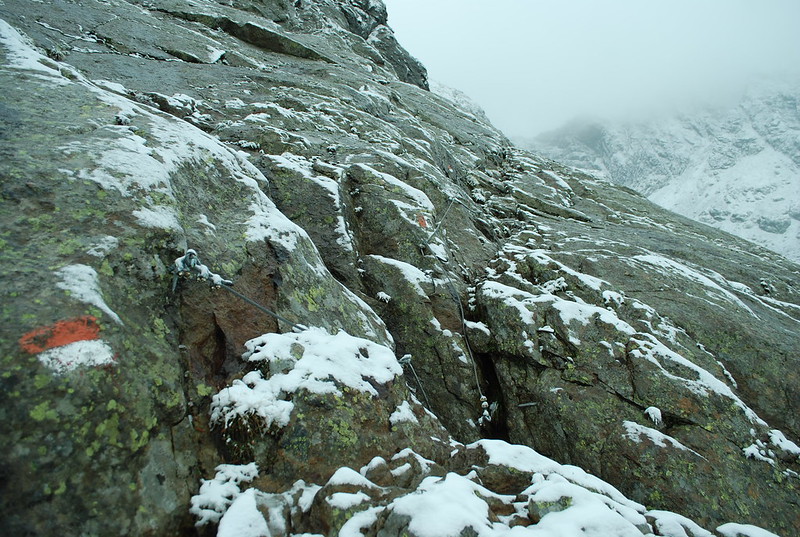
DSC_4176

By 10:40 I'm back in the hutte, and I'm the only guest; everyone else has gone down (various people at breakfast had been talking about going over to the Nurnberger, which was what they actually wanted to do, but one by one they'd talked themselves out of it). The Guardienne looks rather dubious when I tell her I'm going across. I promise myself that I'll turn back if it looks iffy. But, not to build the tension too much, it all turns out to be fine. Before I leave, here's the Bremer in the snow:
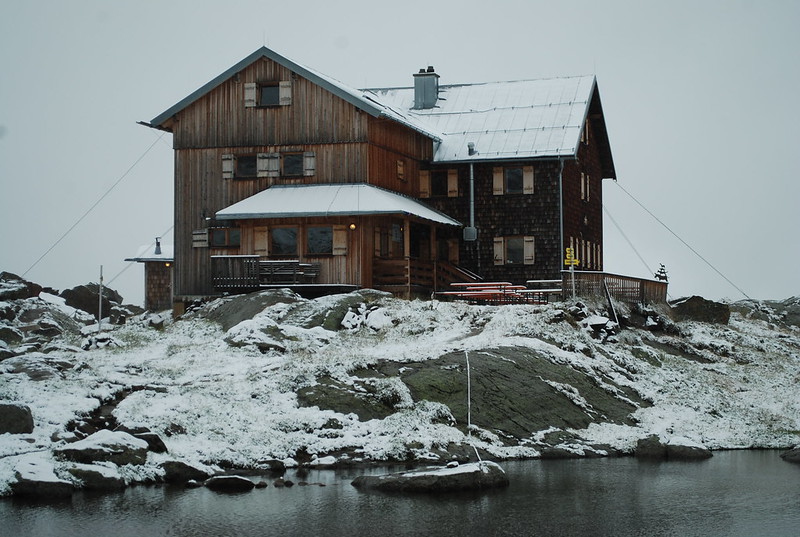
DSC_4178

And for those interested in ecology-in-action-in-the-mountains, here's a pic of the water waste processing reed beds at the hutte. Last year, while we'd been there, we'd watched with great interest while workmen drilled and then dynamited out some rock near the hutte, in preparation for this. Clearly the reeds haven't had time to grow properly yet.
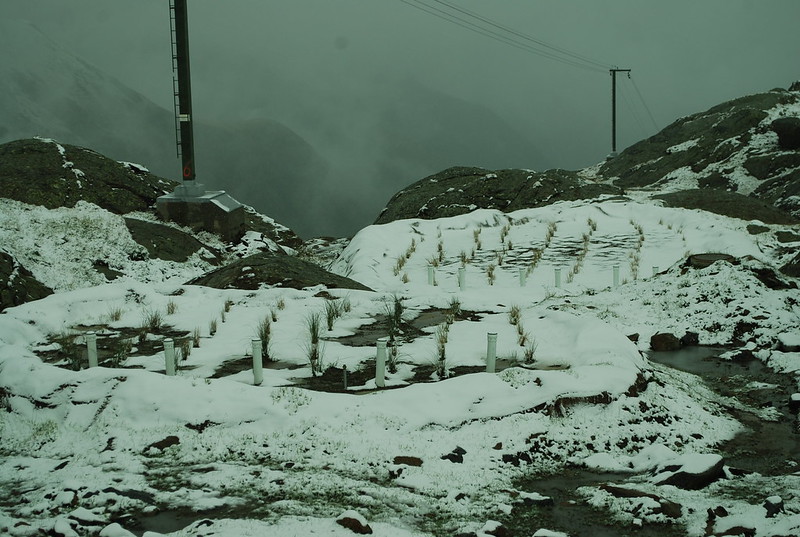
DSC_4183

The crossing to the Nurnberger is 6.4 km, took me 3:55, 500 m up and 600 m down, and I start just before 12. 2 hours to the Joch at 2754. GPS track. Going up to the pass I met a man coming down, and felt faintly disappointed not to be pioneering on the day. But having a fair guarantee that it was passable, and tracks in the snow, was helpful. On the other side I met a few others. Here's me at the Zollhutte at the pass:
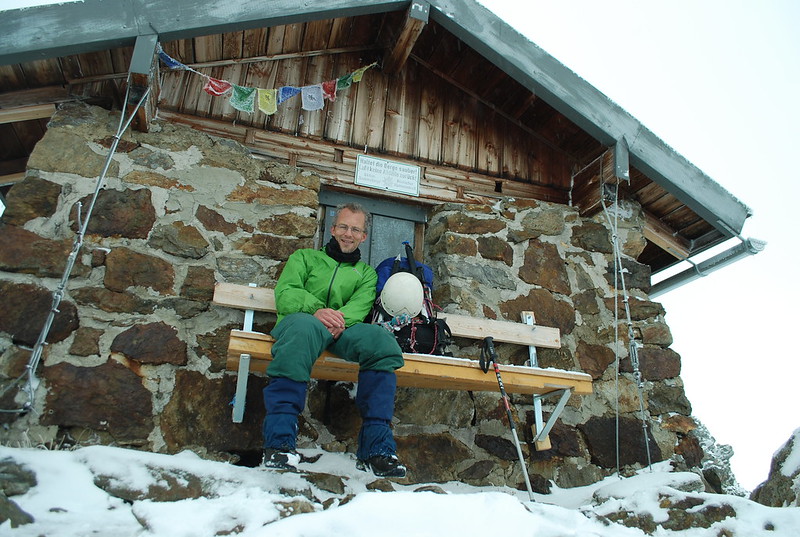
DSC_4188

Climbing up to the Joch was hot work, so I'm sitting around up there until I got chilly again. After that its down the rocks and the short-cut snow slope quite rapidly to the "Paradise" (view down from the col; view back up towards the col. Perhaps slightly more usefully, view from Nurnberger taken on the 3rd when the cloud was clear; you can just see the Zollhutte on the ridge line). The Paradies is lovely even in the snow, the sinuous line of the river is alluring:
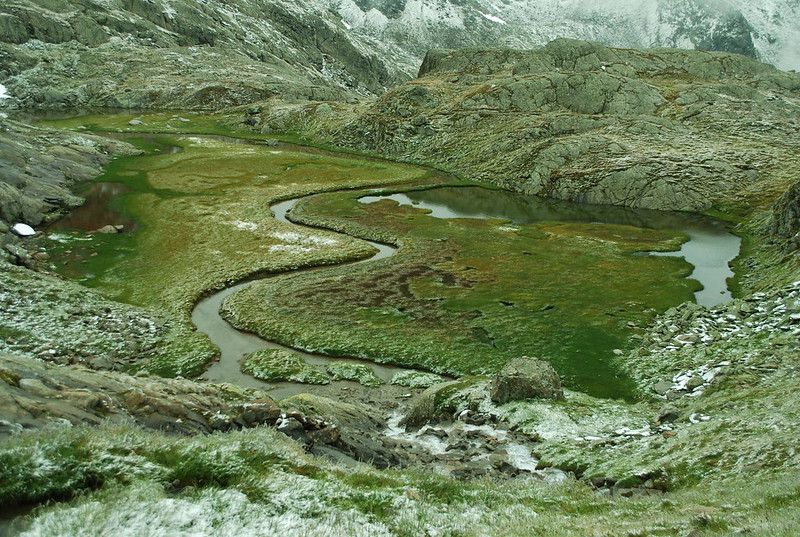
DSC_4196

Snow effects on the plants were fun:

DSC_4208

But it was nice to get to the Nurnberger:
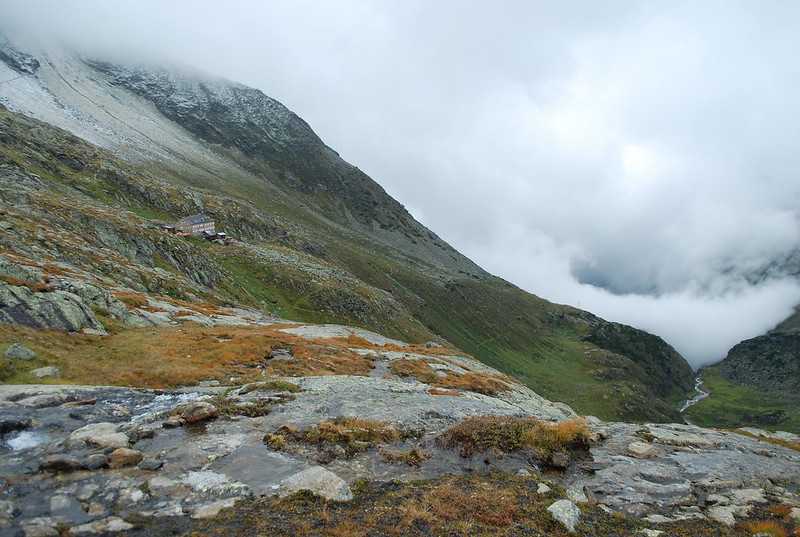
DSC_4210

Sunday, 31 August 2014

Stubai: Sunday 31st August: Habicht and Innsbrucker to Bremer

Yesterday: Arrival: Saturday 30th August
Tomorrow: Lauterer See and Bremer to Nurnberger

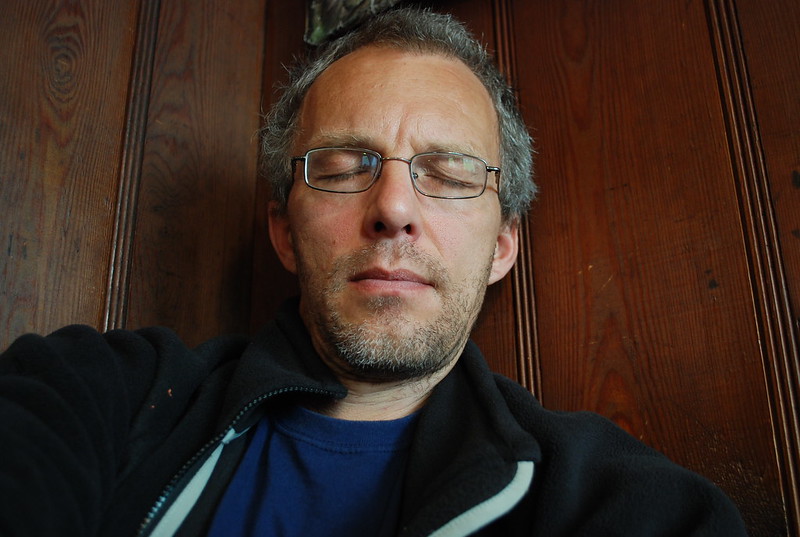
I covered the Habicht on the real blog, so I won't re-do that here. Having returned to the Innsbrucker I was moderately tired:
  DSC_4147

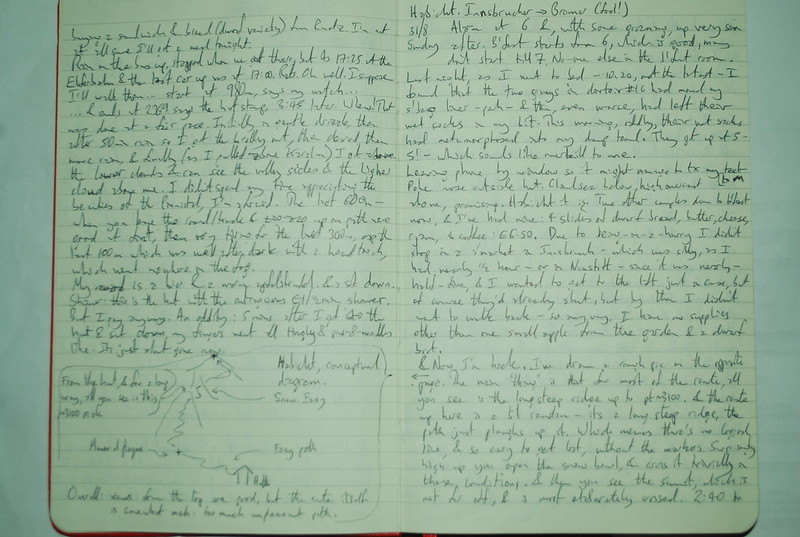
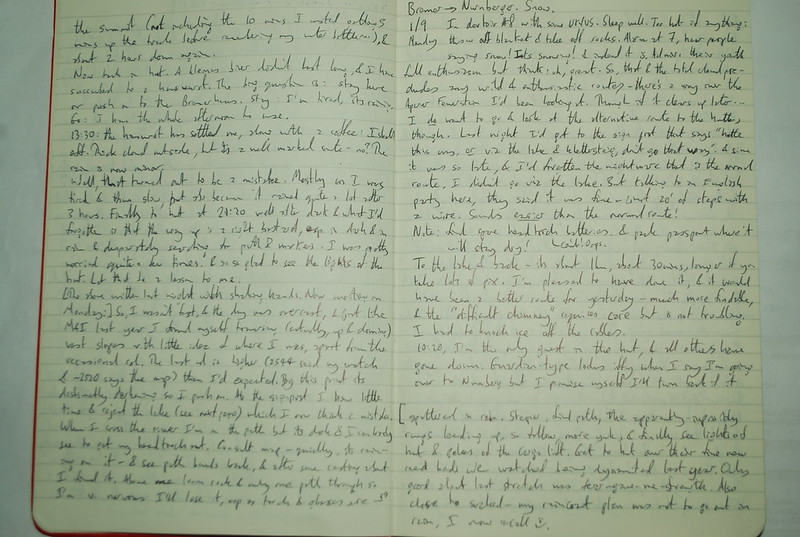
Although that photo is just a touch posed: its how I felt, certainly, but I'm actually awake enough to be holding the camera and pressing the button and carefully arranging the picture. Here are the diary entries:

DSC_4894

and
  DSC_4896

There aren't any pics of the hut xfer, because it was like this:
   DSC_4150

Perhaps not the entire way, but for quite a lot of it. By 13:30 I'd had a kleines bier, followed by a hauswurst and a kaffee, the rain had eased to "gentle", and I'd decided that I'd go for it. The book time is 6-7 hours, obviously I could do better than that, and I hadn't really got it into my head yet that its September not July, the sun does set by 8 and its pretty well dark by 8:30. It had happened yesterday, of course, but somehow I pushed that away.

Anyway: no, I couldn't do it in less than book time. In the end, what with wandering lost in the dark, being tired from the morning's Habicht, and carrying a heavier-than-I-really-ought-to-have sac, it took me 7:20. Sometimes it didn't rain. Here's the GPS track for the bit before it ran out of battery. The GPS track runs out at "the signpost" where you get a choice of the "normal" path to the hut (which descends about 200 m, crosses the river, and then climbs again; see the start of the GPS trace from 2013 for details) and the "klettersteig" route (which traverses to the Lautersee, then traverses to the hutte, but after the See there's a "klettersteig" section. Now I hadn't given much thought to this - Miriam and I, coming the other way, hadn't done the klettersteig last year because it was too snowy, so I didn't know what it was like - but at 19;45 in the gathering dark I decided to be "good", heed the warnings - "nur fur " - and choose the "safe-n-sure-if-longer" normal route.

This was a mistake, for two reasons: firstly and known only in retrospect, the klettersteig is easy. Secondly and really-I-ought-to-have-remembered-in-advance the "normal" route isn't easy - its not at all like the valley path up to the Innsbrucker, it wends its way up through a rock band and is quite hard to find - even with frequent paint-markings - in the dark, by the light of a head torch, with rain spattering my glasses.

At the river I lost the path for a bit - this is easy to do, because you have to rock-hop over a wideish river. In the daylight, this would have been no problem. After casting around for 10 mins and refinding the path I found myself threading up through steepening slopes, sometimes rungs let into the rock (at least I knew I was on track) and seriously wondering if I would have to bivvy for the night. Which wouldn't have been fun as by next morning, there was snow. Happily, fear gave me strength and the bit I was somewhat dreading - regaining the 200 m I'd lost in descent to the river - was no problem at all. In the end, I saw the distant lights of the hutte outlining the cargo-lift pylons and stumbled in over their newly planted reed beds and was safe and comfy and warm and dry.

Oh, and I don't seem to have said much about the scenic quality of the path. It wasn't really a great day for scenic quality, as I said, and I spent time either hurrying on or feeling tired. The end result - after a few days when my mind had settled down - was a feeling of great triumph.

Saturday, 30 August 2014

Stubai: Arrival: Saturday 30th August

Elsewhere: Stubai 2012 / Greece August 2014.

Previous: Packing List
Tomorrow: Stubai: Habicht and Innsbrucker to Bremer: Sunday 31st August

We begin with my reward at the end of the day. Now read on...


DSC_4104

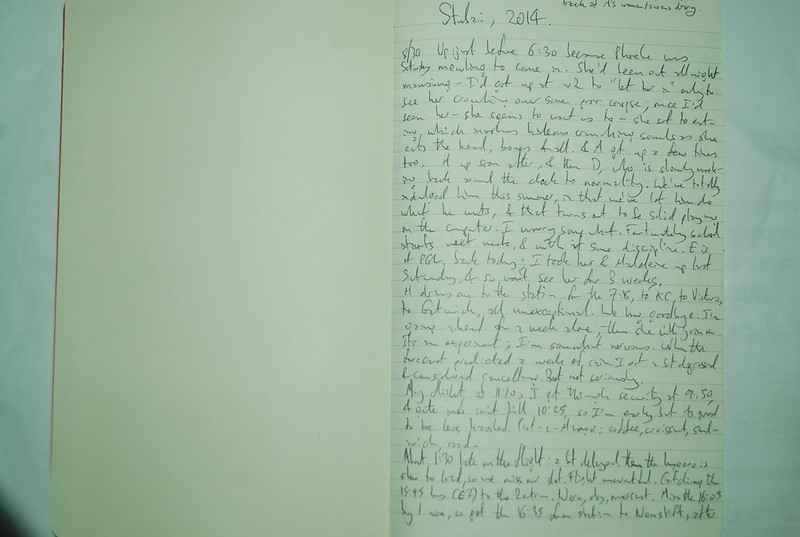
After completing the packing list I went to bed late on Friday night, in preparation for the morrow. The details (probably only readable by me) are in the Red Moleskine diary.
  DSC_4897

DSC_4894

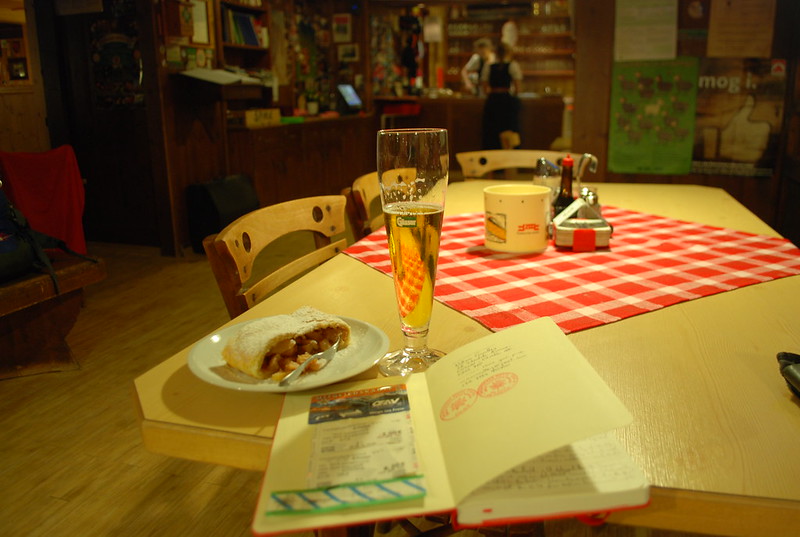
For a flight at 14:45 from Gatwick I needed to get up at 6:30 in order to avoid hassle and rush; but since this gave me coffee-drinking unpressured time at the airport and on the trains, this was fine. Somewhat unfortunately the flight was delayed (luggage, and then take-off slot loss) by about 1:30, and I missed a bus at Innsbruck station by less than a minute (there's another lesson to learn there, which is that the Airport bus and the Neustift bus actually cross somewhere around about the Arch. So its not necessary to get the Airport bus all the way to the Bahnhof, you can get off ~5 mins earlier; had I done that, I'd have caught the earlier bus), which meant that by the time (17:25) I got to Neder the Elferlifte had shut (17:00) so I couldn't execute Plan A, which had been to get the lift up (its the one the parapentists use, you see them in a cloud in fine weather; I've not taken it before) and then stroll down to the Karalm. I briefly considered Plan B: a taxi, but then chided myself for a wimp, shouldered my sac, and strode manfully up into the hills in a very gentle drizzle.

Distance: 12 km; height gain: 1400 m (~980 to ~2350); time: 3:45. GPS track.

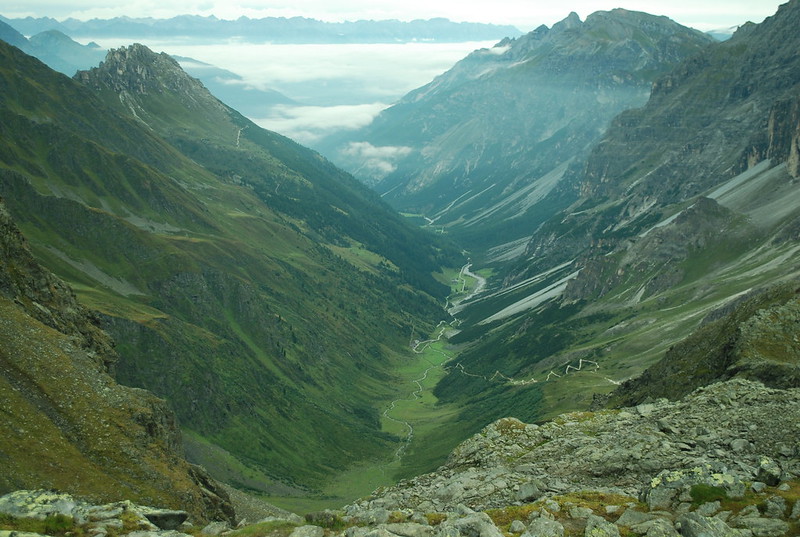
As you can see, I went at a fair pace; back in the Tour de Mont Blanc days we considered ~1000 m elevation gain or loss to be about a days work. I was looking around, but not nearly as much as the end of last year when we descended the lovely Pinnistal in glorious sunshine. The pic (from not-very-high on the Habicht) shows the valley, the roadhead, and the path zig-zagging up. Much of the path you see is newly-resurfaced in near-white gravel which was terribly helpful as the sun set and darkness came on and I got the head torch out.

DSC_4115

Just before the hut there was some confusion in darkness and cloud as I missed a zig and wondered where the path markers had gone. But I was in time for Apfelstrudel.

Wednesday, 27 August 2014

Stubai: packing list

DSC_4103(Saturday: arrival)

(See also: 2015)

Right, I'm going to write this down, so I never lose it again. Ho ho. TO MAYBE BUY WHEN I GET HOME: Stubaier Alpen alpin: Alpenvereinsführer für Hochalpenwanderer und Bergsteiger - Klier, Walter

Items marked with "=" are on the "should not have been taken" list.

* compass and whistle
* phone and charger
* D-80 and charger
* hat
* umbrella
* gaiters
* 30 m cord
* two ski sticks
* crampons
* walking boots
* spare glasses * 2
* sun/glacier glasses
* sun cream
* lip salve
* first aid kit
* money
* passport
* boarding passes
* tooth brush and soap
* towel
* head torch and spare
* turtle
* dayglo "buff"
* "bas" fleece hat
* "silk" balaclava
* E111 / EHIC medical card
* water bottle
* tiny swiss army penknife
* larger opinel
* nail scissors
= helmet
* raincoat (lightweight flimsy, and emergency backup super-flimsy)
* waterproof (ish, mostly for warmth for pre-dawn starts) trousers
* gloves times three: thin inners, fleecey, dachsteins
= books (don't go overboard like usual) "the old ways", Robert Macfarlane; "histories", Herodotus
= two ice axes (adzes; one climbing, one walking)
= big rucksac (macpac)
* daysac (lowe alpine spire 40)
* kindle (shares phone charger) loaded
* lightweight sac (exped 25 yellow)
* at least one bin liner and one spare
* maps (Alpenvereinskarte Hochstubai and Sellrain)
* garmin 610 watch and charger and usb plug
* foreign-to-uk adapter plug
* notebook (Moleskine red) and pen/cil
* a couple of small plastic bags
= pack of cards
* clothes: 2 * long tops; 1 tech t; 2 cotton t; 2 pairs thin socks; 1 pair thick; 4 pairs pants; shorts; running shorts; 2 * tracksters; 
* food - NO
* take sandals - NO

Total weight: 14 kg.

In the end I didn't take any food. This meant I got dwarf bread for breakfast and no lunch at all for a week; this was fine.

Things I should not have taken

Written afterwards.

=  700g - ice axe, the walking one
= 1900g - big rucksac (macpac)
=  750g - books
=  400g - helmet
=  100g - pack of cards
=  100g - second spare pair of glasses
=  400g - thermal top and bottom, excess spare t-shirt

Total: 4.4 kg. That's a lot. I'd have been better off with less than 10 kg on my back instead of more than 14. Having the "spare" large pack was nice, but not worth it. If I trim the books and the axe and the excess clothes, then everything fits into the Spire (and I have the Exped for the plane). Don't take 4 pairs of underpants; two are fine (one on, one off) and 3 pairs of thin socks at most; the thick socks were an unneeded luxury.

Also to be careful of: excess nick-nacks: the "traditional" orange and grey bags. Winnow those.

Sunday, 17 August 2014

Francis Henry Connolley

My uncle died last night. He'd been in a nursing home for about three years and was clearly on the way down.

He was a private person - I'll elaborate on that in a while - and I find I don't really know much about him. He was my father's younger brother. My father served in the army "of King George", as he always put it, and came to England sometime after WWII; Henry was more intellectual, stayed in Jamaica until it became unsafe, and ended up working for Tate and Lyle, eventually as a consultant.

See-also: Henry and Joan.

Update: Rob wrote an obituary at the International Society of Sugar Cane Technologists.

Before I say any more, here's a short story he wrote. I believe it to be substantially accurate and clearly autobiographical; it probably says more about him than I can.

  DSC_4095DSC_4096 DSC_4097 DSC_4098 DSC_4099

There is so much compressed into that tiny piece: nostalgia for the old days. Remembering childhood. The White Man in Jamaica, which is no longer white-man's-land, and perhaps never was, even when we ruled it. Perhaps a longing for a more vibrant vision of humanity.

This isn't a hagiography, so I'll pick up that last thread: I called Henry "private" before but more accurately he might be called uninterested in other people and indeed the world in general. Or so he always seemed to me, and to my family. Perhaps he was otherwise with other people. When we visited, he would never ask after us, or the children, or respond to talk about them; that rather made for awkward conversation, particularly in the last years, when he wasn't doing anything himself. In earlier years he'd done a lot of travelling: while working to various sugar plantations particularly in Brazil; after retirement he returned to South America, and went to New Zealand, and was keen to show off his photo albums. But it was always a rather one-way process. Writing it down like this makes me sound whingey and complaining, which wasn't my intent. The reason I wrote it down was as a record for myself, and perhaps my children, and as something of a warning: if you're not interested in communicating with other people, you end up short of resource.

Other Dox


DSC_4101
THIS POST ISNT FINISHED, or at least so I hope. I intend to add some more. All I can remember, perhaps.

See Also

* William Peter Connolley
* Henry's flat
* Henry and Joan
* Scattering Ashes

Monday, 4 August 2014

Book review: Thucydides: the history of the Peloponnesian war

I started reading this perhaps three months ago. So this is hard going and often dry. Its also often confusing. Top tip: look up the maps in the back and follow where things are, it makes more sense that way. If you don't already know the history of the period well - which amounts to, if you haven't read the book before, because this pretty well is the source book for this period - you'll likely get confused; and not understand what is going on until the end. But if you read carefully, this can be avoided: as the intro states, the true cause of the war was growing Athenian power, and Spartan fear of that. The various incidents and accidents along the way were merely opportunities for people to line up on one side or another.

A theme that comes out in book VIII is the importance of Persia. Suddenly, somehow, the action shifts to the Athenian colonies on what-is-now-Turkey and the offshore islands - Chios, Lesbos, Samos, Rhodes - and the way the Persian power can become the decisive force if it is thrown behind one side or the other; and the scramble for support. The apparent pivotal position of Alcibiades is odd too. As the commentary says, it looks as though T only realised this stuff late on: so that it makes its way into book VIII, but not into re-writes of the earlier books.

I found the description of the Spartan disaster at Sphacteria particularly interesting. The Spartans had a fearsome reputation, and even at more-than-4-to-1 odds the Athenians hesitated to attack the isolated troops on the island. But once they did and it worked, suddenly they were no longer afraid. Or, consider the way Corinth got itself tied into knots over Epidamnus in the lead-in to the war.

So there are any number of mottoes you can take from the book. Above all, there's a what-if (which of course the book doesn't address; its a history): the war killed lots of people, wasted huge resources, and weakened Greece, leaving it prey to Philip and later the Romans. Could they have done better? The book makes it moderately clear, or at least plausible, that the Spartans were actually thinking; and the Athenians too, at least sometimes and when well lead. So it might have been possible - perhaps if they'd had some examples before them, which of course they hadn't - to realise that war would be dreadful and was happening because of this clash in the face of expanding Athenian power, and they desperately needed to come to an accommodation to avoid that.

How does that affect how I think about the Ukraine?

Um, I seem to have drifted away from reviewing the book. But that's great: you see, its a book that provokes thought. But maybe only if you have context, so I wouldn't recommend it unless you do want to try and think like this.

Refs

* Daily Mash

Sunday, 3 August 2014

The Peloponnese: Saturday, and general observations

A reminder: the introduction and general index is at the post about the first day, Saturday. Day the last. Another beautiful cloudless morning and as ever its pretty hard to get out of bed to enjoy it. Nonetheless I'm out by 7 and pounding the pavements. My left Achilles tendon is still somewhat stiff, it seems to me, or am I just malingering? Whichever, thinking about it distracts my mind and body, and therefore slows me down, which I sort-of don't mind to much really. As long as I'm under 5:00 / km that's good enough for today. Same route as yesterday nearly; out to the point, only today about half-way along I follow a sign to "the lagoon" which adds a 200 m detour across the sandbar, which is fine as that makes it exactly 10 k back to the village. Its quite still (later the wind gets up) and I go for a quiet slow swim from the mole out into the blue, heading towards Sphacteria but I know I'm not going to go that far. Turn back, into the hotel, but M not in, so seek her at the pool and join in for a couple of lengths.

...finish this...