Tuesday, 27 April 2021

Climbing: lightweight rope / rap cord pondering

For abseiling when soloing, or for moving together, you don't reeeaaaallllyyy need a "proper" climbing rope. Because a proper dynamic climbing rope is "really" protecting you on major falls, for which a static rope may just break. But a proper rope is heavier. Is it worth getting "rap cord" instead?

Parameter space: Edelrid APUS PRO DRY 7,9MM is 43 g/m but the RAP LINE 6MM is 29 g/m. Over 40 m, that's 560 g: 1.72 kg vs 1.16. Half a kilo is significant. Also, it is thinner so should pack down smaller: if it scales by diameter, the half-rope is ~75% more volume. Update: I bought the rapline. Here it is. Not used yet.

The Edelrid is also not a pure static cord: it says of itself "Withstands two required standard falls for dynamic twin rope tests according to EN 892; Suitable for hauling equipment or abseiling, thanks to the low elongation values". So it is safer than a pure static. I'm not sure how many falls a "proper" rope takes.

I wonder how much my nice slinky 9 mm rope weighs? 49 g/m it turns out... well, 50 m weights 2.43 kg. So I can save 1.3 kg by swapping from that to the 6 mm cord (at the cost of 10 m, well 5m, reach...).

Gimme shelter

While I'm on weights... my bivvi bag weights 615 g.

Tarp


I bought a tarp. Here's me testing it in the garden, in conditions so pleasant it wasn't necessary.

PXL_20210609_054708900

FWIW, it is a Rab Element 1 Grey bought from Trekkit for £70. It is slightly tent-shaped rather than just square. There are reinforced holes front and rear that take - as you see - a ski-pole-tip; and tapes to tie cord to. I've yet to find the best cord combo. The cord is I think 2 mm, £0.32 / m, weight negligible. The tarp came with 6 lightweight aluminium pegs.

Sleeping mat


After much wibbling, I finally splashed out £170 on a Thermarest NeoAir UberLite Regular from ultralightoutdoorgear. It was comfy, easy to inflate without the funny inflato-sack, and didn't crinkle unless I moved. Also it was warm, but last night wasn't a test. As you see, I didn't risk it on bare ground even in the garden, but have our thinnest oldest closed-cell mat underneath.

The weights of things


Refs


Wednesday, 14 April 2021

Book review: The War of the Worlds

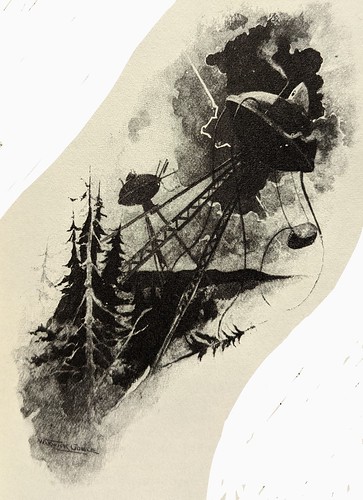
PXL_20210414_103323956_2 By H G Wells. It is famous, so I won't trouble you with a summary. Is it worth reading, nowadays? As a historical document; or as a description of it's times, yes. As a story? Only marginally.

The character of the times, or at least the bit Wells knew, can be told from this snippet near the start: At that, he stood irresolute for a moment, then turned, scrambled out of the pit, and set off running wildly into Woking. The time then must have been somewhere about six o'clock. He met a waggoner and tried to make him understand, but the tale he told and his appearance were so wild - his hat had fallen off in the pit - that the man simply drove on. That's right: trying to talk to someone if you didn't have a hat on would make you appear "wild".

And the locations are desperately parochial: Woking, Leatherhead, Weybridge, Chertsey. Such a limited scope.

Quibble: what is the Martian strategy? To invade the Earth, clearly. So why land so close to London? It seems very risky: England has enough tech to destroy three of the "tripods", and really we don't even try very hard. Would it not be better to land in some remote primitive part of the Earth, build up strength there, and then branch out? Indeed, the Martians get pretty lucky - or if you prefer, unlucky: had they landed 100 years later, they'd have been totally stuffed by the tech we have now. But then again, 100 years earlier and we wouldn't be able to touch them. It seems an odd chance that they land then. The book's trope is that Mars is old, and dying: why didn't they land 10, 100, 1000 kyr ago?

What are they even trying to do? Initially they "heat ray" stuff, although why is rather unclear. Why not just be peaceful - at least until all your cylinders have landed - if no-one is threatening you? Or if you want to kill everyone, why not just land a giant gob of "black gas" in the center of London and kill everyone before you even land?

The answer of course is that the Martians don't have any coherent plan, that's not the point: the point is the human reaction to the Martian landing; and their "strategy" is designed - by Wells - around that, to produce an interesting plot, not to any functional purpose. My guess is that the thing was written in installments; it starts with the "heat ray", and after a bit he realises the obvious: that such a device, whilst deadly to any individual, isn't actually going to do much harm to a big city. So he has to invent "black gas" to get an area effect.

Quibble: leaving aside the problem that a "gun" for interplanetary transport really wouldn't work for a variety of reasons, there is: That night [at midnight] another invisible missile started on its way to the earth from Mars, just a second or so under twenty-four hours after the first one. First, it is a bizarre co-incidence that the "gun" should go off at exactly midnight local time. But second, why would the second be 24 hours from the first? Mars rotation period is 24 hours 39 minutes, so you'd expect that spacing (ignoring the slight movement of the planets in their orbits, which gives you a shift but not much of one).

Oddity: how do the "tripods" move? We have: And this Thing! How can I describe it? A monstrous tripod, higher than many houses, striding over the young pine trees, and smashing them aside in its wallowing career : a walking engine of glittering metal, reeling now across the heather ; articulate ropes of steel dangling from it, and the clattering tumult of its passage mingling with the riot of the thunder. A flash, and it came out vividly, heeling over one way with two feet in the air, to vanish and reappear almost instantly as it seemed, with the next flash, a hundred yards nearer. Can you imagine a milking stool tilted and bowled violently along the ground? So I think he envisages it stiff-legged, not articulated; moving by whirling about one fixed foot at a time. This is supported by the pix; though admittedly opposed by other talk which kinda has it bending down. I suspect he had no clear idea; the tech of the time gave him no model. They do have flexible articulated tentacles, but perhaps only for "horror" effect.

Quibble: towards the end, we discover that the Martians have no digestive system: instead they just inject blood. Which they get - schlock, horreur! - from people. But obviously not when on Mars or in transit, so Wells is forced to invent a race of bipeds-from-Mars, who have no purpose other than to feed the Martians.

Quibble: the Martians are killed by bacteria. This is a nice touch. It would have sufficed for them to have had millions of years of medicine and eradicated all disease and lost all immunity. But no! Wells goes, implausibly, further: the Martians have no bacteria at all. Pull the other one guv.

Borges

A fragment from the intro to LabyrinthsMany of his masters are English. He has an infinite admiration for Wells and is indignant that Oscar Wilde could define him as "a scientific Jules Verne." Borges makes the observation that the fiction of Jules Verne speculates on future probability (the submarine, the trip to the moon), that of Wells on pure possibility (an invisible man, a flower that devours a man, a machine to explore time), or even on impossibility (a man returning from the hereafter with a future flower). Beyond that, a Wells novel symbolically represents features inherent in all human destinies. Any great and lasting book must be ambiguous, Borges says; it is a mirror that makes the reader's features known, but the author must seem to be unaware of the significance of his work-which is an excellent description of Borges's own art. "God must not engage in theology; the writer must not destroy by human reasonings the faith that art requires of us." I find that hard to understand; the "Orchid" story that I think is referred to here was dull to read, and uninspired. To me, it seemed like a "hmm, there's all these new and somewhat weird plants coming in; what if... they were flesh eating?" And then, rather tediously, they try to eat him. Borges has also failed to notice that Wells has an (also rather dull) trip to the moon story.

Saturday, 10 April 2021

Book review: I, Robot

1618063057809-52f06e0b-47c8-4655-a192-c6bca885ca50_ Early robot stories by Asimov, featuring the "positronic brain" and the famous "three laws". But these have aged far worse than Foundation. They are clunky, dated, and not well served by the thin "fixup" linking; they'd be better as just unlinked short stories.

Most or perhaps all of them are really puzzle stories or mysteries. But generally the puzzles are uninteresting or over-contrived (example: in one, the puzzle is to tell one robot apart from a pile of others, all identical, none of which have serial numbers. The idea that they would be physically identical with no serial numbers on any of their internal components is not plausible; but it shows perhaps how far away Asimov was from any kind of robot reality).

Politically the stories are objectionable too, but I don't think Asimov was thinking especially clearly so I don't think that aspect is worth analysing.

Friday, 9 April 2021

Book review: Beasts

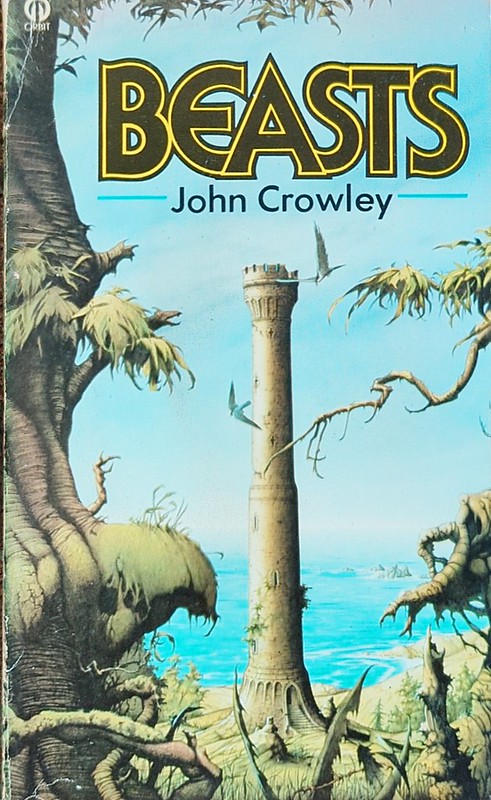
1659076999778-1b1c8fe8-92d8-4461-a2c3-01a25acadfa4 Is an early novel by John Crowley, the third and arguably weakest of the immortal trilogy along with the intricate The Deep and the elegiac Engine Summer. The book is built around Wittgenstein's quote If a lion could talk, we would not understand him1. True to the quote, and despite valiant efforts, Crowley proves unable to make his lions sufficiently incomprehensible and they turn into analogues of the Indians; it is well worth reading nonetheless. But your word-association with "beasts" will likely be very different to mine; the alternate title for this post was "Peace".

Re-read, 2022


I bethought me of this book and Abebooks delivered me a second hand copy with this cover, which is much better than the Gollanz classics cover.

On re-reading, I think my words above, whilst true, are too harsh and don't capture the book. I have failed to draw the connections that Crowley does between Painter, Reynard, and Sweets.

But I will repeat what I said in my review of Heart of Darkness: that the book puts forward, perhaps more as a gentle suggestion befitting the collapsing society it portrays than as a lesson for all times, that people grow weary of the burden of speech, indeed the burden of direction or thought. I don't like that as an idea; perhaps when taken as a warning it is valuable. Perhaps this connects to Popper's "revolt against reason".

Something I didn't quite like is that too much is a little too specific: unlike The Deep, where everything has the universality of myth.

if cats could text you back they would not

Notes


1. Another excellent quote from Big W, on being told that people thought the Sun went round the Earth because it looked that way, is "what would it have looked like if it had looked as if the earth turned on its axis?". Belatedly: I realise (duh) that that big W is not just any old random philosophe; he had a particular interest in language.

Refs


This Goodreads review says what I think better than I have.

Sunday, 28 March 2021

Text fragment: from The Fellowship of the Ring to The Discarded Image

PXL_20210313_134656821 I don't seem to have a post on either LOTR or TDI1, which surprises me. But here's a fragment from the Fellowship of the Ring:

They drew long and elaborate family trees with innumerable branches. In dealing with Hobbits it is important to remember who is related to whom, and in what degree. It would be impossible in this book to set out a family tree that included even the more important members of the more important families at the time which these tales tell of The genealogical trees at the end of the Red Book of Westmarch are a small book in themselves, and all but Hobbits would find them exceedingly dull. Hobbits delighted in such things, if they were accurate: they liked to have books filled with things that they already knew, set out fair and square with no contradictions. 

The connection may not be clear: it is that Lewis says that the mediaevals liked their texts padded with stuff that they knew.

Perhaps relatedly, I'm finding novelty less interesting as time goes by; instead, stuff that is familiar but half forgotten plays well. To my shame, that is particularly true of the harder stuff: I've browsed E's "Real Analysis" year-1 textbook, and enjoyed it, without working through the proofs in detail, because I know them in outline.

Notes

1. I lie. I have The Discarded Image: An Introduction to Medieval and Renaissance Literature, by C. S. Lewis.

Thursday, 18 March 2021

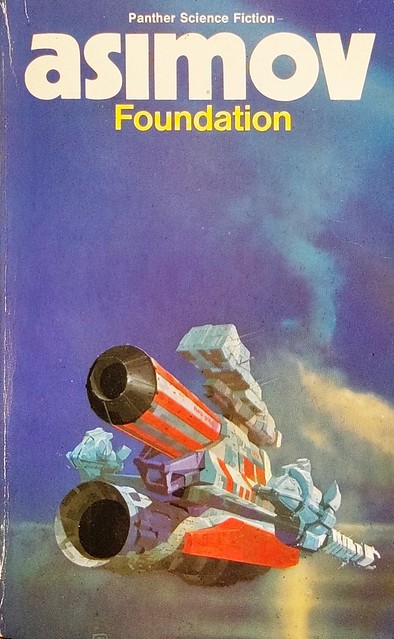
Book review: Foundation

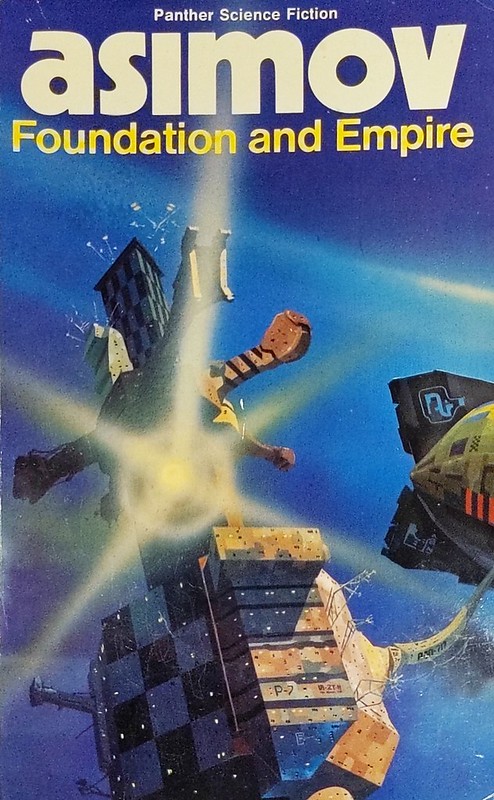
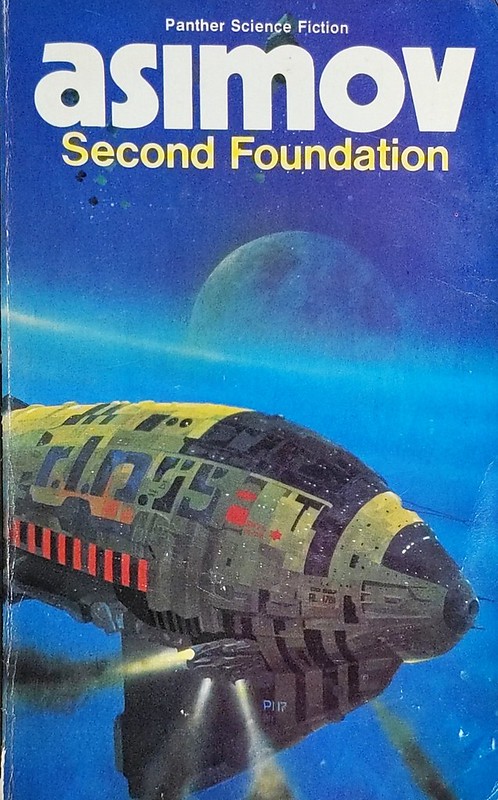
1615657066855-1d53ed3c-22e8-444a-80ac-4c2b1536de53_ A moment ago reviewing Neuromancer, I said it was one of the books you should read, like Foundation. But F - and F+E and SF - are rather more foundational that N is.

Plot: in the far future, the galactic empire is falling, though this is only perceptible to the enlightened. Hari Seldon, via the mathematics of psychohistory, foresees collapse and millennia of barbarism before a new empire; and devises a plan to shorten the interregnum to a single millennium. F is then a series of short stories about the initial growth of this Foundation. F+E is half about the conflict with the remains of the old empire, and half about the Mule, who disrupts the Plan. SF is half about stopping the Mule, and half about restoring the plan back onto its tracks. And the series ends, perhaps wisely, only 400 years into the 1kyr plan.

On this (re-)re-reading, I found F, and the second half of SF, most fun. The Mule bits drag somewhat.

Since this is about philosopher-kings wisely predicting and controlling the future, you might have your doubts about whether this is all really a good idea. The SF folk tell us their plans at one point: the Foundation will provide the physical empire, into which the SF will naturally step as wise benevolent rulers. It is hard to see that working (half of SF is about how much the first hates the second and wants to destroy it), or being desireable. This aspect is poorly worked out: Asimov has no theory of govt, other than the vague Platonic leanings that people who aren't really thinking tend to have: "wouldn't it be nice if...".

As to psychohistory: the idea that history might be predictable with untold billions across millions of stars is perhaps at least plausible enough for the story. That one could do it via mathematical equations in the way described is not; nowhere in the analysis as described does the vast amount of data that would be needed come in1. But that isn't the main problem either. The main problem is the interventions or crises, which "constrict possibilities to keep the plan on track". I think that there's no way to design these in; because Seldon had so few degrees of freedom to work with, at the start. At one point Bayta says that the entire point of the plan is to design a better society than the empire; and it is again hard to see how Seldon has enough d.o.f. to do that.

Looking at Goodreads, I see that many people downgrade it for One-dimensional characters engaged in various trade negotiations, political upheavals and general planning. Dry beyond belief. I think that's a fundamental misunderstanding. If you want to read Great Literature, do that. But only a fool would complain that Great Literature contains no spaceships. More intelligently I was made to believe that this is a SF book. It isn’t. Not really. It is more of a socio-political one. This is kinda true, but also true of many many other things: that many books are "isomorphic"; or are about draping a new skin on old ideas. Star Wars is just Cowboys in Space; Top Gun is just Cowboys in Airplanes. And in fact, this story fits better into its galactic context than many another would. My Goodreads review (which mostly points back here) is here.

Quibble: the Student is inducted by the First Speaker and finds that the Prime Radiant can, effectively, read his mind. WTF? The PR is a first-empire construct; there's no way they had any such devices. This is kinda careless by Asimov, because it isn't needed for the story.

Quibble: Asimov is obliged to invent hyperspace to magic away the distances between the stars. And he invents some ill-defined rules - for example, you can't jump too close to the surface of a planet - as everyone does. But he doesn't get the consequences right; one of which is that the concepts of "trade routes"; or the edge being "blocked" from the centre by an intervening province; is meaningless. Space is so vast, that a ship popping out of hyperspace to prepare for the next jump couldn't possibly be found. Incidentally, he has no real invention for whatever "radar" allows ships to be detected from parsecs away. Really, the setup he describes is analogous to road travel on a continent.

Space is so vast: a thought I've been thinking for a while so I'll write it down: is it the case that the ratio between the distances between stars, and the sizes of solar systems, is the largest such distance ratio? I think the distances between galaxies are comparatively tiny; as are the distances within atoms, or molecules, or within solar systems. Update: this is visible visually? See for example "what Amndromeda would look like if it were bright enough".

Quibble: when Bayta and Toran land on Haven, they brace against acceleration. Why? Artificial gravity has been solved long since; when Gaal lands on Trantor there's no bracing. 

Quibble: when Barr and Devers are on Trantor, they are frequently outside. When they blast a hole in the bureaucrat's office, sunlight floods in. And yet when Seldon is there, everyone is inside always.

Quibble: society in 50 kyr has not moved on from 1950's USA. Men estimate women's weight by their upper arms; everyone smokes; and so on. Not only that, but societal mores are undifferentiated across the galaxy. Nor does society change in the centuries of the plot we see.

Quibble: when they turn up at Trantor and try and find somewhere, it is difficult because the planet is a uniform sea of metal. But this is silly: Trantor's rotation rate is accurately known, predicting the position of any given lat/lon centuries into the future would be nothing. And notice they have no trouble finding the planet in its orbit.

Quibble, that applies to almost all old SciFi: some of the "astonishing" new tech they develope during the plot - say, the new galactic star-finding thing for navigation - now seems charmingly primitive.

In F+E, Bayta diagnoses the Empire's fall as "despotism, inertia and maldistribution of goods". But does this make sense? I think we can't tell, but on the whole, no. They've somehow ended up in a society where science has run out; old things work so well that there's no need to invent new, and even learning that science is no longer useful, compared to just polishing the brass work, that people forget how things work. At least, that's the bit we see. We don't see any maldistribution. We do have Onum Barr's tales of the terrible things that happen during the suppression of the "rebellion", which would indeed fit "despotism". I think the premise of scientific and societal uniformity across so vast a space isn't plausible either.

So the story is fun to read, and is fun to pick apart - unlike much of SciFi, which is so magical that there's no point trying to pick holes. And - if you're new to the series - each crisis is effectively a puzzle, a detective story, that you can try to solve if you like. And the events are sufficiently unmagical that attempts at prediction are possible.

1615657066855-1d53ed3c-22e8-444a-80ac-4c2b1536de53_ 1616022015219-b7185288-6df4-48af-b4da-368d045bffb3_ 1616021595753-9d4371cb-8be4-4058-87e7-24abf0567578_


Notes

1. I feel this is true, but on re-thinking: you don't need vast amounts of data to predict the pressure of a gas inside a box, so I could be wrong.

Tuesday, 9 March 2021

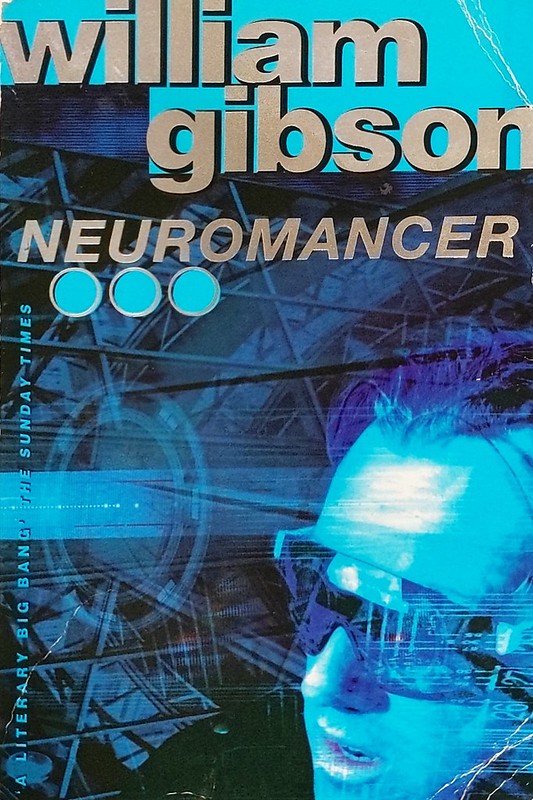
Book review: Neuromancer

1615363743215-f7904269-fe72-46f4-97a1-c9d09e9d8a0f_ Neuromancer is one of the best-known works in the cyberpunk genre according to wiki and that's right. Definitely a classic and one of the books you must read, like Dune and Foundation; and The Peace War isn't. Having said that, there's a review somewhere along the lines of "great book, but Gibson's ideas about computers are comically inept", and that's right too.

Somewhat a-la Dune, the words are important, giving the flavour: Neuromancer, Wintermute, Screaming Fist, Tessier-Ashpool; and so on. They are skillfully blended in, but it does become obvious that without them a major part of the aura would be lost - in a way that, say, Proust wouldn't suffer from if you renamed a pile of his characters. But, the story is good too, as long as you pretend the cyber-nonsense would work.

Despite various angst, the book is shallow. Except for the imagery: the Tessier-Ashpool clan existing largely in hibernation, exiting briefly to sample the world; the AIs patiently striving to meet; I like that.

For another review-by-me that I accidentally discover, see Neuromancer, Beedle and The Uses of Enchantment.