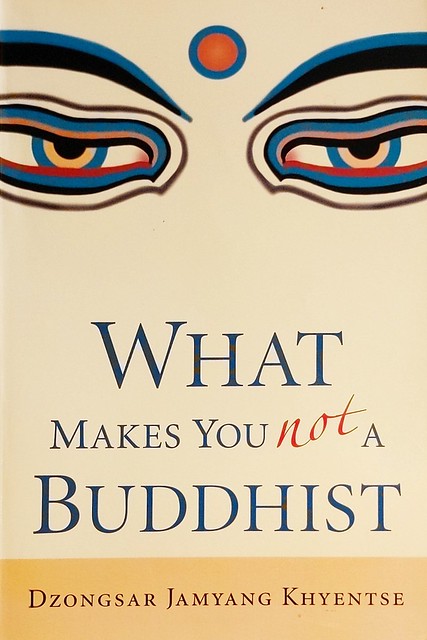
 By Dzongsar Jamyang Khyentse "one of the most creative and innovative young Tibetan Buddhist lamas teaching today" and so on. Goodreads gives it nearly four stars.
M is becoming Buddhist4, and occasionally we discuss it, and invariably disagree, and sometimes she attempts to explain it, and we usually get stuck, with her saying "well I didn't explain that very well" and so she suggested I read this, presumably on the grounds that someone had written it well. Alas, it is deeply flawed.
Let me prove that: "Many of the stars that we romantically gaze at in the night sky are already long gone; we are enjoying the rays from stars that expired a million light-years ago". This is wrong. Can you see why? Well, first off he's made the Kessel-run-in-12-parsecs error: a light-year is a measure of distance, not time. Second, all the stars we see are in the Milky Way and the most distant visible is ~10 kly (see here for a discussion of exactly how far away the most distant visible one is; quibbling, a supernovae could be further but there are no current supernovae; and that wouldn't fit many). So, this is a science-y kinda "fact" thrown in to... impress the yokels? Demonstrate that he understands cosmology? Subtly undermine everything he says? I don't know. So, the book hasn't had any editing by anyone with any science knowledge. He also claims that a "small step" like "just saying no to plastic bags" would significantly help global warning; this is of course nonsense.
There is some shitty politics in there: he admires Che, he admires Mao and hates capitalism1, he says "For example, to the extent that global warming and poverty are products of insatiable capitalistic conditions, these misfortunes can be reversed" and all of that is stupid. Arguably, stupid but irrelevant to his point. In which case, why not omit it? But it does call his judgement, and/or his wisdom, into question.
Fairly early on he is frustrated that people think that Buddha is the "God" of Buddhism; and he reminds us that big B was but a man. Fine. But then it would be nice if it wasn't the case that every single concept introduced is introduced by an episode in the life of big B. Why not, even just as an intellectual exercise, as a discipline, to force you to think, just leave him out entirely?
One is a Buddhist if he or she accepts the following four truths
Ah, good. To the point. And they are2:
1. All compounded things are impermanent.
2. All emotions are pain.
3. All things have no inherent existence.
4. Nirvana is beyond concepts.
Unfortunately 1 is vague as to what a "thing" is; for example, the proton is compound but it is not known if it decays; if it does, its half life is greater than 1034 years. Suppose it does not decay at all. Is this a problem? It is hard to see why it would be; we'd just redefine what we mean by "things". Buddhism is essentially about people, not about the physical structure of the universe; so let us say by "things" we mean "macroscopic things of human experience" or somesuch. In which case the word "compound" becomes irrelevant, which is ugly. Later on, he expands "thing" to include "concepts" at which point I can go ha-ha-gotcha: "All compounded things are impermanent" is itself a concept, and therefore is itself impermanent, and so - one must presume - at some point it will no longer be true. But that kind of thinking comes in with set theory, and I don't think he'd be very good at set theory.
Point 2 comes close to the heart of my problem with big B: like the Christian church's prohibition on suicide, it seems to come from another age when life was really rather unpleasant and peons suffered one literal or metaphorical blow after another. But it doesn't describe our life. Many emotions are pleasant. A little later he expands this a little, to "If you cannot accept that all emotions are pain, if you believe that actually some emotions are purely pleasurable". This is confused: he seems to think that if something isn't pure-pleasure, it must be pain. That isn't true. Elsewhere we have "Fear and anxiety are the dominant psychological states of the human mind". Has he just lead a really unhappy life for some sad reason? How did this get past his editor, or are all Buddhists unhappy? Perhaps Buddhists don't have emotions. Or they can cope with pain. Who knows. [Update: there's a "postscript on translation" which kinda whiffles on this, by saying effectively "oh the word I've used here is 'emotions' but maybe I meant something else". FFS. But, at least it provides some hint that someone read the thing and thought "'old on, this isn't right". So there is some hope for them.]
Point 3 is also I think confused. Re-written as something like "not everyone will view the same events in the same way"; or "we experience the real world through our senses"; or somesuch, it could be made true. Later he expands it to "all phenomena are illusory and empty, [all] things do [not] exist inherently", so there's no doubt he is taking the hard line here. I think he's wrong. There is an objective reality (see-also my takedown Book review: Why Materialism is Baloney).
4. Meh. Means nothing to me.
At the end of it, though, I am left to wonder if Buddhism is, or regards itself as, anything more than a self-help system. Unlike - let us say - Christianity it makes no supernatural claims (I think; I'm leaving out any belief in reincarnation which isn't on the list of 4, and M gives me to understand is somewhat controversial from the inside). What claims does it make? Realising that things are impermanent, and that wasting your life in striving after impossible pleasures is the road to pain?
Let's look at the chapters about those four points.
1. Impermanence
Well, this is point 1. Buddha, we are told, came to the astonishing realisation that everything is impermanent. Possibly back then everyone was too stupid to have noticed this, but nowadays he gets zero points for the bleedin' obvious. Ridiculously, the book tries to pretend this is novel by noticing that people are sad when a loved one "passes away". WTF? He's also badly confused by noticing that people would like to live longer, and appears to confuse this with people wanting to live forever. Come to that, he confuses impermanence with not-immortality: impermanence of itself does not prohibit immortality. There is a lot of muddy thinking in this chapter.
"Fearlessness is generated when you can appreciate uncertainty..." - well, no. If I'm walking across a glacier unroped and aware that there are crevasses, the uncertainty over each footstep does not remove fear, and nor would I want it to. Fear is useful. He means something else; that you can live with uncertainty. But this is no great insight.
2. Emotion and pain
There seems to be more error and confusion here, too. Perhaps he isn't too good at sticking to his topic? This is a chapter about emotion, nominally, but we get inevitably these conveniences [elevators, laptop computers, recharge able batteries, electric dishwashers, toasters] provide an equal measure of headache. Which reads to me more like live-a-simple-life-and-renounce-things; which is different. Never mind. His idea is wrong, obviously: we think that dishwashers provide a net benefit, or we wouldn't have them. He seems curiously unsubtle; not understanding the idea of balances; that things can have good and bad elements, and that just because a thing has some bad elements, that doesn't make it bad overall.
But wait, there's more wrong than that. Consider: If you examine emotions as Siddhartha did, if you try to identify their origin, you will find that they are rooted in misunderstanding and thus fundamentally flawed. All emotions are basically a form of prejudice; within each emotion there is always an element of judgment. Why is my happiness at seeing a flower a form of prejudice, rooted in misunderstanding? If he has a point here, it isn't at all clear what it is.
He continues and we come, sort of, to "our minds can be confused by illusions". For example: a torch that is spun around at a certain speed appears as a circle of fire. At the circus, innocent children, and even some adults, find the spectacle entertaining and enchanting. Very young children don't separate the hand from the fire from the torch. They think that what they see is real; the optical illusion of the ring carries them away. However long it lasts, even if for just a moment, they are completely and deeply convinced. Yeeessss... very good. But: so what? Well: Siddhartha could now see his own physical body as essenceless. To him the fire ring and the body have the same nature. But this is an error. The fire-ring is a trick-of-perception, in the way that constellations are: they depend on your viewpoint. The stars we see as "close" in a constellation, aren't. Unlike, say, a globular cluster, which really is a close group of stars. Similarly, the body "really is" a thing: a constructed thing, if you like, but a real thing, in a way that the ring of fire isn't. I think his misunderstanding here is core and important: it would be interesting to know if it is just his, or if all Buddhists make the same mistake.
As to the self: Siddhartha realized that there is no independent entity that qualifies as the self to be found anywhere, either inside or outside the body. Like the optical illusion of a fire ring, the self is illusory. This too is wrong: there is no independent entity, indeed, but that doesn't mean there is no self.
At around this point I gave up, so I can't tell you anything about the last two chapters. In my defence, I was discussing this with M as we went along, and she mostly agree with me that the bits that seemed wrong, were wrong, so there didn't seem much point.
3. Update: Everything is emptiness
It's a slow day at work, I decided to push on to chapter 3. I have had an enlightenment: he - and possibly Buddhism as a whole - has a Trump-like indifference to consistency and/or truth. He will happily say things that aren't true, presumably - granting him good intent - with the idea of drawing you towards some other concept. This is annoying, and lazy of him; it is not the case that he needs to keep lying; he just can't be bothered to express himself clearly; probably, because whenever he discusses this with others of his ilk they all nod and say "oh that was so wise"; and he has the terrible example of previous writing to guide him. But really, he should drop the drivel about Milarepa's yak horn.
The closest he comes to saying what he means is when we depend on external substantiation, eventually we are disappointed. Things are not as they seem: they are impermanent and they are not entirely within our control. And this is reasonable: we are happier if we do not lean too heavily on external reality, especially if we don't lean on our illusions about external reality (not quite right, but it's a nice quote: thou trustest in the staff of this broken reed, on Egypt; whereon if a man lean, it will go into his hand, and pierce it). This is very much as per The Consolation of Philosophy by Boethius, though I doubt either read the other; that isn't necessary, as the idea isn't a difficult one.
Coming back to the level of the yak horn, he discusses flying, in dreams and when awake. You can fly in dreams, but you can't (except using Evil Modern capitalist Tech) in the real world3. Somehow, though, he fails to see the obvious lesson from this: the real world is indeed real; you can tell this because it is bound by real rules that constrain you, unlike the dream world.
karma: at one point it is stated that this is simply a law of negative cause-and-effect. Moments later, he talks of generating negative karma. This uses are incompatible. See my comments on indifference, above.
4. Update: Nirvana
This appears to be aimed at people who believe an an "afterlife": rebirth, reincarnation, heaven, whatever you care to call it.
The parable of the wine glass: when you buy a glass, it is clean. It may get dirty. You can wash it. But the fingerprints were not part of the glass. similarly, if we get angry we feel impure and defiled, but these emotions are not part of our "true nature". This is a false analogy: there is a genuine structure to the wineglass and the fingerprints are merely laid on the surface. But there is no surface to our "true nature"; our emotions are genuinely part of it, not separable from it; they cannot be wiped away. He seems to think of us as a sort of inner or "true nature" with a cloud of emotions and reacting-to-the-world on top of it. Sort of like the id / ego stuff. That seems simplistic: chopping up, for the purpose of analysis, something more complex and more tightly bound.
Notes
1. You don't believe me, do you? Well: Imagine how the world would be if capitalism had never existed and every nation and individual truly lived Mao Tse-tung's pragmatic communist philosophy: we would be perfectly happy with no shopping malls, no posh cars, no Starbucks, no competition, no large gap between the poor and the rich, health care for all-and bicycles would be more valuable than Humvees. M, in a desperate attempt to defend this nonsense, tried "he is being provocative"; but that I think is a defence of tired, lazy writing. See-also Is Bruno Latour a useless ponce? featuring the assertion is either true but banal, or else surprising but manifestly false.
2. "Thou shalt remember that guns, bitches, and bling were never part of the four elements, and never will be" from Thou Shalt Always Kill.
3. later on (chapter 4, p 97) there are sly more-than-hints that big B could fly, but they don't talk about it much, cos that stuff was just a sideline. This is for-the-rubes drivel though; if he believes it, he's a fool; if he doesn't, he's a liar.
4. Her (brief, not very public) blog is here.