Tuesday, 13 October 2020

Wales: Caernarfon, and the hills beyond

IMG_20201005_161108_790 Words written as usual in arrears, though not too far behind. Due partly to Covid, partly due to pressure of work, and partly the way the world goes, I have too much holiday again, but this time I actually decided to take some of it, so spend (most of) a week in Wales. With no clear plans in mind but some intent to look at the "Welsh Three Thousanders" I booked Sunday and Monday night at least in the Angelsey Arms at Caernarfon. We had dropped off E at Magdalen on Sunday, preceded by a Saturday overnight at the Eastgate which is now Well Ponced Up. Rather than drive through the North coast, which had rumours of travel restrictions due to Coivd, I went through mid-Wales - well, Welshpool and Tremadog - arriving around 7 pm. 

The pub turned out indeed to be on the sea front and backs onto the town walls, with the castle nearby, and the narrow streets just passable; fortunately, the world is quieter in October than the summer. Alas as I restarted the car to move it somewhat it threw the wobbly of infamous memory and complained about "ESP" again, but started on the second go. Hmmpf: after the last set of troubles, I could really do without this again, especially on holiday. So, after a little look around, and a drink, I spent a quiet evening and a somewhat worried but quite peaceful night. Forgive me for going on about this; this post will turn into something about the hills, in a little while. You may prefer to skip ahead to Tuesday.

Note: GPS tracks contain geolocated pix.

Monday

Breakfast; there are a few others about; as is my wont I linger and have two cups of coffee and browse the wub; their wifi works downstairs but not in my room; perhaps that's a good thing. I've moved my stuff up into my room, and there's only my bike and a few bits in the car; I decide to stop avoiding the problem and try starting it; it does, on the third go. So... again, I should not avoid the problem; Google points me to a not-very-distant Citroen garage, Elim, on Anglesey; and I drive there. Alas they can't look at it today, pleading new-plate season, but may be able to run diagnostics tomorrow; so taking my bike from the car, putting walking boots in my bag, I cycle off to nearby Llangefni for a cafe and, if memory serves, to wait out some rain. This didn't work perfectly, so I set out. I didn't have lights, the grey cloud made light conditions poor, cars drive quickly, and I was somewhat worried about safety. GPS track. I intended to follow Google - see the route on Wednesday - but failed, so ended up on the "alternative" route that was actually nicer, if hillier. Cafe in Menai Bridge, and over the bridge, and then back to Caernarfon; but this part mostly goes on cycle tracks though you have to be attentive to it shifting sides and so on; towards the end, there's a dismantled railway which was lovely, even in the wet.

Back at the AA for coffee and internet catch-up; afternoon a windy but dry walk along the sea front over the river over the pedestrian swing-bridge. I make no effort to tourist the town or the castle; that's not my intent; I am merely here.

Tuesday

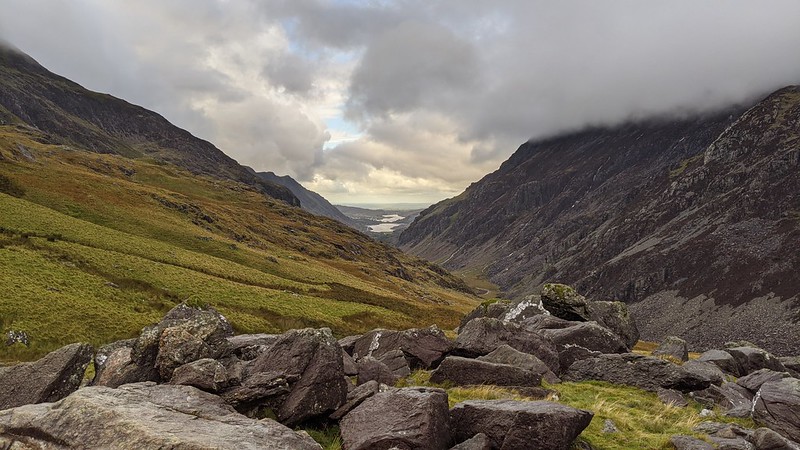
I manage to start somewhat later than I'd planned, past 11, due to more malingering over breakfast waiting for some bands of rain to pass. Oh, and I had to go back after a km or so because, having changed into longs, I'd forgotten my money. Not that I needed it, a phone was fine. GPS track for the day. The forecast tells me that the weather will slowly improve over the day, and indeed it did. I cycle inland to Llanberis, following Google map route, with my lights on I am invulnerable. ~45 mins, ~100 m height gain, fine, not entirely dry. I'd forgotten how bleak the place can feel in anything other than sunshine. I'd also forgotten quite where Pete's Eats is, but I got there. A large mug of tea and a cheese toasty is good. Which same cheese toasty turned out to be all my food for the day after breakfast; a mistake. At times, some sun through yonder window: how pleasant. Head on up, past the ruined castle, and grind up the pass, past Dinases Cromlech and Mot. Ah, old times. To Pen-y-Pass, ~360 m, that wasn't so bad (I see that Strava calls it a cat 3 climb. I took 25 mins... the record is just under 10). Have some tea in the YHA, which is rather quiet and, in it's Covid-safe state, not desperately welcoming.
PXL_20201006_135122241

The cloud is on the peaks but it seems plausible to attempt Crib Goch, or at least give it a go; though I'm somewhat late in the day due to my late start. But I'm hardly familiar with the paths, so it will be good for that. Start off along the Pyg track, which goes around the shoulder, and is very well if roughly paved; reach the "col" overlooking the lakes, then branch off R up towards CG in good shape and moving reasonably quickly. Up ahead something looms, disappearing into the clouds, and a couple of signs warn me of the terrors of CG. The way is clear enough, until I get to the scrambly bits, where it becomes somewhat obscure, but I stick to the ridge mostly, though sometimes avoiding the northern side as it is windy that way. However, at just short of 850 m, I decided to turn around. By that point I was in cloud; I'd just been hailed on; and I was doubtful I had time to get to the top of CG let alone Snowden, and I don't know any way of getting off CG other than continuing to S. So, down, getting only a bit lost in the process. Back to the bike.

Now out of the cloud there is some lovely sun, shining off the rain-washed road, which slants down towards Beddgelert, and I can just freewheel down; lovely. At Beddgelert at 5:30 and a slight flaw appears in my careful planning: I'd neglected to check my assumption that P-P to B to Caernarfon was all down hill, and it isn't: B is at ~40 m, and there's a ~200 m hill in the way, and some rolling stuff past that. Courage, onwards! And I do go on. The countryside is lovely although I'm a little too empty to appreciate it; back, with the last of the light, not much before 7.

Dinner is burger and bacon and cheese with chips, which was a little on the large side for me, even in my hungry state; I could have done quite well without either bacon or cheese. Watch the Giro, there's an hours worth available, the same thing at different times on different channels, so I don't have to rush my dinner.

Car: half-way down CG I get a phone call; they have looked at the car and don't find anything wrong. Hmm. anyway, I'll pick it up tomorrow. At some point, I've booked two more nights: Tues and Weds, leaving the end of the week undecided.

Wednesday

More decent weather, for the time of year. Again a lingering breakfast; tonight is my last booked night, should I reserve another? Should I plan to get out my sleeping bag and trek out somewhere? I put off the decision and cycle off, this time largely in the sun, and do a better job of finding the cycle path. I even sit outside with coffee and cake in a cafe on Angelsey. At the garage all is smiles, they've "cleared the fault register" though I'm unsure why that is helpful, and don't charge me, since they couldn't tell me what is wrong; and so I'm off. And indeed, it works. I decide to go look at the Cneifion Arete which I read about because someone fell badly on it recently; also, it's off Ogwen which I haven't been to on this trip. And so, off, packing (after a little thought) my helmet but also harness and a couple of slings and a little cord, in case I need to ab off. Ogwen requires coins, so I go a little further and park by the lake, walk back, and then up; again the path is good, as I suppose it has to be given the volume of footfall during the summer. Up to the lake, with the slabs beyond, and about halfway down the little island, a wall, a gate, and just past it the path up; which is now very thin. 

PXL_20201007_131607294

I probably go up too high; there's a sort of grassy section, then a rocky section, and perhaps I should have traversed across at the top of the grassy bit, because now I have to traverse across, losing ~30 m in the process, but there is again a faint path so I'm not alone in this,  And then I get into the nameless cwm, and contrary to what I expected I can unambiguously see the arete and its scree, which is a great relief as finding the bloody route is always the hard part. Wx and rock is dry and not windy.

PXL_20201007_141020786

But how hard is it? From below it looks pretty damn steep, and if I didn't know it was but a scramble (albeit grade 3) I would be really rather doubtful. But things always look harder from below. Starting right from the very bottom looks tricky, so I start from a little way R, before moving a little left. The route description, as usual, is totally useless. I think I wimped out on the L of the slightly-tricky chimney which is part of the first pitch but I'm unsure. After that I kept pretty strictly to the ridge line, far more so that the heather-clad wimp-outs you'll see in the route pix of the page I linked to. It is very good. It is steep, but not absurdly so and there are frequent rests if you want them; the rock is very good (though not quite 100% sound so you do need to test holds); the holds are good, and sometimes small. I think it is usually escapable on the L onto grass, if you ever get worried.

PXL_20201007_141407834

So you might want to know: well how hard is it, really? Always a difficult question, because it depends on how hard you are. You'll want to be comfortable high up without ropes, obvs. There are no technical difficulties that I could see, so climbing at my 4b (I once did 5b you know, but that was decades ago) was fine, in stiff walking boots.

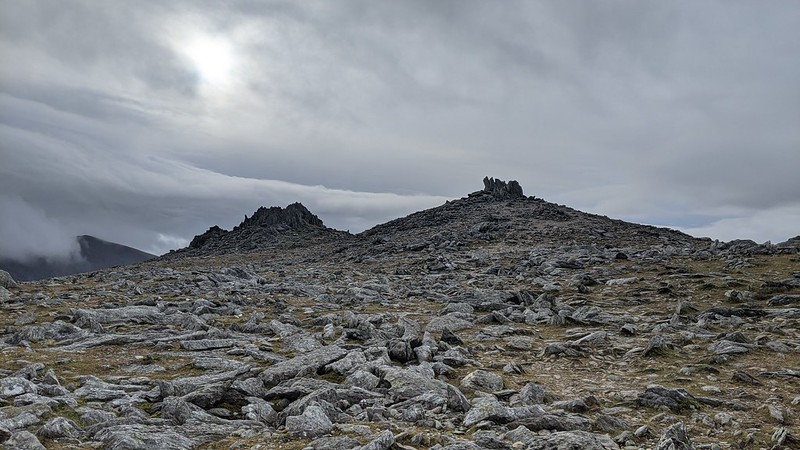
And so, onto the top. GPS track. It runs from about 680 m to about 780 m. Above that the continuation to Glyder Fawr is also scrambly, but easy. GF itself is somewhat surreal, nearly in cloud, a little like Skiddaw in a way, with fields of stones, but with weird little "castles" of sticking-up ?slate? From there I'm a little unsure of how to get down; fortunately the answer is a pretty clear path, and the cloud doesn't get in the way, so down I go. Down into cwm Idwal with views up into the Devil's Kitchen where I think Howard took us long years ago on a rainy day pu a route under a chockstone, yummy. And so, back.
PXL_20201007_154101124

But, alas, back at the car it decides to be iffy again: it will start, but second time, and again with warnings. Oh, sigh.

Back to the AA, have what I intend to be a light dinner of sides: garlic bread, chips and onion rings. But it is quite large, I should have omitted one. But I manfully get through it. Pondering, especially this mornings "should I book another night", I decide that all in all I really ought to take the car home, and not risk it getting stuck somewhere in the wilds. Annoying in a way, but a relief to make the decision.

Thursday

Not very exciting: I drove home. After another long breakfast, and a rueful glance at some blue sky - but it was still cloudy inland, thank heavens - I loaded up the car and with a feeling of dread tried to start it; failed; tried again; and it did, but with warnings. And in that state, home we went. I went via North Wales, since I didn't intend to stop; and in order to avoid turning the engine off I trundled along at 55, or following whatever lorry went my way, which seems to reduce fuel consumption markedly. To complete the story-of-the-car: I drove home, dumped out my stuff, drove to St Ives, and left it there, taking the busway back to Cambridge and walked home from town.



Friday, 25 September 2020

Ruth Bader Ginsburg died on September 18th

Or so The Economist says. It includes She was stunned by the lack of caution in the Roe v Wade ruling of 1973 that legalised abortion; though she certainly approved of the outcome, reform should have come through state legislatures, where it was slowly starting to appear, of which I approve. Looking, I don't see I've written about this so I'll write it here: Roe vs Wade, however desireable it might be from a societal point of view as a reflection of changing times is - as I understand it - on very thin ice, constitutionally: founded on two weak links: a right-to-abortion derived from a right-to-privacy; and the right-to-privacy itself. And it is certainly a point of view - which I definitely sympathise with - that a lot of the bitterness in the abortion debate in the USA stems from it having been removed from the political process, where people's enthusiasm could have some outlet, to the judicial, where it cannot.

However, der Ekonmeister skips lightly over where Brian dares to tread: A cheer for Ginsburg, and a wish that she retired in 2013. At the moment she is a secular saint and cannot be criticised - well, not by anyone who expects their words to be read - but she is the very antithesis of nothing in his life Became him like the leaving it. In that she clung on to her power, thereby losing Obama the chance to replace her with someone else "on her side". And she did cling on; it was after all by then her life, and she could not bear to let it go, putting herself above her party at the very least, and above her country, if you like many believe that the USA has lost by allowing the Mango Mussolini to appoint a third judge.

Updates

Since this is now my Roe vs Wade page: there's a quasi-interesting article in the New Yorker from 2015 attempting to argue that repro-rights folk aka those in favour of abortion should have based their arguments on equality, not privacy. That's slightly strange as an argument, I think, though I'm open to correction on this point, because I think in RvW it was the court that made up the justification, not the litigants.

But that same article did teach me that is wasn't RvW that made up the right to privacy, that was done earlier in Griswold v. Connecticut, in the context of contraception; from which we get the language that the right was to be found in the "penumbras" and "emanations" of other constitutional protections.

Oh, and as Timmy points out (though I saw it first...), there's a great deal of drivel talked about RvW, for example What will they do if that 6-3 court overturns Roe v Wade and bans abortion across the entire country? But Reversing RvW wouldn't ban abortion, of itself: it would merely make laws doing so constitutional, in the states that wished to do so.

Sunday, 20 September 2020

Book review: Space, Time and Nathaniel

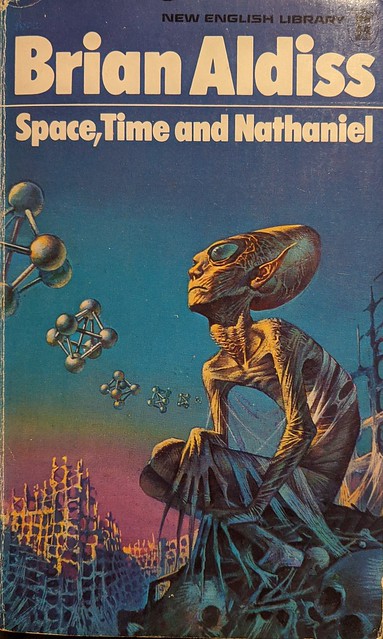
IMG_20200919_215326 A Brian Aldiss collection of short stories; possibly his first. For some reason, I've kept it: perhaps I like the front cover; and it is thin. I liked one of the stories (Conviction) enough to OCR it. Here's a review by someone who likes the collection. I guess I like it too. There's nothing dramatically exciting, but generally they are clever. Or inventive. The downside is, in places, a little too much material from English suburbia of the fifties and sixties, which must have been a somewhat drab place.

Contains the surreal Journey to the Goat Star.

Saturday, 19 September 2020

Brian Aldiss: Conviction

IMG_20200919_215326 A short story from the collection "Space, Time and Nathaniel". Of which Aldiss says A fourteen story collection, compiled at a time when BWA had had only thirteen stories published. The stories form a romp across many of the then standard themes of SF; the marked stylishness and frequent elegiac notes (as, for instance, in ‘The Failed Men’) serve as a warning of more ambitious volumes ahead. That seems true: these are early stories, very much "scifi" unlike say the Drowned World which is more dreamlike, but showing more literary talent and playful inventiveness that was the norm. Goodreads gives the collection 3.5/5 which is not unreasonable.

OCR'd by Google Lens. Note that "Ped2" should be "Ped2" (except the top of the 2 should be level with the top of the d).


CONVICTION


The four Supreme Ultralords stood apart from the crowd, waiting, speaking to nobody. Yet Mordegon, son of Great Mordregon; Antibes Isis of Sirius III, the Proctor Superior from the Tenth Sector; Delphi J. Bunswacki, Ruler of the Margins; and Ped2 of the Dominion of the Sack watched, as did the countless other members of the Diet of the Ultralords of the Home Galaxy, the entrance into their council chamber of the alien, David Stevens of Earth.

Stevens hesitated on the threshold of the hall. The hesitation was part-natural, part-feigned; he had come here primed to play a part and knowing a pause for awe might be expected of him; but he had not calculated on the real awe which filled him. He had come to stand trial, for himself, for Earth, he had come prepared-as far as a man may prepare for the unpredictable. Yet, as the dolly ushered him into the hall, he knew crushingly that the task was to be more terrible than any he had visualized. 

The cream of the Galaxy took in his hesitation. 

He started to walk towards the dais upon which Mordegon and his colleagues waited. The effort of forcing his legs to go into action set a dew of perspiration on his forehead. 

"God help me!” he whispered. But these were the gods of the galaxy; was there, over them, One with no material being and infinite power? Enough. Concentrate. 

Squaring his shoulders, Stevens walked between the masses shapes of the rulers of the Home Galaxy. Although it had been expressly stated before he left Earth that no powers, such as telepathy, which he did not possess, would be used against him, he could feel a weight of mental power all round him. Strange faces watched him, some just remotely human, strange robes stirred as he brushed past them. The diversity! he thought. The astounding, teeming womb of the universe!

Pride suddenly gripped him. He found courage to stare back into multitudinous eyes. They should be made to know the mettle of man. Whatever they were planning to do with him, he also had his own plans for them.

Just as it seemed only fitting to him that man should walk in his hall, it seemed no less fitting that of all the millions on Earth, be David Stevens, should be that man. With the egotism inherent a junior races, he felt sure he could pass their trial. What if he had been awed at first? A self-confident technological civilization, proud of its exploration projects on Mercury and Neptune, is naturally somewhat abashed by the appearance of a culture spreading luxuriously over fifty hundred thousand planets.

With a flourish, he bowed before Mordegon and the other Supreme Ultralords. 

"I offer greetings from my planet Earth of Sol,” he said in a resonant voice.

"You are welcome here, David Stevens of Earth,” Mordegon replied graciously. A small object the size of a hen's egg floated fifteen inches from his beak. All other members of the council, Stevens included, were attended by similar devices, automatic interpreters.

Mordegon was mountainous. Below his beak head, his body bulged like an upturned grand piano. A cascade of clicking black and white ivory rectangles clothed him. Each rectangle, Stevens noted, rotated perpetually on its longitudinal axis, fanning him, ventilating him, as if he burned continually of an inexorable disease (which was in fact the case).

"I am happy to come here in peace;" Stevens said. “And shall be still happier to know why I have been brought here. My journey has been long and partially unexplained." 

At the word "peace", Mordegon made a grimace like a smile, although his beak remained unsmiling.

"Partially, perhaps; but partially is not entirely," Mordregon said. "The robot ship told you you would be collected to stand trial in the name of Earth. That seems to us quite sufficient information to work on." 

The automatic translators gave an edge of irony to the Ultralord's voice. The tone brought faint colour to Stevens's cheeks. angry, and suddenly happy to let them see he was angry. 

"Then you have never been in my position," he said "Mine was an executive post at Port Ganymede. I never had anything to do with politics. I was down at the methane reagent post when your robot ship arrived and designated me in purely arbitrary fashion. I was simply told I would be collected for trial in three months-like a convict-like a bundle of dirty laundry!"
 
He looked hard at them, anxious to sec their first reaction to his anger, wondering whether he had gone too far. Ordinarily, Stevens was not a man who indulged his emotions. When he spoke, the hen's egg before his mouth sucked up all sound, leaving the air dry and silent, so that he was unable to hear the translation going over; he thought, half-hopefully, that it might omit the outburst in traditional interpreter fashion. This hope was at once crushed.

"Irritation means unbalance," said Delphi J. Bunswacki. It was the only sentence he spoke throughout the interview. On his shoulders, a mighty brain siphoned its thoughts beneath a trans parent skull case; he wore what appeared to be a garishly cheap blue pinstripe suit, but the stripes moved as symbiotic organisms plied up and down them ceaselessly, ingurgitating any microbes which might threaten the health of Delphi. J. Bunswacki. 

Slightly revolted, Stevens turned back to Mordegon. 

"You are playing with me," he said quietly. "Do I abuse your hospitality by asking you to get down to business?" 

That, he thought, was better. Yet what were they thinking? His manner is too unstable? He seems to be impervious to the idea of his own insignificance? This was going to be the whole of hell: to have to guess what they were thinking, knowing they knew he was guessing, not knowing how many levels above his own their IQ was. 

Acidic apprehension turned in Stevens's stomach, His hand fluttered up to the lump below his right ear; he fingered it nervously, and only with an effort broke off the betraying gesture. To this vast concourse, he was insignificant: yet to Earth, to Earth he was their sole hope. Their sole hope!-And he could not keep himself from shaking.

Mordegon was speaking again. What had he been saying? 

"...customary. Into this hall in the city of Grapfth on the planet Xaquibadd in the Periphery of the Dominion of the Sack are invited all new races, each as it is discovered." 

Those big words don't frighten me, Stevens told himself, because, to a great extent, they did. Suddenly he saw the solar system as a tiny sack, into which he longed to crawl and hide.

"Is this place Grapfth the centre of your Empire?" he asked. 

"No; as I said, it is in a peripheral region-for safety reasons you understand," Mordegon explained. 

"Safety reasons? You mean you are afraid of me?"

Mordegon raised a brow at Ped2 of the Sack. Ped2, under an acre of coloured, stereoscopic nylon, was animated cactus, more beautiful, more intricate than his clothing. Captive butter Aliens on germanium, degravitized chains turned among the blossoms his head; they fluttered up and then re-alighted as Ped2 nodded spoke briefly to the Earthman. "Every race has peculiar talents or abilities of its own," he explained, "It is partly to discover those abilities that you aliens are invited here. Unfortun ately, your predecessor turned out to be a member of a race of self-propagating nuclear weapons left over from some ancient war or other. He talked quite intelligently, until one of us mentioned the key word 'goodwill', whereupon he exploded and blew this entire hall to bits."

Reminiscent chuckles sounded round him as he told the story. 

Stevens said angrily: "You expect me to believe that? Then how have you all survived?"

"Oh, we are not really here,” Ped2 said genially, interlocking a nest of spikes behind his great head. "You can't expect us to make the long journey to Xaquibadd every time some petty little system-no offence of course-is discovered. You're talking to three-dimensional images of us; even the hall's only there-or here, if you prefer it (location is merely a philosophical quibble) in a sort of sub-molecular fashion."

Catching sight of the dazed look on the Earthman's face, Ped2 could not resist driving home another point. (His was a childish race: theologians had died out among them only some four thousand years ago.) 

"We are not even talking to you in a sense you would understand, David Stevens of Earth,” he said. "Having as yet no instantaneous communication across light-year distances, we are letting a robot brain on Xaquibadd do the talking for us. We can check with it afterwards; if a mistake has been made, we can always get in touch with you."
 
It was said not without an easy menace, but Stevens received st a part of it eagerly. They had as yet no instantaneous communicator! No sub-radio, that could leap light-years without time lag! Involuntarily, he again fingered the tiny lump beneath the lobe of his right ear, and then thrust his hand deep into his pocket. So Earth had a chance of bargaining with these colossi after all! His confidence soared. 

To Ped2, Mordregon was saying: "You must not mock our invited guest."

"I have heard that word 'invited' from you before," Stevens said. "This has all seemed to me personally more like a summons. Your robot, without further explanation, simply told me it would be back for me in three months, giving me time to prepare for trial."

"That was reasonable, surely?" Mordegon said, "It could have interviewed you then, unprepared." 

"But it didn't say what I was to prepare for," Stevens replied, exasperation bursting into his mind as he remembered those three months. What madness they had been, as he spent them preparing frantically for this interview: all the wise and cunning men of the system had visited him: logicians, actors, philosophers, generals, mathematicians. ...And the surgeons! Yes, the skilful surgeons, burying the creations of the technologists in his ear and throat.

And all the while he had marvelled: Why did they pick me? 

"Supposing it hadn't been me?" he said to Mordregon aloud. "Supposing it had been a madman or a man dying of cancer you picked on?"

Silence fell. Mordegon looked at him piercingly and then answered slowly: "We find our random selection principle entirely satisfactory, considering the large numbers involved. Whoever is brought here is responsible for his world. Your mistakes or illnesses are your world's mistakes or illnesses. If a madman or a cancerous man stood in your place now, your world would have to be destroyed; worlds which have not been made free from such scourges by the time they have interplanetary travel must be eradicated. The galaxy is indestructible, but the security of the galaxy is a fragile thing."

All the light-heartedness seemed gone from the assembly of Ultralords now. Even Ped? of the Dominion of the Sack sat bolt upright, looking grimly at the Earthman. Stevens himself had gone chill, his throat was as dry as his sleeve. Every time he spoke he betrayed a chunk of the psychological atmosphere of Earth.

During the three months' preparation, during the month-long voyage here in a completely automatic ship, he had chased his mind round to come only to this one conclusion: that through him Man was to be put to a test for fitness. Thinking of the mental homes and hospitals of Earth, his poise almost deserted him; but clenching his fists together behind his back-what matter if the assembly saw that betrayal of strain, so long as the searching eyes of Mordregon did not?-he said in a voice striving to remain firm: "So then I have come here on trial?" 

"Not you only but your world Earth and the trial has already begun!" The voice was not Mordregon's nor Ped2's. It belonged to Amtibis Isis of Sirius III, the Proctor Superior of the Tenth Sector, who had not yet spoken. He stood like a column, twelve feet high, his length clad in furled silver, a dark cluster of eyes at his summit probing down at Stevens. He had what the others, what even Mordegon lacked: majesty. 

Surreptitiously, Stevens touched his throat. The device nestling there would be needed presently; with its assistance he might win through. This Empire had no sub-radio; in that fact lay his and Earth's hope. But before Antibes Isis hope seemed stupidity.

"Since I am here I must necessarily submit to your trial," Stevens said. "Although where I come from, the civilized thing is to tell the defendant what he is defending, how he may acquit himself and which punishment is hanging over his head. We also have the courtesy to announce when the trial begins, not springing it on the prisoner half-way through." 

A murmur circling round the hall told him he had scored a minor point. As Stevens construed the problem, the Ultralords were looking for some cardinal virtue in man which, if Stevens manifested it, would save Earth; but which virtue did this multi coloured mop consider important? He had to pull his racing mind up short to hear Arntibis Isis's reply to his thrust.

"You are talking of a local custom tucked away in a barren pocket of the galaxy," the level voice said. "However, your intellect being what it is, I shall enumerate the how and the wherefore. Be it known then, David Stevens of Earth, that through you your world is on trial before the Supreme Diet of the Ultra lords of the Second Galaxy. Nothing personal is intended; indeed, you yourself are barely concerned in our business here, except as a mouthpiece. If you acquit yourself—and we are more than im partial, we are eager for your success, though less than hopeful your race Man will become Full Fledgling Members of our great concourse of beings, sharers of our skills and problems. If you fail, your planet Earth will be annihilated-utterly." 

"And you call that civilized?" Stevans began hotly.

We deal with fifty planets a week here," Mordegon interrupted. Its the only possible system-cuts down endless bureaucracy." 

"Yes, and we just can't afford fleets to watch these unstable communities any more," one of the Ultralords from the body of the hall concurred. "The expense...:"

Do you remember that ghastly little time-swallowing reptile from somewhere in the Magellans?" Ped2 chuckled reminiscently. "He had some crazy scheme for a thousand years' supervision of his race."

"I'd die of boredom if I watched them an hour," Mordegon said, shuddering.

"Order, please!" Antibes Isis snapped. When there was silence, he said to Stevens: "And now I will give you the rules of the trial. Firstly, there is no appeal from our verdict; when the session is over, you will be transported back to Earth at once, and the verdict will be delivered almost as soon as you land there.

"Next, I must assure you we are scrupulously fair in our decision, although you must understand that the definition of fairness differs from sector to sector. You may think we are ruthless; but the Galaxy is a small place and we have no room for useless members within our ranks. As it is we have this trouble. with the Eleventh Galaxy on our hands. However.... 

"Next, many of the beings present have powers which you would regard as supernormal, such as telepathy, deep-vision, precognition, outfarling, and so on. These powers they are holding in abeyance, so that you are judged on your own level as far as possible. You have our assurance that your mind will not be read.

"There is but one other rule; you will now proceed with your own trial."


For a space of a few chilly seconds, Stevens stared unbelievingly at the tall column of Amtibis Isis: that entity told him nothing. He looked round at Mordregon, at the others, at the phalanx of figures silent in the hall. Nobody moved. Gazing round at the incredible sight of them, Stevens realized sadly how far, far from home he was.

"...my own trial?" he echoed. The Ultralords did not reply. He had had all the help, if help it was; now he was on his own: Earth's fate was in the scales. Panic threatened him but he fought it down; that was a luxury he could not afford. Calculation only would help him. His cold hand touched the small lump at his throat; his judges had, after all, virtually played into his hands. He was not unprepared. 

"My own trial," he repeated more firmly.

Here was the classic nightmare made flesh, he thought. Dreams of pursuit, degradation, annihilation were not more terrible than this static dream where one stands before watchful eyes explaining one's existence, speaking, speaking to no avail because if there is right it is not in words, because if there is a way of delivering the soul it is not to this audience. He thought, I must all my life have had some sort of a fixation about judgement without mercy; now I've gone psychopathic-r'll spend all my ears up before this wall of eyes, trying to find excuses for some crime I don't know I've committed. 

He watched the slow revolutions of Mordregon's domino costume. No, this was reality, not the end results of an obsession. To treat it as other than reality was the flight from fear; that was not Steven's way: he was afraid, but he could face it.

He spoke to them. 

"I presume by your silence," he said, "that you wish me to formulate both the questions and the answers, on the principle that two different levels of intelligence are thus employed; it being as vital to ask the right question as to produce the correct answer,

"This forcing of two roles upon me obviously doubles my chance of failure, and I would point out that this is, to me, not justice but a mockery.

"Should I, then, say nothing more to you? Would you accept that silence as a proof that my world can distinguish justice from injustice, surely one of the prime requisites of a culture?"

He paused, only faintly hopeful. It could not be as simple as that. Or could it? If it could the solution would seem to him just a clever trick; but to these deeper brains it might appear otherwise. His thoughts swam as he tried to see the problem from their point of view. It was impossible: he could only go by his own standards, which of course was just what they wanted. Yet still he kept silence, trusting it more than words. 

"Your point accepted. Continue," said Ped2 brusquely, but he gave Stevens an encouraging nod. 

So it was not going to be as easy as that. He pulled a hand kerchief from a pocket and wiped his forehead, thinking wildly: Would they accept that as a defence: that I am near enough to the animal to sweat but already far enough away to object to the fact? Do they sweat, any of them? Perhaps they think sweat's a good thing. How can I be sure of anything?" 

Like every other thought to his present state of mind, it turned circular and short-circuited itself. 

He was an Earthman, six foot three, well proportioned, he made good in a tough spot on Ganymede, he knew a very ly woman called Edwina, Suppose they would be content n hearing about her, about her beauty, about the way she oled when Stevens left Earth. He could tell them about the just being alive and thinking of Edwina: and the prodding knowledge that in ten years their youth would be sliding away.

Nonsense! he told himself. They wouldn't take sentiment here; these beauties wanted cold fact. Momentarily, he thought of all the other beings who had stood in the past where he stood now, groping for the right thing to say. How many had found it? 

Steadying himself, Stevens began to address the Ultralords again.

"You will gather from what I say that I am hoping to demonstrate that I possess and understand one virtue so admirable that because of it you will, in your wisdom, be able to do nothing but spare me. Since modesty happens to be one of my virtues, I cannot enumerate the others: sagacity, patience, courage, loyalty, reverence, kindness, for example-and humour, as I hope that remark may hint to you. But these virtues are, or should be, common possessions of any civilization; by them we define civilization, and you presumably are looking for some thing else.

"You must require me to produce evidence of something less obvious... something Man possesses which none of you have." 

He looked at the vast audience and they were silent. That damned silence!

"I'm sure we do possess something like that. I'll think of it if you'll give me time. (Pause.) I suppose it's no good throwing myself on your mercy? Man has mercy-but that's not a virtue at all acceptable to those without it."

The silence grew round him like ice forming over a Siberian lake. Were they hostile or not? He could not tell anything from their attitude; he could not think objectively. Reverse that idea: he thought subjectively. Could he twist that into some sort of a weird virtue which might appeal to them, and pretend there was special value in thinking subjectively? 

Hell, this was not his line of reasoning at all; he was not cut out to be a metaphysician. It was time he played his trump card. With an almost imperceptible movement of a neck muscle, he switched on the little machine in his throat. Immediately its droning awoke, reassuring him. 

"I must have a moment to think," Stevens said to the assembly. 

Without moving his lips, he whispered: "Hello, Earth, are you there, Earth? Dave Stevens calling across the light-years. Do you hear me?"

After a moment's pause, the tiny lump behind his ear throbbed and a shadowy voice answered: "Hello, Stevens, Earth Centre here. We've been listening out for you. How are you doing?"

"The trial is on. I don't think I'm making out very well." His lips were moving slightly; he covered them with his hand, standing if deep in cogitation. It looked, he thought, very suspicious. He went on: "I can't say much. For one thing, I'm afraid they ill detect this beam going out and regard our communication as infringing their judicial regulations."

"You don't have to bother about that, Stevens. You should know that a sub-radio beam is undetectable. Can we couple you up with the big brain as pre-arranged? Give it your data and it'll come up with the right answer."

"I just would not know what to ask it, Earth; these boys haven't given me a lead. I called to tell you I'm going to throw up the game. They're too powerful! I'm just going to put them the old preservation plea: that every race is unique and should be spared on that account, just as we guard wild animals from extinction in parks-even the dangerous ones. O.K.?"

The reply came faintly back: "You're on the spot, feller, we stand by your evaluation. Good luck and out." 

Stevens looked round at the expressionless faces. Many of the beings present had gigantic ears; one of them possibly probably-had heard the brief exchange. At that he made his own face expressionless and spoke aloud.

"I have nothing more to say to you," he announced. "Indeed, I already wish I had said nothing at all. This court is a farce. If you tried all the insects, would they have a word to say in their defence? No! So you would kill them-and as a result you yourself would die. Insects are a vital factor. So is Man, How can we know our own potentialities? If you know yours, it is because you have ceased to develop and are already doomed to extinction. I demand that Man, who has seen through this stunt, be left to develop in his own fashion, unmolested, 

"Gentlemen, take me back home!"

He ended in a shout, and carried away by his own outburst expected a round of applause. The silence was broken only by a polite rustling. For a moment, he thought Mordegon glanced encouragingly at him, and then the figures faded away, and he was left standing alone, gesticulating in an empty hall. 

A robot came and led him back to the automatic ship.


In what was estimated to be a month, Stevens arrived back at Luna One and was greeted there by Lord Sylvester as he stepped from the galactic vessel. 

They pumped each other heartily on the back.

"It worked! I swear it worked" Stevens told the older man.

"Did you try them with reasoning?” Sylvester asked eagerly. 

"Yes-at least, I did my best. But I didn't seem to be getting anywhere, and then I chucked it up. I remembered what you said, that if they were masters of the galaxy they must be practical men to stay there, and that if we dangled before their variegated noses a practical dinkum which they hadn't got they'd be queuing up for it." 

"And they hadn't got an instantaneous communicator!" Sylvester exclaimed, bursting into a hoot of laughter. 

"Naturally not, the thing being an impossibility, as our scientists proved long ago! But the funny bit was, Syl, they accidentally told me they hadn't got one. And I didn't even have to employ that argument for having no mind-readers present." 

"So that little bit of recording we fixed up behind your ugly great ear did the trick?"

"It sounded so absolutely genuine I almost believed it was the real thing." Stevens said enthusiastically. "I'm convinced we ve won the day with that gadget."

And then, perversely, the sense of triumph that had buoyed him all the way home deserted him. The trick was no longer clever: to have duped the Ultralords gave him suddenly nothing but disappointment. With listless surprise at this reaction, he realized he knew himself less well than he had believed. 

He glanced at the gibbous Earth, low over Luna's mountains: it was the colour of verdigris. 

All the while, Sylvester chattered on excitedly. 

"Phew! You knock at least nine years off the ten I've aged since you left! When do we get the verdict, Dave?—the mighty Yea or Nay!" 

"Any time now—but I'm convinced the Ultralords are in the bag. Some of the mammoth ears present must have picked your voice up."

Sylvester commenced to beat Stevens's back again. Then he sobered and said: "Now we'll have to think about stalling the when they come and ask for portable sub-radios. Still, that can wait; after all, we didn't actually tell them we had them! Mean while, I've been stalling off the news-hounds here-the Galactics can't prove more awkward than they've been. Then the President wants to see you-but before that there's a drink waiting for you, and Edwina is sitting nursing it."

"Lead the way!" Stevens said, a little more happily.

"You look a bit gloomy all of a sudden," Sylvester commented, "Tired, I expect?"

"It has been a strain...." 

As he spoke, the door of his transport slammed shut behind him and the craft lifted purposefully off the field, silent on its cosmic drive. Stevens waved it a solemn farewell and turned away quickly, hurrying with Sylvester across to the domes of Luna One. A chillness was creeping over him again. 

Our Council of the Ultralords must be certain it pronounced the correct verdict when aliens such as Stevens are under examination; consequently, it has to have telepaths present during the trials. All it asks is, simply, integrity in the defendants-that is the simple touchstone: yet it is too difficult for many of them. The men of Earth tortured themselves chasing phantoms, cooking up chimeras. Stevens had integrity, yet would not trust to it. Those who are convicted of dishonesty perish; we have no room for them.

The robot craft swung away from Luna and headed at full speed towards Earth, the motors in its warhead ticking expectantly, counting out the seconds to annihilation.


And that, of course, would be the end of the story-for Earth at least. It would have been completely destroyed, as is usual in such distressing cases, but Mordegon, who was amused by Stevens's bluff, decided that, after all, the warped brains of Earthmen might be useful in coping with the warped brains of the enemy Eleventh Galaxy. He called it "an expedient war-time measure."

Quietly, he deflected the speeding missile from its target, ordering it to return home. He sent this message by sub-radio, of course; dangerous aliens must necessarily be deluded at times.

Sunday, 23 August 2020

Book review: Bastiat: The Law

 The Law by Bastiat is recommended by various Libertarian leaning folk such as EconLib. So I decided to read it. However, I was somewhat disappointed. Perhaps quoting from the start will help explain:

The law perverted! And the police powers of the state perverted along with it! The law, I say, not only turned from its proper purpose but made to follow an entirely contrary purpose! The law become the weapon of every kind of greed! Instead of checking crime, the law itself guilty of the evils it is supposed to punish! If this is true, it is a serious fact, and moral duty requires me to call the attention of my fellow-citizens to it.

It is all rather polemical. His complaint is revealed in the section The Complete Perversion of the Law: that unfortunately, law by no means confines itself to its proper functions. I agree with pretty well all he says but don't find it to be helpfully well said; Hayek I think says such things better. But if you've never read H or his ilk, this might be interesting.

Friday, 21 August 2020

Newton on diffraction

I'm reading - well, browsing; or perhaps skipping - Principia Vol 1, and am in the middle of a rather tedious part where he proves various uninteresting results about attractions of spheres and so on in great detail. Section XIV (The motion of very small bodies when agitated by centripetal forces tending to the several parts of any very great body) Proposition XCIV Theorem XLVIII is:

If two similar mediums be separated from each other by a space terminated on both sides by parallel planes, and a body in its passage through that space be attracted or impelled perpendicularly towards either of those mediums, and not agitated or hindered by any other force; and the attraction every where the same at equal distances from either plane, taken towards the same side of the plane: I say, that the sine of incidence upon either plane will be to the sine of emergence from the other plane in a given ratio.

And the proof is (note: you may not want to read the proof, whose details do not concern us, or the scholium that follows; try reading my final para first):

IMG_20200821_133709~2

CASE I. Let Aa and Bb be two parallel planes, and let the body light upon the first plane Aa in the direction of the line GH, and in its whole passage through the intermediate space let it be attracted or impelled towards the medium of incidence, and by that action let it be made to describe a curved line HI, and let it emerge in the direction of the line IK. Let there be erected IM perpendicular to Bb the plane of emergence, and meeting the line of incidence GH pro longed in M, and the plane of incidence Aa in R; and let the line of emergence KI be 6 produced and meet HM in L. About the centre L, with the radius LI, let a circle be described cutting both HM in P and Q, and MI produced in N; and, first, if the attraction or impulse be supposed uniform, the curve HI (by what Galileo hath demonstrated) will be a parabola, whose property is that of a rectangle under its given latus rectum, and the line IM equal to iare of HM; and moreover the line HM will be bisected in L. Hence ro MI there be let fall the perpendicular LO, then MOW, OR will be equal; and adding the equal lines ON, Ol, the wholes MN, IR will be equal also. Therefore since IR is given, MN is also given, and the rectangle MI MN is to the rectangle under the latus rectum and IM, that is, to HM in a given ratio. But the rectangle MI MN is equal to the rectangle MP MQ, that is, to the difference of the squares ML2, and PL2 or LI2; and HM2 hath a given ratio to its fourth part ML2; therefore the ratio of ML2-LI2 to ML2 is given, and by conversion the ratio of LI2 to ML2, and its square root, the ratio of LI to ML. But in every triangle, as LMI, the sines of the angles arc proportional to the opposite sides. Therefore the ratio of the sine of the angle of incidence LMR to the sine of the angle of emergence LIR is given. Q.E.D. [Note: in this pic, the planes Ae and Bb are really parallel despite what my rubbish photo might appear to show.]

IMG_20200821_134045~2

CASE 2. Let now the body pass successively through several spaces terminated with parallel planes AabB, BbcC, &c., and let it be acted on by a force which is uniform in each of them separately, but different in the different spaces; and by what was just demonstrated, the sine of the angle of incidence on the first plane Aa is to the sine of emergence from the second plane Bb in a given ratio; and this sine of incidence upon the second plane Bb will be to the sine of emergence from the third plane Ce in a given ratio; and this sine to the sine of emergence from the fourth plane Dd in a given ratio; and so on in infinitum, and, by multiplication of equals, the sine of incidence on the first plane is to the sine of emergence from the last plank in a given ratio. Let now the intervals of the planes be diminished, and their number be infinitely increased, so that the action of attraction or impulse, exerted according to any assigned law, may become continual, and the ratio of the sine of incidence on the first plane to the Sine of emergence from the last plane being all along given, will be given then also. Q.E.D.

Aaaanyway, the point is that this is all very dull: who cares other than as an abstract curiosity about motion in such a gap? And it isn't the end of it; he goes on to prove some more. The answer is given by the Scholium at the end:

IMG_20200821_135430~2

These attractions bear a great resemblance to the reflections and refractions of light made in a given ratio of the secants, as was discovered by Snell; and consequently in a given ratio of the sines, as was exhibited by Descartes. For it is now certain from the phenomena of Jupiter's satellites, confirmed by the observations of different astronomers, that light is propagated in succession, and requires about seven or eight minutes to travel from the sun to the carth. Moreover, the rays of light that are in our air (as lately was discovered by Grimaldi, by the admission of light in a dark room through a small hole, which I have also tried) in their passage near the angles of bodies, whether transparent or opaque (such as the circular and rectangular edges of gold, silver, and brass coins, or of knives, or broken pieces of stone or glass), are bent or inflected round those bodies as if they were attracted to them; and those rays which in their passage come nearest to the bodies are the most inflected, as if they were most attracted; which thing I myself have also carefully observed. IMG_20200821_135430~3 And those which pass at greater distances are less infected; and those at still greater distances are a little inflected the contrary way, and form three fringes of colors. In the figure s represents the edge of a knife, or any kind of wedge AsB; and gowog, fnaf, meme, dsld are rays inflected towards the knife in the arcs owo, non, mom, Ist; which inflection is greater or less according to their distance from the knife. Now since this inflection of the rays is per formed in the air without the knife, it follows that the rays which fall upon the knife are first inflected in the air before they touch the knife. And the case is the same of the rays falling upon glass. The refraction, therefore, is made not in the point of incidence, but grad ually, by a continual inflection of the rays; which is done partly in the air before they touch the glass, partly (if I mistake not) within the glass, after they have entered it; as is represented in the rays cxc, bipi, ahxa, falling upon r, q, p, and inflected between k and z, i and y, h and x. Therefore because of the an alogy there is between the propagation of the rays of light and the motion of bodies, I thought it not amiss to add the following Propositions for optical uses; not at all considering the nature of the rays of light, or inquiring whether they are bodies or not; but only determining the curves of bodies which are extremely like the curves of the rays.


Enough of this Newton clown, what about me?


So, he is trying to understand what will come to be called diffraction (not in the coplanar bit; which is analogous to refraction; I mean in in the bulk of the Scholium). FWIW, this casts some doubt on whether he has indeed observed this stuff himself, or is only relying on others. But more importantly, he's wrong, because diffraction is the wave-like nature of light coming out, and Newton believes in a corpuscular theory. This is minorish; these were early days for a theory of light, people were getting things wrong, and the "true" aka QM view is waaay out of his reach. But nonetheless I think he can know his theory is wrong, by about the one thing he doesn't try to do, which is to try to quantify it - which is common to much of the volume. He knows - or he could know, if he cared to look - that light is not bent to any measureable degree by the gravitational fields of anything as tiny as a piece of glass. But if he admits that, he has no theory at all for diffraction, which would annoy him.


And on the tides


Apparently from nowhere, he pulls out the third power law. This is suspicious (or did I miss something). Did he understand the reason or just somehow guess it? If he understood, I would have expected him to expound on the reasons in some detail. As the book's notes point out, he then tries to deduce the relative density of the moon, but gets it wrong by a factor of two, because he uses the ratio S - L / S + L, but doesn't realise that it is All Very Complicated, especially in channels. But he could have suspected that, and used values from mid-Atlantic islands, perhaps?


And on novae


At the end of the section on comets, he notes that some come very near the sun, and will inevitably eventually fall in. He then speculates that at the other end of their orbits - I think; but he could have meant around other stars; but I think he doesn't realise there's an Ooort cloud, he takes them more generally spread - some fall in, and nourish failing stars, and cause novae. Which is of course wrong, comets are far too small and so on, but it is an interesting idea.

Saturday, 8 August 2020

Ecrins 2020: Saturday and Sunday: Home

Pack up and off, though I forget exactly when. It's about 5:30 from Vallouise to Dijon - we'd done our usual break-somewhere-now-where-shall-we-choose and picked Dijon, the name at least is good - and we got there around 5, with stops at the Col du Lautaret and <somewhere else>, so I'll guess we left around 10.

IMG_20200808_181018

Dijon was... disappointing, I'm sorry to say. We arrived, found somewhere to park, checked in, and found we'd just missed the Cathedral closing time, which was regrettable; and then somehow there wasn't much else to see. It didn't help that it was bakingly hot. Sitting in the shade in a courtyard on the other side of, and contemplating, the cathedral helped a bit. My recollection is that it wsan't easy to find anywhere decent for dinner, either.

Our appt for the night at "City Loft" was good though: lots of space, central, and in a nice "turret" like the one opposite.

PANO_20200808_213511.vr

But our lunch stop in Saint Quentin made up for Dijon.

IMG_20200809_133646

Spot the Panda.

IMG_20200809_135024

One last steak tartare. D looks elegant in my hat.

IMG_20200809_142506

Drive, tunnel, all fine. And then, all of a sudden, we were home.