Monday, 4 January 2021

Book review: the Voyage of the Dawn Treader

As a film night, we recently watched The Chronicles of Narnia: The Voyage of the Dawn Treader; and so I've re-read CS Lewis's book. My verdict is that it is... OK, but a bit... pale? Perhaps even sickly? Everything is just too nice, except early-Eustace, and he isn't enough.

The story has some nice elements, and is well crafted. But... Aslan is too much, or too obviously, in charge? For example, when Caspian wants to go off the end of the world, and can't due to duty, and sulks, Aslan "has a word" with him, and he stops sulking. But the point is that he's already accepted that duty says he can't go; all Aslan has done is stop him sulking; that seems like waaay overkill. And of course appearing as a lamb that changes into a lion is just a touch unsubtle.

The voyage on the ship is nice, but the sailors, while they play their background part, are not really human beings in the story, which remains relentlessly if perhaps inevitably focussed on Our Heroes, who wander off whenever they feel like.

Amusing note: in TLTWATW, Miranda noticed that whenever he says "...went into the wardrobe" he is careful to add "...and didn't close the door, because everyone knows that is a bad idea". But in this one, at the Dark Island, he compares the darkness to going deeper and deeper into a railway tunnel, and doesn't tell you that going in there is a really bad idea.

Refs

* The White Witch as Tragic Figure

* The film, from 2011

Saturday, 2 January 2021

House: flooring the loft

The loft is a foreign country... well, at least partly. Years ago I put some nice pine boards down over half of it, but the other half - the side near the neighbours - was neglected, and is a pit of dust and spiders, though it has the inverter for the solar system on the dividing wall. Anyway, for <reasons> I got all enthusiastic and decided to board it. Having observed a video or two on Youtube I realised that the govt's guidance for insulation is 270 mm; I have a nominal 100 at the moment, but it was put in rather shonkily by the previous inhabitant, probably at the behest of his wife, because he didn't bother finish behind the chimney breast and hid a few rolls of spare insulation there.

Most of the point of this post is to link to pix I took of the work, so that later I can find all the pipes and wires that got hidden.

We begin with "before". the water pipes are from rework in 2006ish. The old insulation really is grey, mostly, though it's also covered in dust. View off Lwards, from slightly forwards. Note old wasps nest remains, which I cleared away.

Cost so far is: £32 + 35 + 120 + 122 + 170 +135 + 98 + 18. 

Example: £122 was Eko base layer loft ins x2, 38; 4x1 x4, 23; chipboard loft floor 3 pack x4, 35. Plus some bits. £98 was 2 more chipboard packs o' 3; two jigsaw blades; another 4 x 4x1; one 2x3; omre screws (50 x 3.5x50).

PXL_20210102_114902547.NIGHT

I refreshed the insulation with some pink stuff that was lying around, and raised the level 10 cm with some 1 x 4's (lighter than 2 x 4 but slightly awkward as not so wide). Note cut-outs for the pipes. The insulation goes not-quite-to-the-edges, as I understand this is required for ventilation.

PXL_20210102_131118801.NIGHT

* Looking back the other way, the wires that lead down to Miranda's main light. More context.

* The inverter and switches.

So now, infill the extra 10 cm height with (old pink) and (new white / grey) stuff, and then put 18 mm 48" chipboard on top. It is a bit of a pain getting started and getting a platform that can be stood / sat on stably without risking going through the ceiling.
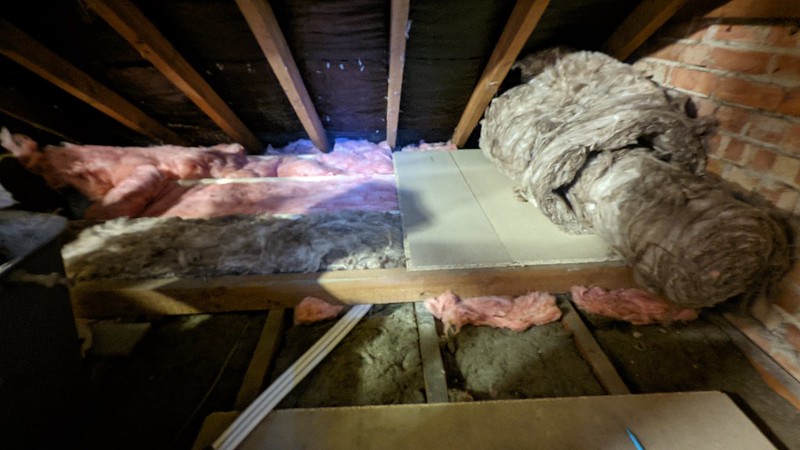
PXL_20210102_132412416.NIGHT

At this point I've run out of <stuff>, principally the 1 x 4, so it is back to B+Q for some more.

* View of the middle, showing some wires...

Here's how I left it at 7 pm on Saturday. I've got form one side into the middle. The big grey box is the old water tank that needs removing. Notice that I am (humiliatingly) using a corded drill with a - gasp - keyed chuck. That's because my stupid deWalt charger refuses to charge my generic replacement battery.
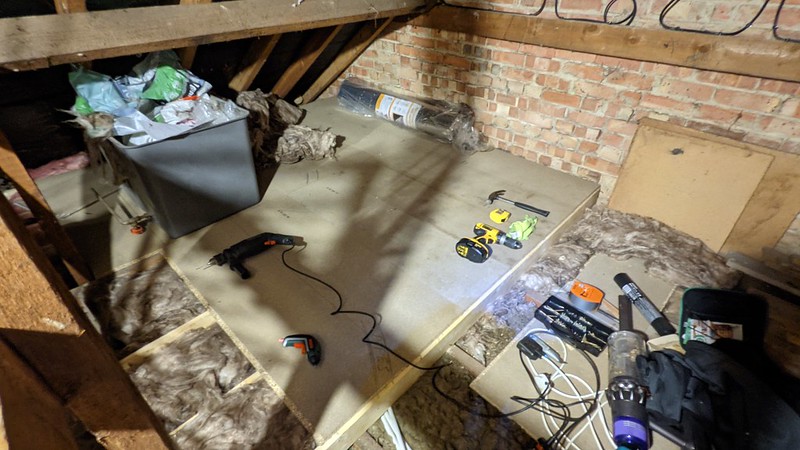
PXL_20210102_191308620


The Next Day: Sunday

That was Saturday. Sunday is another day. Running an extension lead up from below is tedious, so I connected to the existing light wiring, on the grounds that I'm taking lowish current and not for long, and just plugged in some LED lighting. Headtorch no more! I also got another thing of insulation, this one apparently in "blocks" not a roll (pic of yesterdays; pic of today's showing the blocks), with some thought of using it between the rafters. However it is 18" not 14", and my rafters are somewhat variable between 15 and 17, and it doesn't compress laterally well. It can be cut, but it's a bit of a fuss.

My main beams are awkwardly spaced, so it is just a fraction short to bridge across the middle, so the ones on the R (looking from the loft hatch; the last ones laid today) are supported at the R end by battens. Where the pesky water pipes go is marked on the boards, but anyway there are pix to show.

Here's where I am at the end of the day. A decent amount of usable area now. Next steps are either to go R to the loft ladder or more likely forwards into the slope and get all the way across, which is probably less awkward, and will give me more space to clear other stuff into.
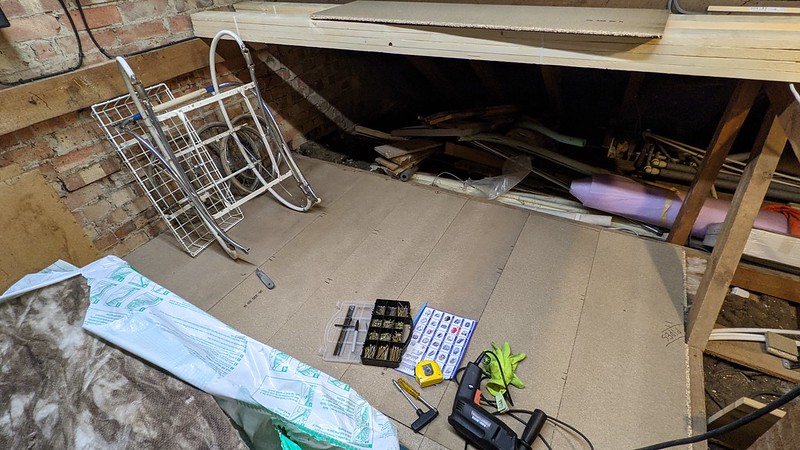
PXL_20210103_173620334

This pic shows the new "block" insulation and it is easier to work with.

The Third Day: Monday

Sneaking in a little work in the lunch hour. Not to spoil the surprise, here's how I finished.
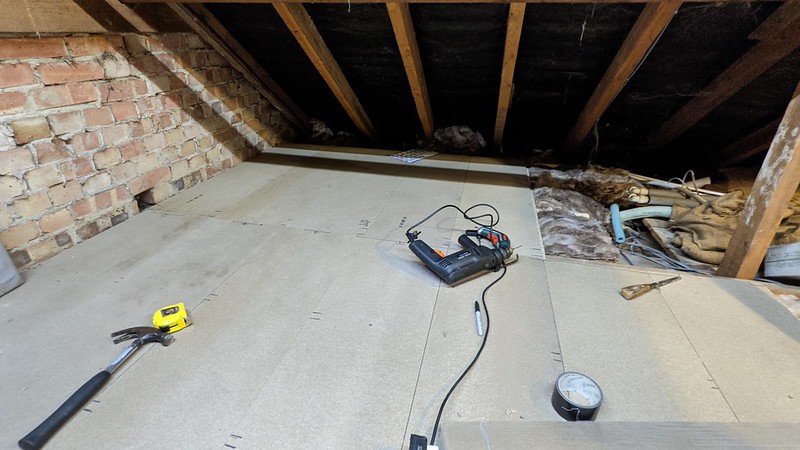
PXL_20210104_145538235.NIGHT

The only interesting "hidden" thing is the wires leading to the ceiling rose in the "laundry" bedroom. You can see those here (or with more context here); and they're marked on the chipboard. Next step is probably to push towards the pipework, if I'm feeling brave. Incidentally, the old underlying insulation wasn't so bad here: it seemed to have been laid better. Nonetheless it was only about 5 cm thick at best, so I still overlaid it with new.

The Fourth Day: Tuesday

Less action today; no new floor laid. Instead I crept gingerly towards the piping. L is towards the center; R towards the road, top towards the neighbours. We're about over the wall separating shower room from small bedroom; indeed I think the wires going down at the L are the ones for the lightswitch in that room. The pipes off the bottom head towards the boiler; those off R head towards the wall and down.

PXL_20210105_143040372.NIGHT

I've lifted some of the wooden planks that were supporting the (now long removed) cold water tank, and removed rather a lot of sawdust, which I think has been there since the construction of the house. Tomorrow I need to extend the new joists (visible at top) downwards, without damaging the pipes.

Fifth: Wednesday

Not much today. Hoovered up more sawdust, considered the pipes a bit. On the "floored" other half, I tidied up and took down the side boards on the street side, in prep for the boilerman tomorrow. My new Ryobi cordless drill turned up.

Sixth: Thursday

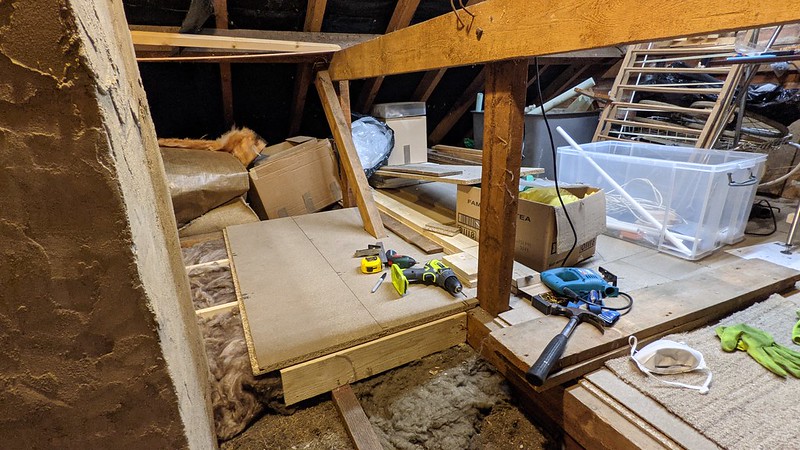
The boilerman came today (Compton and Parkinson) and he thought the leak was probably in the boiler, perhaps the pressure relief valve (PRV); if so, that would be good news(as the runoff is onto D's roof). While he was doing that - about 30 mins total - I cleared out behind the chimney somewhat, an area that has been a dumping ground for generations. And then got a couple more boards down. There's a bit of wiring underneath - one fairly neat grey one, you can see it here - but nothing that needed noting.
PXL_20210107_155734169

Here are the two new boards - you can also see my new Ryobi cordless. I'm starting to hit the non-linearity of the roof I think; the nearest thing to a right angle is the chipboard, which shows up the wonkiness elsewhere.

Seventh: Friday

I've extended backwards a little from where you can see, towards the garden side.

PXL_20210108_151912148.NIGHT

There's a white/grey wire running across as you see; I've marked it on the board to the R. Note Mfd+J's old carpet which we must have thrown up here some time ago. perhaps I'll actually use it, but for the moment it is annoyingly in the way. Next pic: with the boards on. Notice annoying little gap where the "sticking out" board butts onto the chimney and it seemed easier not to cut it.

I cur the sticking-in "joint" on one of the panels, so it can be lifted once unscrewed, because if I didn't do that you'd have to lift the whole floor from one end. I'm now out of insulation and 1x4s.

Eighth: Saturday

And on. I'm on the garden side, working R to L, now level with the chimney stack, hence the slightly awkward hole you see at the bottom R; I'll probably fill that later. Note that the panel here - you see it says "LIFT" - has had the connector cut. Old carpet abounds. I feel I am nearly at the point where I can unroll it all and have it as a useful addition, instead of being muchly in the way. The old wasps nest is now fully cleared away (that pic also shows the old black, possibly no-longer-live, wire at the back). And I bought some more LED lights to illuminate this bit.

PXL_20210109_170448936

Silliness of the day: using my jigsaw to cut some 4x1 I foolishly cut towards myself... and thought that being 3" from the cut would be fine, but I was careless. No fingers lost, and not much blood.

Ninth: Sunday

Perhaps 3-4 hours worth today. Around the back, on the garden side, I've not got past the chimney.

PXL_20210110_155548135

I think I'll be able to unroll the carpet soon, which will free up more space, which will allow more. Soon, I'll get to the bit I've already floored decades ago, which is going to require re-work, I think. Looking the other way, I've got to the loft hatch, and raised the loft-ladder supports up.

PXL_20210110_161124459

Notice that I somewhat stuffed up the cutting of the board nearest the hatch, but that can be "fixed" by bringing in the one that will go over the pipes, to the L. Once I've worked out what to do with the pipes; it is a bit of a mess. Meanwhile, since there were the parts lying around, there's now some shelves at the back. I'm down to two bits of 4x1 left, so may need another B+Q trip soon.

Monday: not much. Had a look and saw that all was good. Thought about the piping a bit: rather than rearrange it, perhaps I could go to 300 mm and get above it? Could even use the "loft legs" there, perhaps? Also put off doing anything about the carpet. Did remove and bin the old yellow vacuum cleaner, and the stack of microVAX imaging boards.

Tenth: Tuesday

Thinking overnight, I realised I could fix the problem of the mess of water pipes by raising the floor higher there, perhaps to the recommended 270 mm depth of insulation. So, off to B+Q to get some "loftlegs". But! These turn out to be 270 mm tall: not 170, which I'd expected, since the joists are 2x4. I almost buy some anyway, indeed I get as far as putting two cases on my trolley, but then I think again and realise that buying some 2x3" will get me 75 mm just as well. And be cheaper, too. So I do that, and here is the result, or the beginning of same: 1x4, as before, raised 75 mm on 4" of 2x3". the pipes weaving too and fro means that some of the blocks aren't quite in line, but they'll do.

PXL_20210112_175736686

Eleventh: Wednesday

Still at work on the road side. The back joist goes in fine, but the middle one is tricky, due to the pipework. I end up putting in 2/3 of it, but a little further back than it really should be; and then on the L end put in a short one, offset. This, combined with a "DO NOT STEP! WARNING! PIPES!" notice towards the left should serve (though the chipboard is fairly strong and I think you will be able to step there without problems; it's so low you can't, though). There are a few little cuts and adaptions around pipes, but nothing that needs recording.

PXL_20210113_161740625

Twelfth: Thursday the 14th

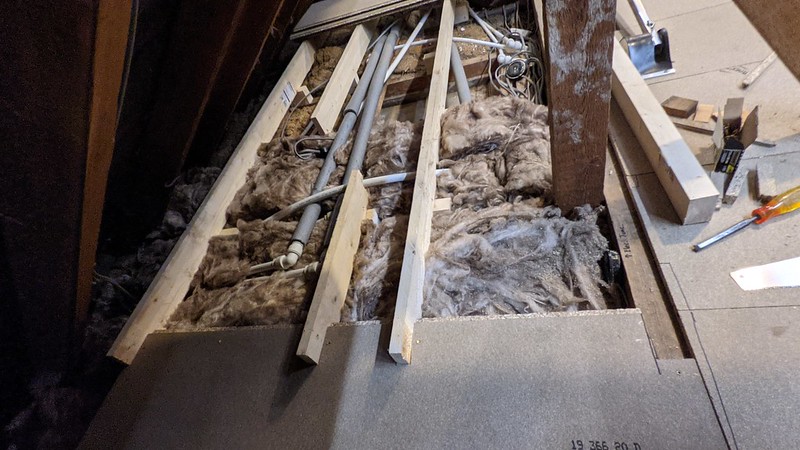
Continuing on yesterday's theme. First I need to straighten out the bathroom light, since I'll be covering over its wires. This involved vacuuming all the sawdust out near it (remembering all the stuff that fell down into it last time), putting tape over the rough edges, disconnecting the light and taking it downstairs to clean it carefully, attaching some wood strips with hotglue, and sticking it to the ceiling with D's help with same. And it stays there, now making the ceiling look rather dingy. A somewhat awkward view from above; the white box is the transformer.

Attach one of those round wiring-junction thingies to the beam.

And so, here is before (or here), and then after:
PXL_20210114_162113194

The irregular spacing is obvious but as before I blame the plumbing. This will get an extra cross-layer before the boards go on. BTW, as should be obvious from the earlier photos, all this area is absolutely bone dry.

Thirteenth: Friday the 15th
PXL_20210116_142852876

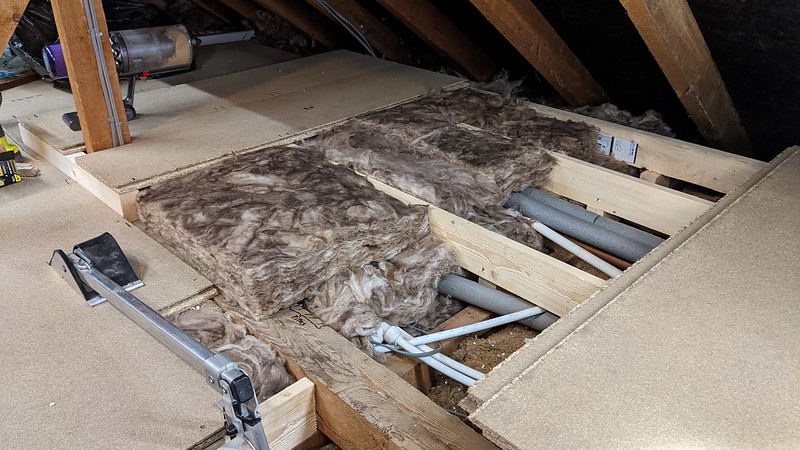
Proceed along, filling and flooring. I've now run out of 2x3, which is why I stopped.

Fourteenth: Saturday the 16th
2021-01-16_05-14-34

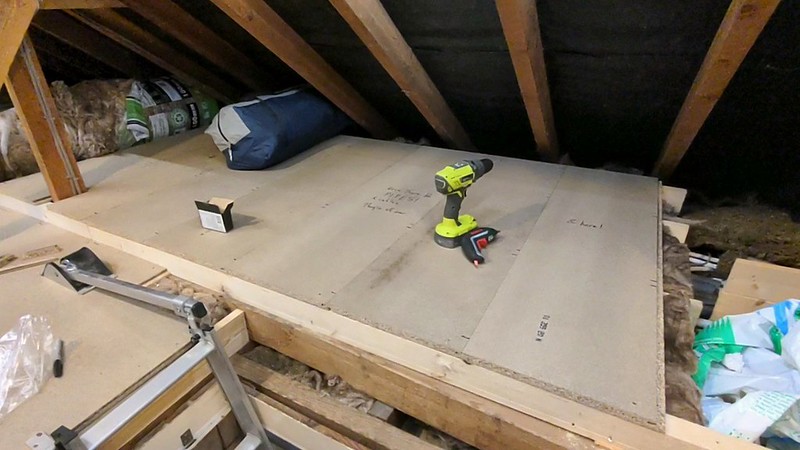
And here we are, with the boards continued about as far as I can, without hitting the next snag, which is the existing boarding off to the R. I think I may have some more to do behind the chimney, but then I'll have done all the boards on this side, and I'll need to decide if I want to re-do the other side where the boiler is, which is nicely pine boarded, but with no insulation.

I want to put some foil rafter insulation up, but at the moment I lack (heavy duty) staples. Also, the question of the carpet arises.

Notice that I've put the big old Blacks' "Calder" tent up there - it is starting to be of use!

Wednesday, 23 December 2020

Book review: Look to Windward

PXL_20201223_212212387Yes, it's P. A. M. Dirac's infamous scifi saga... while I'm here, don't miss Consider Phlebas, arguably a better book.

This is I think the second time I've read this, the first was my read-through of all the Culture novels, once I discovered them. I found this disappointing the first time, but not this. Mostly, if I recall correctly, because after all the setup (warning: spoilers) it all turns out to be a damp squib, at least in terms of the nominal plot. But since I knew that the second time round it wasn't disappointing.

The story, overall, is respectable and respectably told, in the usual IMB style; I enjoyed it. We get a variety of interesting environments, though I'm not at all sure that the "airsphere" made any kind of sense in any way - in its gravity, or nominal dynamics, or even purpose in the plot: why would you go there to do experiments quietly, when you could just float quietly in your spaceship? Nor is it clear why Sansemin got destroyed, or how... that's a slight irritation, but passes easily. The "Sublimed" don't make a great deal of sense either... indeed the closer you look at the plot, the more it is propped up by implausibilities. Is it really likely that a composer would inspire such adulation?

But there's also moderately extensive sections of trying to fill in what the Culture might be like. It seems to me that the bit people tend to like, the post-scarcity, no-money, limited-only-by-your-own-mind part isn't terribly plausible. Things like the best-most-central house space remain scarce, no matter what: tickets to sell-out concerts; and so on. Lay that aside, and Banks still seems to have left himself the problem of ennui, which can only be held off for so long by lava-rafting. There's something of a connection to Icehenge: what would you do with a very long life?

End criticism: the book has little of the "trademark" Banks violence or horror, with the possible exception of the charnel-room inside the behemothaur, until he remembers and stuffs in the body-filling-with-nanobot-insects schlock-horror at the end.

Testing... multiple images without borders

This is an uninteresting test of splitting up an image to display different text in each part. Refer to this Twit for why I might want to do this, or something better. Removing the borders requires this or similar.

 ja1ja2Oh dear

Tuesday, 15 December 2020

Alas poor C5, I knew it well

We've just given up our last C5, so here is a post-of-record to mourn its passing and replacement by a Passat. In summary it was a good car, but fragile.

We had four C5's over the years. The first, cloud-grey, was our first decent car and our only from-new car. It replaced a second-hand red Citroen BX that I gave away to someone at work. Here we see that BX having its rear window repaired; here's another view.

Dscn2509-d-watch-car-repair

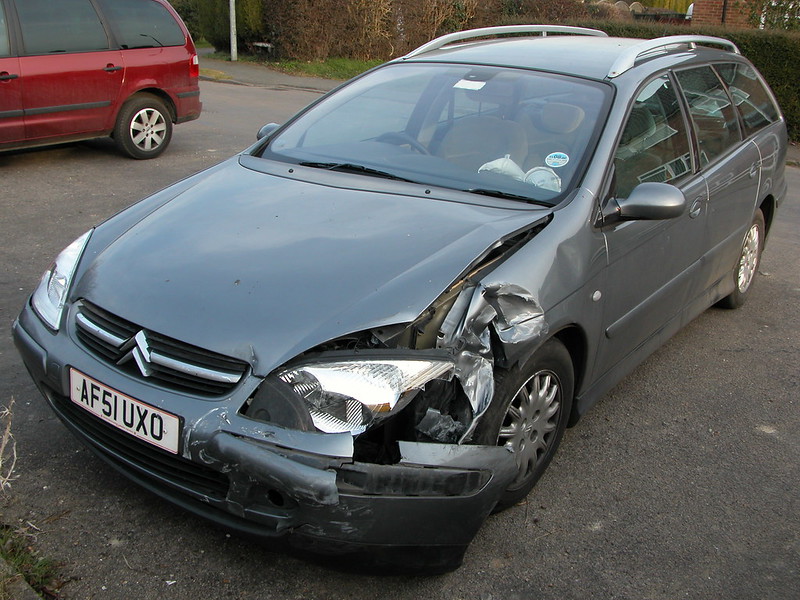
Miriam bought the C5 in the flush of the dotcom boom, or thereabouts. It was a marvel: it had air conditioning - indeed, it had climate control, a  distinction we didn't know about until later - and all sorts of other nice stuff (oh yes: the glass in the tailgate could be lifted separately, wonderfully useful for loading for holidays). It cost about £13k, partly cheap because discounted as the first of its class and Citroen were promoting it. AF51 UXO. At least briefly, we even cared about it: Miriam bought it a fire extinguisher, to be good, and we put a blanket on the back seat to preserve the seat from the children.

DSCN6038

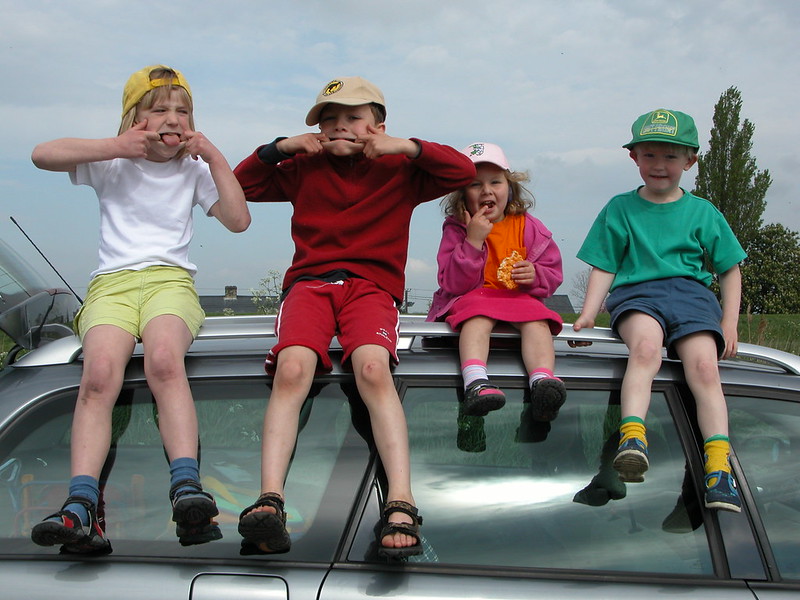
Alas it got pranged - see pic - by someone changing lanes badly while E and I were coming back from picking up kitchen parts from Ikea in Milton Keynes. Here it is in happier times - this will be one of the times I took D, E, N and P to the Norfolk coast around Old Hunstanton.

DSCN2785-n-d-e-p-on-car

That prang, and the results, was a nasty shock: although the car didn't seem, superficially, badly damaged it was a write-off (as far as the insurance were concerned) because (a) the front crumple zone, whilst really good at crumpling, is rather hard to un-crumple; and (b) the air bags had gone off, and are expensive to replace. So, we took their cash and bought a private second-hand C5 in deep blue, RX04 MKD. It was in decent condition and spec, and cost £8k cash. That's what went to Kerouini in 2007, and it must have lasted a while, because here it is in 2012:

2012-09-16 08.12.09

That's with Joy-the-scull at Boston on the top on my cunning James-aluminium-ladder-roofrack, because i was too cheap to buy a real one. and anyway, the ladder was better, because longer; and a couple of wooden beams made a decent rack. Regrettably (I think I'm recalling this right) I managed to trash that one by driving into some idiot who stopped abruptly at the entrance to a roundabout. Again, the glass nose came into play.

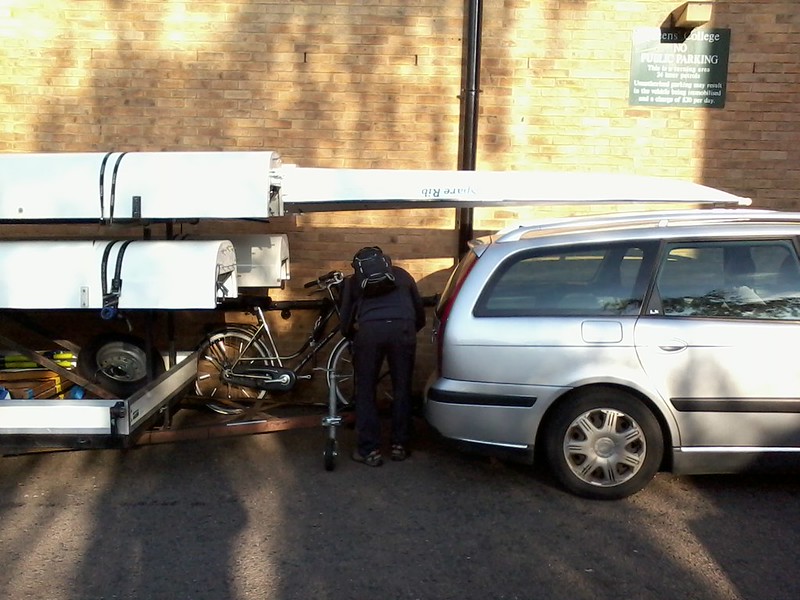
So we replaced it - in something of a hurry - with a rather cheap (£2k) not very high spec silver C5, whose sole virtue was that it had a towing hook. Which was rather useful as we were going to lots of regattas around then.

2014-05-31 07.01.23

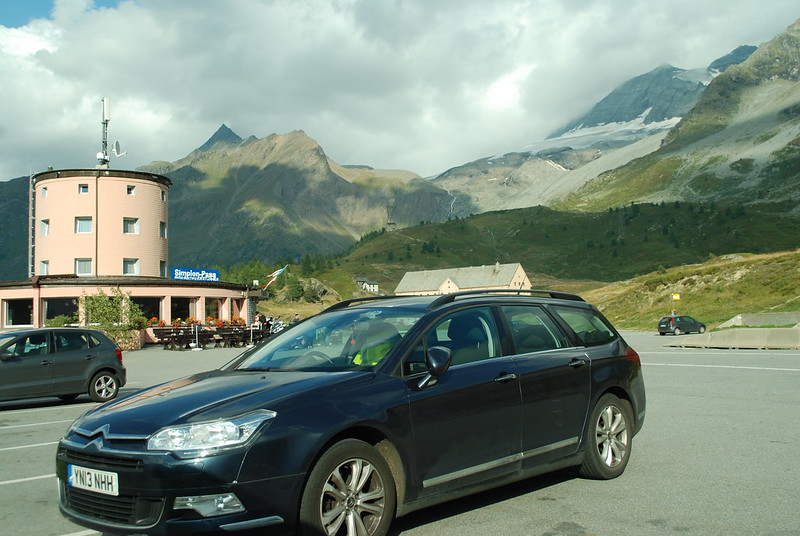
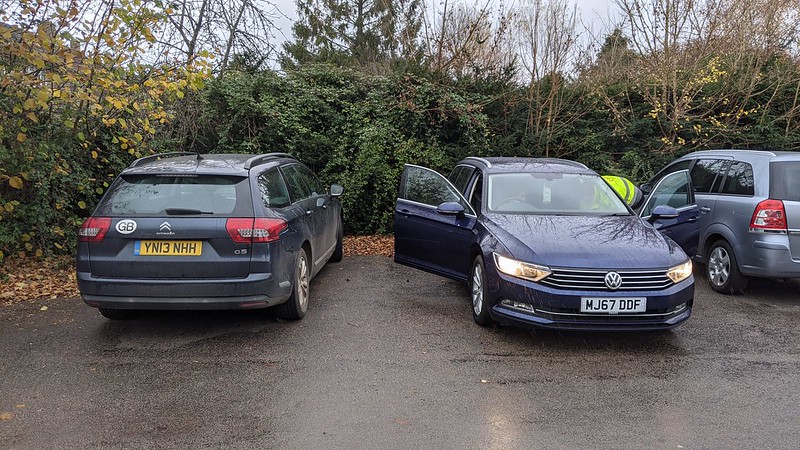
This didn't have the lifting rear glass. Nor did it have alloy wheels, oh the shame. It didn't even have electric rear windows. And it didn't have climate control, it had crummy air conditioning. Meh, it worked. For a reasonable length of time. But then, something went wrong - and I forget exactly what - something to do with the ABS system (possibly, now I think of it, prophetically, the ESP bit) - and fixing that would have bene more than it was worth. So... we got a decent (and decent spec: our first SavNav, and Bluetooth. Funkily, the wing mirrors folded when it was locked, which was great for telling form a distance that it was locked) blue C5 (new model) for about £9k; YN13 NHH. This, being the new model, didn't have the pneumatic suspension. Here it is, in 2018, at an alpine pass, on the way back home (see here for the Dolomites segment).

DSC_7976

And this too was a good car... until it stopped being good, and the ABS / ESP started playing up. And despite the best efforts of the garage, they couldn't fix it, and we lost patience - after a long time, mind you - and with regret (because it was 99% perfectly functional, and the non-functional bit really wasn't important, but was able to prevent it starting if it got uppity, gave it up as scrap. See-also Wales: Caernarfon, and the hills beyond.

In all of our C5's the engines have worked flawlessly and they've driven fine and all of that.

So, here's the Passat MJ67 DDF. Second-hand, 43k on the clock, £13k, from Cazoo. Vignette: Rob, spotting the Cazoo sticker in the back: "you mean you actually bought this from Cazoo? I couldn't imagine the sort of person who would do that". Because he is a car-owning sort of person that would like to feel his car before buying it. To be fair, we'd driven Mfd+J's Skoda estate, which is similar.

PXL_20201125_133057762

Its OK. It has 6 gears, but is - to my current tastes - somewhat weirdly geared. I can stall it in first and second without much trouble. It has "keyless" which I haven't got used to yet. The roof bars are odd. It has crummy AC not climate control. Miranda, when she first saw it, asked it is was from-new, because it was so clean, and she hadn't realised anything but a new car could be that clean. It still fits a bike in the back. It has no handbrake, instead it has autolock, which is probably good, but feels weird.

Refs

* Fixing my Citroen C5 tourer rear washer water

Thursday, 10 December 2020

Howard Zinn: A People's History of the United States: part 2

Don't miss part 1, which covers chapters 1-12. The text is here.

Chapter 13: the Socialist Challenge

One of the themes of this book ought to be - in my humble opinion of course - how easily "the people" are tricked by the Evil Capitalists. Perhaps HZ is indeed subtly doing this, by providing example after example of people falling for it, and never learning anything from the past. But his method of doing this is odd. He does provide a lead-in quote: "But when... the cost of the war came back to the people in an increase in the price of commodities.. it suddenly dawned on us that the cause of the Spanish-American war was the price of sugar". Did it occur to him or anyone else that a lesson from this is that tariffs are a really bad idea and they should be opposed? No, of course not, that's far too "economic theory" for him and them.

HZ is concerned that everything is bad and always getting worse; in this age-of-gold thinking he is following the fascist Plato: In the face of the facts that modern man lives more wretchedly than the cave-man and so on; but this is of course nonsense.

The theme of the chapter is socialism and, I think he would like to give you the impression, the glorious successes thereof. And this is demonstrated by a succession of strikes and revolts against poor conditions, lovingly detailed over pages, which invariably end rather abruptly with The conditions in the factories did not change much or equivalent. He does not find space to notice that over time the conditions in the factories have indeed improved. In part 1 I noted that the strikes invariably falied because they had such a limited programme; in this chapter we meet the IWW who did not have such limited ideas, they hoped workers would take power, not by seizing the state machinery in an armed rebellion, but by bringing the economic system to a halt in a general strike, then taking it over to use for the good of all. Alas for them, the degree of bravery-in-thinking required to push for such thinking only exists in a very few people, so it wasn't popular. FWIW I'm doubtful it could work in an industrial society; the interconnections are too complex.

I think that Socialism moved out of the small circles of city immigrants-Jewish and German socialists speaking their own languages-and became American is probably whistling in the wind. I do believe There was almost a religious fervor to the movement, but I don't think that's a good thing.

Why do the plebs fail to cast off their shackles? HZ does know the answer. Undoubtedly, ordinary people benefited to some extent from these changes. The system was rich, productive, complex; it could give enough of a share of its riches to enough of the working class to create a protective shield between the bottom and the top of the society but he can't hold the thought for long; a few paras later we have Fundamental conditions did not change, however...

Chapter 14: War is the Health of the State

World War One. The USA was late to the party, and you won't find that discussed by HZ. Nor will you find much in the way of discussion of causes:  The rhetoric of the socialists, that it was an "imperialist war," now seems moderate and hardly arguable says he; but I do indeed argue; a better description is a pointless accidental war that no-one wanted. HZ links the USA's entry to effects of its interest in global trade. As usual, HZ's theme is envy: but did the workers in the steel plants gain as much as U.S. Steel, which made $348 million in profit in 1916 alone? Err, well: I doubt any individual work made $349 million. Did they in aggregate make more? We don't find out, because despite asking the question, HZ doesn't give a toss about the answer. It isn't a question; it is propaganda.

The Schenck v. United States case comes up. By modern standards, it was clearly erroneously decided. If you read wiki, you will discover that via Brandenburg v. Ohio. If you read HZ, you won't, who gives you the impression ("has been constantly in force since 1950...") that the problem still exists; perhaps his reading doesn't extend to 1969? No, of course not. the reason is that it's a nice thing. He doesn't want nice things. There was conscription, to which some but not enough people objected, and conscientious objects were treated badly. That's about it; he is no more interested in the course of the war than he was in his own civil war.

Chapter 15: Self-Help in Hard Times

Or, and better, post-WWI to pre-WWII. There were strikes, which never achieved their objectives due to not really having objectives, but are better thought of by analogy to "the concept of pressure" vs "individual molecules bouncing off walls". And so, in a process too complex to disentangle, things got better. Even HZ cannot fully ignore this: There was some truth to the standard picture of the twenties as a time of prosperity and fun. But fear not! Things, really, were grim: prosperity was concentrated at the top... only the upper ten percent of the population that enjoyed a marked increase in real income. It's a little bit like the GW deniers who draw the temperature series as a basically flat, by quietly ignoring the upwards bits.

More good things happen: Women had finally, after long agitation, won the right to vote in 1920... but don't worry, this too had its downside: not only was voting was still a middle-class and upper-class activity but also those pesky women didn't vote as they should have: "women have shown the same tendency to divide along orthodox party lines as male voters."

The Crash of '29 happens, and this is something maybe to write about sometime; needless to say the capitalist system was by its nature unsound: a system driven by the one overriding motive of corporate profit and therefore unstable, unpredictable, and blind to human needs. And he does note that Clearly those responsible for organizing the economy did not know what had happened, were baffled by it. Apart from the unconscious assumption that the entire economy requires organisation from above, he is largely correct; and std theory says the Govt / Fed made things worse. To HZ the solution is better organisation; I would of course promote a more Hayekian view. Things are bad, along comes the New Deal. Generally this gets a good rap from the std histories, but for HZ it was dominated by Big Business with just enough sop to the plebs to prevent them rioting. HZ notes that it was initially thrown out by the Supremes, but doesn't cover any of the subsequent excitement of it getting rammed through.

Moving right along, there are more strikes and so on, but it was rank-and-file strikes and insurgencies that pushed the union leadership, AFL and CIO, into action... moderate labor rebellion by channeling energy into elections-just as the constitutional system channeled possibly troublesome energy into voting... Factory workers had their greatest influence, and were able to exact their most substantial concessions from government, during the Great Depression, in the years before they were organized into unions. Their power during the Depression was not rooted in organization, but in disruption. I agree. Unions are easy to corrupt, easy to co-opt, and end up representing the relatively better off against the poor, the blacks, the women and the riff-raff. This is an important point, for any agitator; I'm surprised HZ doesn't make more of it.

Chapter 16: a people's war?

WWII is I think generally regarded as a popular war against an evil enemy; both of which points HZ accepts. But asking if it was a "people's war" seems odd. As for the Civil War and so on, HZ has no interest in the military conflict; the Normandy landings for example get less than a sentence. But during the war the US govt is planning for what will come afterwards, strangely enough. As someone said, Leadership toward a new system of international relationships in trade and other economic affairs will devolve very largely upon the United States because of our great economic strength. We should assume this leadership, and the responsibility that goes with it, primarily for reasons of pure national self-interest. The very last part of not altruistic, but I would defend it, in a Smithian "It is not from the benevolence of the butcher" way.

Trivia: in Catch-22, Yossarian is an officer, as I think are most of the characters. If I was going to questions HZ's narrative of a racist army with a sharp officer / men distinction, I'd compare it to civilian life.

Allied bombing raids in Europe: I think I already knew that the British night-time raids were indiscriminate. But I had though the US day-time somewhat more targetted. HZ disagrees, and wiki agrees with him; though with the proviso that the military impact may still have been significant. And, the US was implicated in Dresden too; I thought that was our mistake. Then we have the A-bombing of Japan and was-that-really-necessary. Here, there is a lot of second guessing, and I don't think HZ manages to add anything useful to all the words written over the years. I doubt I can, either.

After WWII is a rather confused period where things happen, including the Korean war, with McCarthy coming in and then we come to the Rosenberg's. An ugly episode, and HZ quibbles their conviction but as I read wiki the Venona decryptions of '95 make his involvement at the least clear; and HZ's problem is that he revised this book in '95, 98 and 99. There's anti-communist hysteria, and hysteria is bad; but so is communism.

HZ tells us At the start of 1950, the total U.S. budget was about $40 billion, and the military part of it was about $12 billion. But by 1955, the military part alone was $40 billion out of a total of $62 billion... In 1960, the military budget was $45.8 billion—9.7 percent of the budget. but these numbers appear to be a bit dodgy: according to a random internet site 1950 was 24 / 70 (34%) against 47 / 110 in 1955 (43%) and 53 / 151 (35%) in 1960. But nonetheless the % of military is much higher than I'd have guessed - driven, in a sense, by the lower-than-nowadays values for pensions, healthcare and education. Wiki has a useful graph.

It seems odd that the post-war "war on communism" doesn't deserve a chapter of its own. Various interventions - the 1953 Iran coup for example - happen, in retrospect setting the scene for decades of instability in those regions. And yet - I say this not to excuse it, but to try to understand it - the nationalise-the-oil-industry stuff has echoes of how the 2011 Egyptian revolution ultimately failed: too revolutionary, too-much-too-young. Perhaps this in turn has some inverse connection with the post Civil War reconstruction. And then, Cuba shows the USA's curious incompetence.

To be continued...

Well, I hope so. This isn't finished, you'll have noticed. Partly because I was finding it dull. Partly because I was disagreeing with almost everything, and not finding very much new, or much in the way of ideas. It is just very slanted history, and a piece of history I'm not desperately interested in. See-also some comments on the post on the first twelve chapters.

Continued and concluded

I'm not going to finish off chapter-by-chapter: I lack the inclination and I don't think it worth my while. There are a lot of words, I read most of them, I will remember few of them; there is clearly a lot of historical research; there are some errors that are a result of bias on HZ's part; I cannot raise the enthusiasm to find out how many; but I do not trust him.

I am put in mind of Gaitskell's Socialism and Nationalism: that fundamentally, HZ is wrong, and there is no rescuing him. What is he wrong about? One striking thing I notice is that things are always terrible1, and always getting worse; in this he resembles Plato's falling-away-from-the-age-of-gold; but he also (as I think I said before) resembles the GW denialists who convince themselves that the world is not warming by drawing graphs that are flat, or declining, except for a few anomalous jumps upwards, which they proceed to ignore. You will not find any graphs-over-time of literacy rate; or life expectancy; of calories-per-day; well, you won't find any graphs at all; it is all more anecdotal; which allows him to select his favoured view.

Why does he want to believe everything is terrible? I think mostly because people he doesn't like are in charge, and the system isn't one he favours, so obviously things must be getting worse - how else could it be? But also I think there's the std.marxist whip-up-the-workers type stuff: you need to convince the proles that their lot is terrible.

HZ is fundamentally a populist, much as Trump is, though on the opposite end of the left-right axis: in that he doesn't really believe in the rule of law. In his case, that is partly - and with some reason - from a feeling that the law isn't on his side; that the law favours rich over poor, and has betrayed the poor in the past. But the solution to that is to strengthen the law1. Examples from RBG of HZ's contempt for the law: he puts constitutional rights in scare quotes; he simply can't understand that the death penalty might be constitutional: to him, the death penalty is a Bad Thing, if he were in charge it would be swept away, law or no law.

HZ has a vision, or a hope, of where society might go:

We would need-by a coordinated effort of local groups all over the country-to reconstruct the economy for both efficiency and justice, producing in a cooperative way what people need most. We would start on our neighborhoods, our cities, our workplaces. Work of some kind would be needed by everyone, including people now kept out of the work force-children, old people, "handicapped" people. Society could use the enormous energy now idle, the skills and talents now unused. Everyone could share the routine but necessary jobs for a few hours a day, and leave most of the time free for enjoyment, creativity, labors of love, and yet produce enough for an equal and ample distribution of goods. Certain basic things would be abundant enough to be taken out of the money system and be available-free-to everyone: food, housing, health care, education, transportation.

This is hopeless, naive, unrealisable3. It is the familiar socialist / Marxist dream of happy peasants dancing around maypoles in the long intervals in their remarkably short-working lives.

I will give him one thing: Despite the political consensus... there were millions of Americans, probably tens of millions, who refused, either actively or silently, to go along. Their activities were largely unreported by the media. They constituted this "permanent adversarial culture.". Sadly he doesn't make much of this. But I agree: the political show in Washington and the meeja, despite it's domination of the news, doesn't dominate people's lives. This is a hint that what we need is less politics, not different politics. See-also the beginning of chapter 21, on disenchantment.

HZ's other big problem, perhaps his main one, is his failure to disentangle capitalism and politics. I don't think he even tries, or would try: to him they are either the same, or so interlinked as to be non-separable, but this is a failure of discrimination on his part. We need less politics - politics is a zero-sum game in which people fight over the spoils - and more free market4, which is a positive-sum game where our progress fundamentally comes from.

Notes

1. One example of how nothing can ever be good enough not to be terrible is Clinton's appointment of Ruth Bader Ginsburg to the Supremes, which he harshly criticises: she is too right wing for him. Would you really want to live in a country where RBG was too right wing?

2. This doesn't mean add more laws; it doesn't mean apply it more harshly; it means apply it correctly.

3. Well, unrealisable as written. But see-also the notes on the Commie's 10-point-plan that I stole from Popper. capitalism may get us there yet.

4. More free market isn't synonymous with less welfare for the poor. But it does mean less govt: less regulation, less interference with people's lives.


Wednesday, 2 December 2020

Generic life: the drains

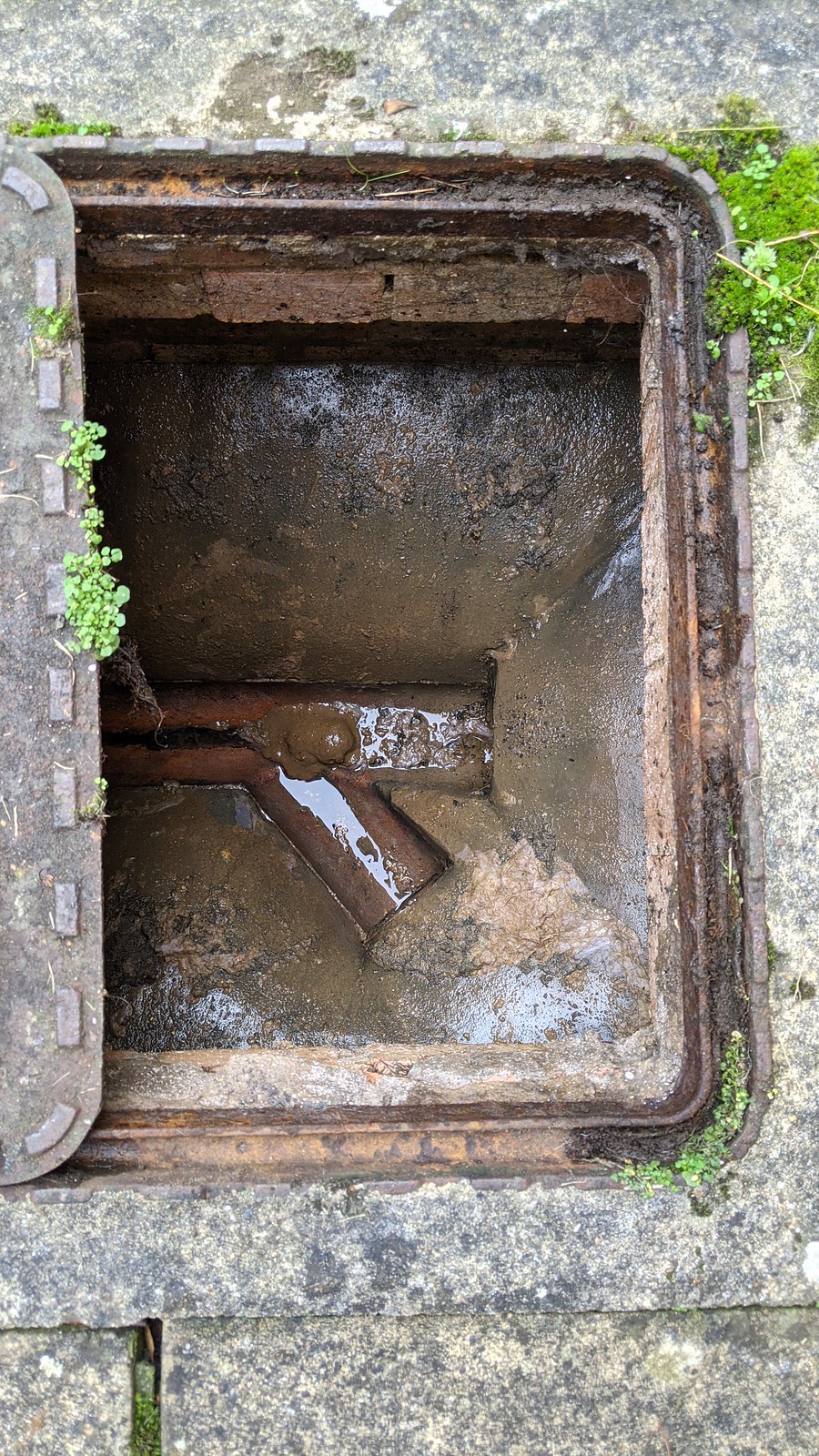
Flushing the toilet yesterday - this is a post about drains, don't read on unless you're interested in grimy details - I noticed that the water wasn't going down as quickly as I'd expect. So, just on the off-chance, I lifted a drain cover and hit, errm, pay-dirt. Oh, joy. naturally, the first thing I did was to post to fb.

PXL_20201201_120456936

Picking the nearest water-related bill I could find I contacted the Cambridge Water Company who responded promptly via fb chat, which seems to be their preferred method of communication. But the answer was "we are sorry for your woe, but we deal with the inputs; you need Anglian Water for the output". So I phoned them, and they promised to send someone "within 24 hours". That didn't sound terribly urgent but I hadn't sounded panicky over the phone. And monitoring the level over the next few hours, we had ~300 mm to spare. It went up and down, going up to 240 about 4 pm when the local children came back from school then dropping back to 280 late at night.

This isn't the first time... quite some time ago (perhaps five years) they actually dug up the pipes in our back garden leading down to the old sewage works; and about two weeks ago I was happily sitting in the living room looking out over the garden when I saw some white van-like object in the field, which turned out to be a Drain Man water-jetting the drains.

PXL_20201117_144017331

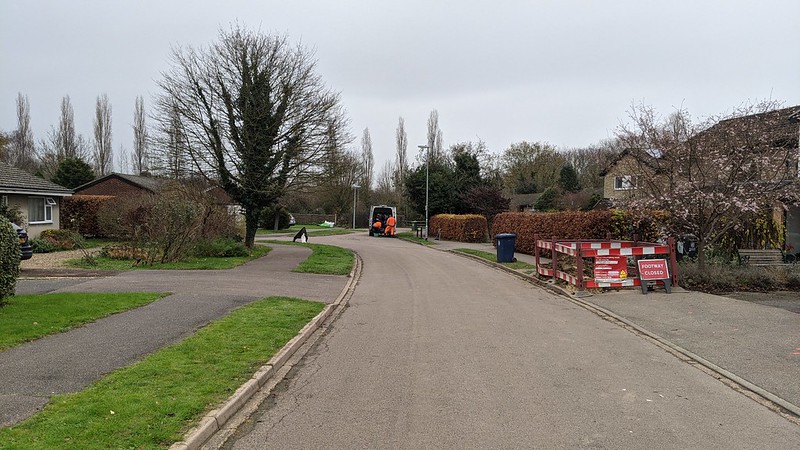
In the morning the level wasn't much changed. About 11 am an orange-suited Drain Man knocked on the door and introduced himself; I told him the obvious and he set to work, and I went back to work. Nothing much seemed to happen - I'd been expecting him to take his van into the field again - but by 12 all was well Down Below. Wandering out, I found him and a friend down the lane aways, still jetting.

PXL_20201202_114321743

Rubbish picture, huh? The "road closed" stuff isn't them, that some electrical works going on. You can just make out the reel in the van, and the connection to the mains for the water. Anyway, we had a little chat, but fairly short since the machine is noisy and we had to shout. He blamed mostly "wipes", but they also had a bucket of gravel or grit or tarmac chippings that had come out. I said "so this is going to happen again?" and he said that they'd try to do a thorough clean to avoid that.

And now my drain is as clean as a rather dirty whistle, but I think that's clean enough for a drain.

PXL_20201202_113756420

He also mentioned that it had overflowed at the back, and they'd spent a happy hour or two raking it all back up. And indeed, it seems so. Note this is not the drain cover nearly-behind us, it is one over. I could not detect anything left, on casual inspection.

PXL_20201202_153228586