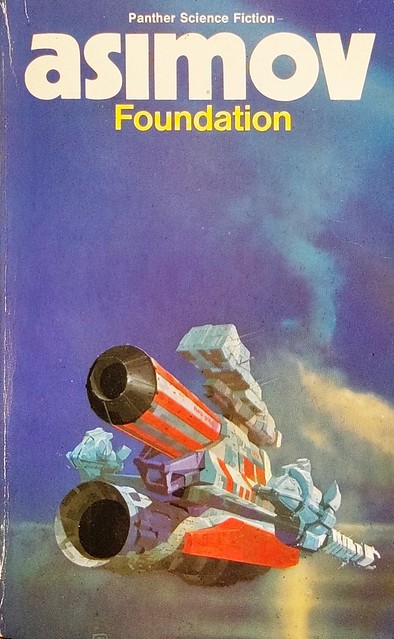
 A moment ago reviewing Neuromancer, I said it was one of the books you should read, like Foundation. But F - and F+E and SF - are rather more foundational that N is.
Quibble: Asimov is obliged to invent hyperspace to magic away the distances between the stars. And he invents some ill-defined rules - for example, you can't jump too close to the surface of a planet - as everyone does. But he doesn't get the consequences right; one of which is that the concepts of "trade routes"; or the edge being "blocked" from the centre by an intervening province; is meaningless. Space is so vast, that a ship popping out of hyperspace to prepare for the next jump couldn't possibly be found. Incidentally, he has no real invention for whatever "radar" allows ships to be detected from parsecs away. Really, the setup he describes is analogous to road travel on a continent.
Space is so vast: a thought I've been thinking for a while so I'll write it down: is it the case that the ratio between the distances between stars, and the sizes of solar systems, is the largest such distance ratio? I think the distances between galaxies are comparatively tiny; as are the distances within atoms, or molecules, or within solar systems. Update: this is visible visually? See for example "what Amndromeda would look like if it were bright enough".
Quibble: when Bayta and Toran land on Haven, they brace against acceleration. Why? Artificial gravity has been solved long since; when Gaal lands on Trantor there's no bracing.
Quibble: when Barr and Devers are on Trantor, they are frequently outside. When they blast a hole in the bureaucrat's office, sunlight floods in. And yet when Seldon is there, everyone is inside always.
Quibble: society in 50 kyr has not moved on from 1950's USA. Men estimate women's weight by their upper arms; everyone smokes; and so on. Not only that, but societal mores are undifferentiated across the galaxy. Nor does society change in the centuries of the plot we see.
Quibble: when they turn up at Trantor and try and find somewhere, it is difficult because the planet is a uniform sea of metal. But this is silly: Trantor's rotation rate is accurately known, predicting the position of any given lat/lon centuries into the future would be nothing. And notice they have no trouble finding the planet in its orbit.
Quibble, that applies to almost all old SciFi: some of the "astonishing" new tech they develope during the plot - say, the new galactic star-finding thing for navigation - now seems charmingly primitive.
In F+E, Bayta diagnoses the Empire's fall as "despotism, inertia and maldistribution of goods". But does this make sense? I think we can't tell, but on the whole, no. They've somehow ended up in a society where science has run out; old things work so well that there's no need to invent new, and even learning that science is no longer useful, compared to just polishing the brass work, that people forget how things work. At least, that's the bit we see. We don't see any maldistribution. We do have Onum Barr's tales of the terrible things that happen during the suppression of the "rebellion", which would indeed fit "despotism". I think the premise of scientific and societal uniformity across so vast a space isn't plausible either.
So the story is fun to read, and is fun to pick apart - unlike much of SciFi, which is so magical that there's no point trying to pick holes. And - if you're new to the series - each crisis is effectively a puzzle, a detective story, that you can try to solve if you like. And the events are sufficiently unmagical that attempts at prediction are possible.
|
 |
 |
Notes
1. I feel this is true, but on re-thinking: you don't need vast amounts of data to predict the pressure of a gas inside a box, so I could be wrong.

No comments:
Post a Comment