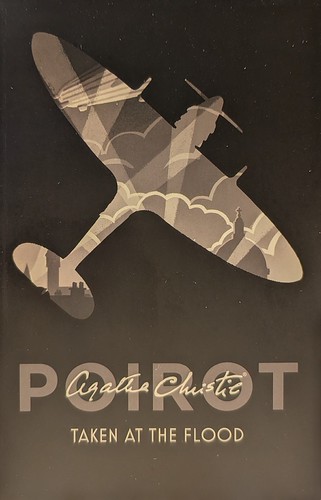
 Aka There is a Tide. Our Ag again, and once again decent, but despite a good start not her best: the ending does not resolve as smoothly as it should.
The plot driver is as ever money; this time we're just-post-WWII, money is tight amongst formerly gentlefolk, rationing is still in force, and some people back from the war no longer fit into the pleasant Olde Englishe countryside as they once did. All of this is quite nicely sketched. That the characters are somewhat stock is no great flaw.
Wiki will tell you the plot, so I won't bother. Spoilers ahead.
I managed to guess that Major Porter was lying about the body being Underhay. But this part doesn't quite work properly. Rowley contacts Poirot, who then conveniently finds Porter, but Rowley doesn't know that Poirot knows Porter: Rowley knows about the wartime scene in the club from Jeremy, but Jeremy wouldn't know that Poirot was present. Also Aunt Katie visiting Poirot becomes rather pointless (and makes no sense, because Underhay is supposedly not a spirit, so can't have communicated). Having Porter then top himself is plot-device rather than plausible (and having a service revolver result in a nice round hole rather than blowing his head messily off isn't plausible either).
The swap of Rosaleen for Eileen is fun and I give her that; it also adds the delightful comedy of both sides of the blackmail unsure who the other is.
Enoch Arden's death turns out to be accident. But it occurs when he is struck hard enough on the chin to be knocked over and hit the marble mantlepiece; this would definitely leave traces on the corpse, and whilst that is said initially, it is carefully never mentioned again and this is not reasonable. The happy ending at the end of the book depends on the police accepting Eileen's death as murder, and Enoch's as unexplained; yet really, would they be ready to so quietly drop the inquiry?
All the stuff with the various phone calls was messy and over-complicated and I think should have been better; perhaps just omitted.
The final scene with Lynn telling Rowley she realised she really loved him when he started to strangle her and is now his woman is tasteless to modern sensibilities, even mine; reading reactions to it on Goodreads is amusing.
